
Monroe County BZA denies Hough New Road variances after staff, neighbors raise erosion and slope concerns
Get AI-powered insights, summaries, and transcripts
Subscribe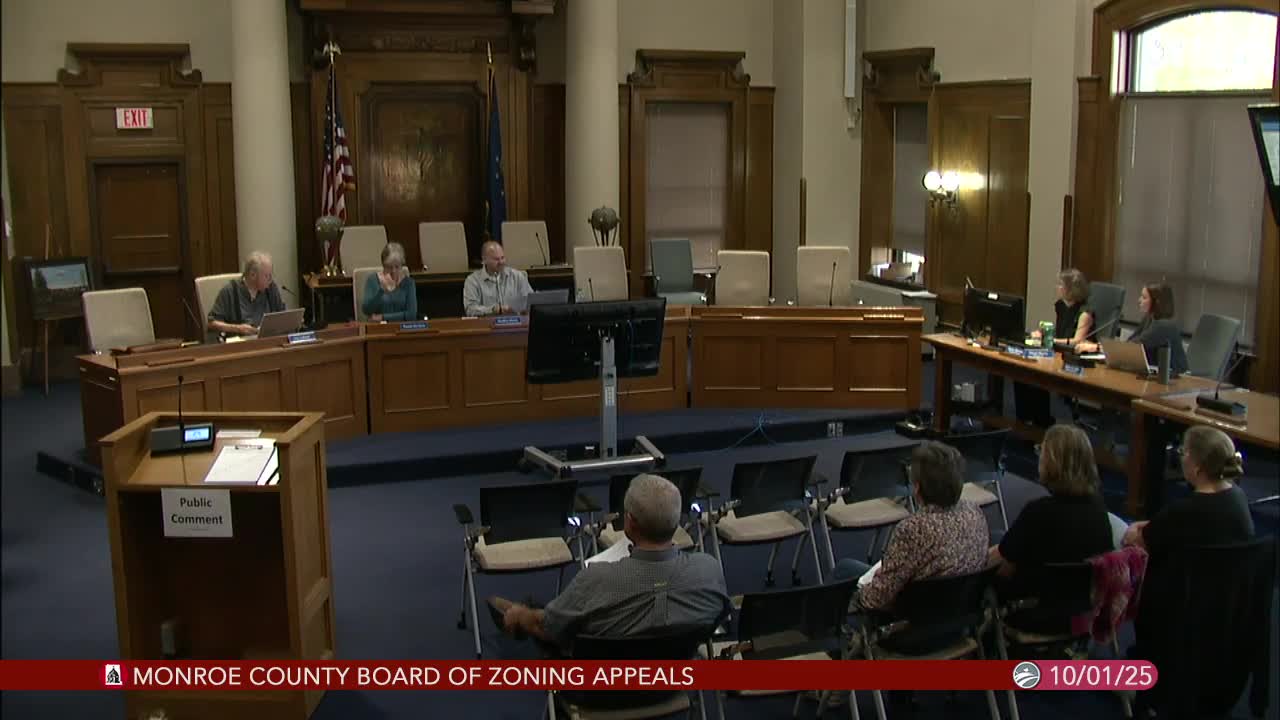
Summary
The Monroe County Board of Zoning Appeals denied two variances that would have allowed construction and widening of a 1.41-mile road across steep slopes and riparian areas on the Hough property, citing environmental constraints, lack of engineered plans and alternatives for access.
The Monroe County Board of Zoning Appeals voted 3-0 to deny VAR-25-48A and VAR-25-48B, variances that would have allowed creation and widening of a 1.41-mile segment of the proposed “Hough New Road” across steep slopes and riparian areas.
The variances were the subject of an extended presentation by Tammy Bierman, assistant director for the Monroe County Planning Department, and a formal case from the petitioner's attorney, Nicholas Moline. Bierman told the board that staff recommends denial of both variances based on the findings of fact. She summarized staff’s site-visit observations, mapped slope analysis and identified the amount of proposed disturbance: “Petitioner is proposing roadway creation of 72,118 square feet, and then the roadway widening, is 13,102 square feet,” and additional disturbance in Eco Area 2 of “roadway creation of 5,191 square feet and the road widening of 10,641 square feet.”
The nut graf: The board’s decision follows detailed staff analysis that the proposed road would traverse large stretches of slopes restricted by the county’s environmental constraints overlay (Eco Area 1 and Eco Area 2), cross four creeks (two within riparian zones), and require substantial grading and tree removal. Staff concluded the petitioner had not shown the road was the minimum necessary to overcome a design limitation because existing easements provide access to buildable ridge-top areas.
Bierman told the board that of the 1.41 miles proposed, “0.74 miles are located in slopes greater than 12% or 15%, and an additional 0.18 miles are within the riparian areas,” and that “total, we have 0.91 miles of the 1.41 mile proposed road that are not in buildable area.” She said staff could not verify some of the claimed existing 8–10-foot logging roads during a site visit and that construction plans, grading plans and an engineer stamp were not provided with the petitioner’s site plan.
Petitioner’s attorney Nicholas Moline argued the road is necessary to restore agricultural access to the southern Chumley parcel, which he said became landlocked after the Army Corps created Monroe Reservoir. Moline told the board the Huffs “do not currently have access to the Cholmondeley parcel for agricultural purposes,” and that denying the variance would prevent them “from using that parcel for agricultural purposes.” He cited a state statute (as he quoted it: “Indiana code 36 7 4 1 1 0 3”) and argued the denial would run afoul of state law by blocking the owner’s ability to use forest and mineral resources outside urban areas.
Several nearby residents and local environmental advocates opposed the variances during public comment. Sherry Mitchell Brooker, president and founder of Friends of Lake Monroe, said the eco overlay “includes preserve and enhance the quality of the water supply, prevent pollution, erosion, siltation, and the loss of topsoil” and urged strict enforcement of zoning protections to prevent nonpoint-source pollution into Lake Monroe. Kathy Meyer, a retired environmental educator, summarized watershed risks and cited the county watershed plan: “Lake Monroe maintains almost 92% of the sediment that enters with an estimated accumulation rate of 35,696 tons per year,” and said sediment-bound phosphorus and erosion increase algal blooms and treatment costs. Other speakers described steep terrain, past storm-related washouts and concerns about traffic and wildlife impacts along Shadyside Drive.
Board members repeatedly cited the absence of engineered construction plans and the staff finding that the petitioner had not proven the road widening and paving to 16 feet is the minimum variance needed. The motion before the board was to deny both variances; the board approved the motion 3-0. The record shows the denial was based on staff’s recommended findings of fact and on testimony and public comment highlighting erosion risk, steep slopes and alternative access points to buildable areas.
Ending: The denials mean the petitioner must either revise plans, provide stronger evidence that no reasonable alternative access exists, or pursue other legal remedies. The Board of Zoning Appeals’ written order and findings will specify conditions and reasoning and will be added to the permit record.