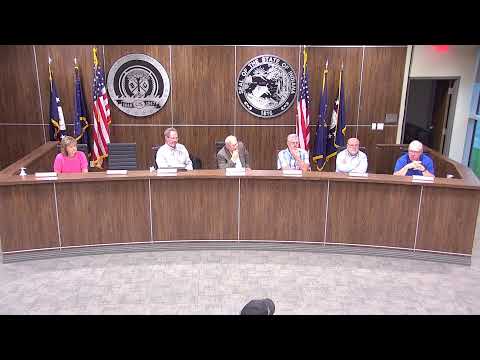
Daviess County hears hospital CEO warn rising costs are straining local EMS; council reviews local tax options
Loading...
Summary
Justin Harris, chief executive officer of Daviess Community Hospital, told the Daviess County council that rising costs and stagnant reimbursements threaten the county’s ambulance and emergency services and that the hospital is working to keep more care local.
Justin Harris, chief executive officer of Daviess Community Hospital, told the Daviess County council that rising costs and stagnant reimbursements threaten the county’s ambulance and emergency services and that the hospital is working to keep more care local.
Harris said the hospital’s EMS program, launched in February 2019, has served more than 30,000 patients and that labor and equipment costs have climbed sharply. “Salaries and wages … has gone up over 25%,” Harris said, adding that repairs and maintenance costs have increased “over 50%.” He told the council that reimbursement increases have not matched cost growth and summarized the gap this way: reimbursements have grown “roughly a fifth” of the rise in costs.
The remarks came as council members described a statewide property‑tax change that will reduce local property tax revenue and shift more long‑term funding responsibility to counties. Council members and a Baker Tilly consultant, Jason Simler, presented local income tax scenarios the county could consider to offset projected shortfalls. Simler’s presentation showed that a 0.09% local income tax dedicated to EMS would add about $58 a year for a worker earning $68,000; a 0.13% public safety levy on his projections would raise about $83.78 for that same earner.
Nut graf: The county faces a projected revenue loss from recent state property‑tax changes and is exploring options — including local income taxes, partnerships and operational changes — to avoid service gaps in ambulance coverage. Hospital leaders, council members and residents all told the meeting they want to preserve local emergency care but noted funding, workforce and regulatory limits.
Details and discussion
Harris described a post‑COVID financial environment for rural hospitals in which reimbursements have remained low while operating expenses rose. He said Daviess Community Hospital is “working hard to capture every dollar that we can get and is owed to us from those insurance conglomerates” but that denials and deductions are increasing. Harris added that Medicare announced a 2.6% hospital reimbursement increase earlier this year, a change he called small compared with rising costs.
Council members and residents raised staffing and coverage concerns. Harris said the service meets required staffing and response standards in its primary area but that recruitment is difficult because urban centers and larger systems can pay substantially higher wages. He described opportunities to trim costs in revenue cycle and operational management and said the hospital is pursuing partnership arrangements with Deaconess Health System to share guidance and some services while retaining local control.
Residents and volunteers emphasized response gaps. A volunteer firefighter who identified himself as an EMT since 1980 said long delays — he cited instances of 35‑minute waits — and the need for more local training worried volunteers. The speaker urged the county and hospital to support training so first responders can stabilize patients while ambulances are en route. Paul Traylor, who identified himself as a longtime county resident, asked whether adopting new levies would result in residents “being taxed twice.” Council members said the county is examining options (including an emergency management tax and a public safety tax) and acknowledged the need to avoid overlapping charges.
Financial context presented at the meeting
- The county’s EMS operation has averaged about 4,500 runs per year (the transcript indicates that number includes transfers). - Harris said the hospital currently subsidizes EMS from hospital operations; a council member reported that the county is subsidizing the hospital’s ambulance service about $800,000 annually and that subsidy recently rose by $200,000. - The county is projecting a loss of “over a million dollars” in property tax revenue for the next fiscal year because of state changes; commissioners said those shortfalls could increase through 2031 unless addressed. - Consultant figures presented: 0.09% local income tax for EMS (~$58/year for a $68,000 earner); 0.13% public safety tax (~$83.78/year for a $68,000 earner).
Partnerships and alternatives
Harris described outreach and partnership efforts with regional hospitals and systems (including Deaconess Health System and other nearby hospitals) to share services, platforms and staff where feasible. He said Deaconess has partnerships with more than 170 agencies across the state and that Daviess Community Hospital had submitted a proposal in response to an RFP from neighboring Martin County to explore economies of scale.
Harris told the council he would prefer to attempt operational changes and local partnerships for 12–24 months before recommending outsourcing ambulance operations to a private contractor. “Give me 2 years and I believe I can get our troops together,” he said.
What the council did and next steps
No formal vote on a new local tax or EMS contract was taken. The council described the current stage as information gathering: staff and consultants are modeling revenue impacts and tax scenarios so commissioners can consider options before any formal proposal or public referendum. The meeting ended with a routine motion to adjourn, which was seconded and approved.
Ending
Council members said they plan further briefings and noted the county’s financial reserves provide time to study options, but they signaled the changes will require decisions in coming years. Harris asked the community for support for the hospital’s efforts to stabilize finances and expand services so the county can keep emergency care local: “We will never sacrifice a dollar for the patient. Never. Patient will always be number 1,” he said.