Pulaski County delays decision on Mammoth solar tax abatement after public hearing; schedules executive session to negotiate terms
Loading...
Summary
Pulaski County council members on a public hearing on a proposed tax abatement for the Mammoth Pastures and Mammoth Grazing Lands solar project heard developer representatives and consultants explain the project’s projected tax and economic effects, received extended public comment, and voted to table a final decision while negotiating terms with the developer.
Pulaski County council members on a public hearing on a proposed tax abatement for the Mammoth Pastures and Mammoth Grazing Lands solar project heard developer representatives and consultants explain the project’s projected tax and economic effects, received more than an hour of public comment, and voted to table a final determination and convene an executive session to negotiate an economic development agreement with the developer.
The council heard Doral Renewables representatives describe the project and their proposal for a personal‑property abatement paired with an economic development agreement (EDA). Kevin Parzic, senior vice president with Doral Renewables, told the council, “We are not looking for any kind of handout or anything like that. We are looking to work with the county on coming up with a very favorable agreement that’s good for both the county and the project.” He said the company sought predictability in costs for lenders and investors and was open to negotiating EDA terms.
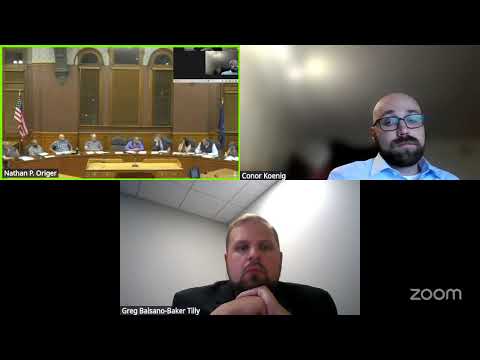
County consultants and independent advisers presented the tax and economic analyses the council requested. Greg Balsano of Baker Tilly Municipal Advisors summarized the firm’s tax‑impact study, saying the project would reclassify about 5,265.6 acres from agricultural use to utility, increasing land assessed value by roughly $60.1 million. Baker Tilly’s model estimated a first‑year personal‑property assessed value in the range of about $512.2 million (with alternative assumptions showing a floor around $480.2 million after depreciation). The study examined a 20‑year, 100% abatement on personal property and showed that under a 30% taxable floor (an assumption used in parts of the study) total property taxes over 21 years would differ materially depending on whether an abatement was granted.
Baker Tilly also presented economic‑impact figures prepared with ePlan modeling: Doral’s development spending was described as roughly $1.7 billion in capital investment, producing construction‑phase output of about $2.1 billion and supporting thousands of temporary construction jobs; annual operations were modeled to support roughly several hundred jobs in the region while the company projects about 20 direct onsite operations positions. The consultants and Doral representatives repeatedly noted that changes in Indiana law (referred to in the hearing as SEA 1 or SB 1) that altered personal‑property depreciation and reporting thresholds materially affect long‑term tax receipts and how abatement/EDA packages should be evaluated.
Public comment ran long and included both detailed legal objections and expressions of support. Attorney Jason Kuchme, representing landowner Connie Ehrlich, urged the council to deny the confirmatory resolution and argued the property does not meet the statutory standard for an Economic Revitalization Area (ERA). Another speaker, Isaiah Tidwell, raised procedural concerns about who filed applications and whether all required lease or ownership documents had been provided. Several other residents, including farmers and longtime county residents, urged denial on grounds including loss of farmland, potential declines in property values for neighbors, and long‑term revenue impacts. Supporters said the county could secure new, flexible revenue via EDA payments and that reclassification would increase assessed land values under the panels, lowering rates elsewhere.
Council discussion at the hearing focused on several technical points raised by speakers: whether the ERA standard (areas “in need” of revitalization) applied to productive farmland; whether the application and public notice process had omitted or misstated parties; how SEA 1’s removal of the 30% personal‑property “floor” affects tax receipts; and how an EDA could include assignment or security provisions to protect the county if a project or LLC changes ownership. Baker Tilly and Doral’s tax consultant (identified in the hearing as Jacob, founder/CEO of Course of Strategy) agreed to produce revised analyses showing scenarios with and without a 30% taxable floor.
After public comment and deliberation, a council member moved to table the confirmatory resolution pending a negotiatory executive session with the developer; that motion was seconded and, after a voice vote, the council approved tabling the resolution and scheduled an executive session to negotiate in good faith with Doral. The public hearing was then adjourned. The council did not adopt a confirmatory resolution, nor did it approve any EDA, during the meeting.
What happened next: the council directed staff to coordinate scheduling for a negotiating executive session and to request additional analysis from Baker Tilly (including runs that assume no 30% floor). Officials said any final confirmatory resolution or EDA would return for public action after negotiations.
Why it matters: the decision will determine whether Pulaski County moves into formal EDA negotiations with Doral, a step that could lock in a structure for payments that substitutes some or all personal‑property tax receipts for contract payments from the developer for up to two decades. Doral and its advisers argued the arrangement provides predictable revenue and supports large capital investment; opponents said the county risks foregoing long‑term personal‑property receipts, harming neighbors and agricultural uses and that the ERA standard and application documentation deserve closer legal and procedural scrutiny.