
School board adopts safety-plan concept B and directs staff to pursue March bond
Get AI-powered insights, summaries, and transcripts
Subscribe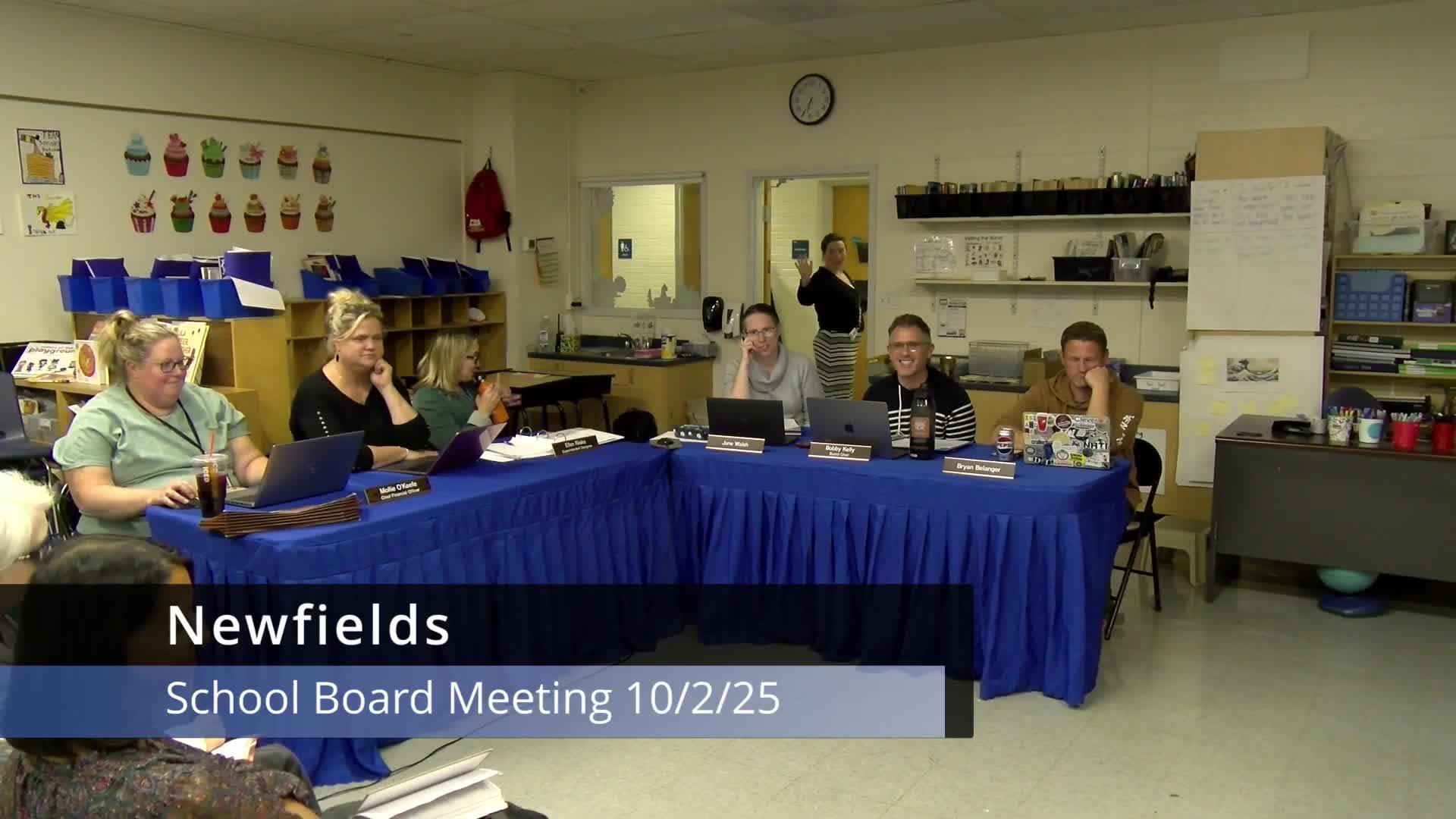
Summary
After presentations from the safety committee and consultants, the Newfields School Board voted to adopt the committee’s Concept B site plan and to pursue putting a bond on the March ballot to fund the work. Consultants presented two phased and one-time options and cost estimates; the board approved moving forward by voice vote.
The Newfields School Board voted to adopt Concept B — the school safety committee’s preferred site plan — and directed staff to pursue placing a bond for the work on the March ballot.
The board’s decision followed a presentation from a citizen-led school safety committee and engineers from TF Moran. The committee recommended Concept B because it most fully separated vehicle traffic from student walkways and created a one-way traffic flow, added crosswalk and pavement markings, and provided parking and buffer areas around the building.
Why it matters: The project is intended to reduce pedestrian–vehicle contact at Newfields Elementary School. Committee members and consultants said Concept B addresses the committee’s four stated priorities: a designated crossing on Route 87, clarified traffic flow around the building, visible signage and pavement markings, and a buffer area to reduce intersecting paths of vehicles and students.
Consultants presented two high-level options. One engineering estimate presented Option A (a smaller “bare-bones” set of changes) at roughly $218,000–$275,000 and Option B (the fuller build shown to the board) at about $575,000. A second estimate from a different contractor put Option A at about $363,000 and Option B at about $480,000. Committee members emphasized these are preliminary contractor estimates and that final costs will be set by a formal bid process and by the level of scope the board chooses.
Pallavi, a member of the safety committee, summed up the group’s recommendation to the board: “We recommend option B because it solves for everything. The idea is to reduce the interaction between children and vehicles, and doing it once avoids having to redesign traffic flow twice,” she said.
Chris, a TF Moran project engineer, told the board the estimates include conservative assumptions about site grading and drainage; he said a more detailed grading plan and bid documents would be the next technical steps. Committee members and contractors also flagged common site unknowns — ledge, buried tanks and other subsurface items — that can raise costs if encountered during construction.
Financing and next steps: Board members asked the district’s finance contact to prepare bond amortization schedules. The district agreed to ask the bond bank for sample payment schedules (for example, five-, seven- and ten-year terms) using a notch above the high-end estimate so the board has worst-case numbers for planning. The committee and staff will refine design documents, produce a bid set and hold community outreach if the board approves moving the project onto a warrant/bond article.
Votes at a glance: The board approved (voice vote) the motion to adopt Concept B and to pursue placing a bond on the March ballot. The meeting record notes the motion was seconded and approved by voice; a numerical roll-call tally was not recorded in the public transcript.
Context and committee process: The safety committee said it started from a blank sheet and worked through traffic-flow diagrams, community priorities and line‑item cost options. Committee members thanked Jane (committee lead) and others for frequent, focused meetings; the committee reported unanimous support for Concept B before the board vote.
What the vote does and does not do: The board’s action approves Concept B as the plan to advance and to prepare financing and bid documents. It does not commit the district to final construction contracts — those will follow the bond process, the decision whether to place a warrant on the ballot, and the public bidding and contract-award process. Board members and consultants said work can be phased if needed and that some items can be removed from scope to reduce cost if bids exceed planned funding.
Officials cited remaining coordination needs with the town (public works/plowing, police and fire), ADA parking and ramp details, and final stormwater/drainage design. The committee said it will lead community outreach and brief municipal stakeholders before the formal bond process.