
Newfields group to present pared-down campus safety and parking plans, with bond option
Get AI-powered insights, summaries, and transcripts
Subscribe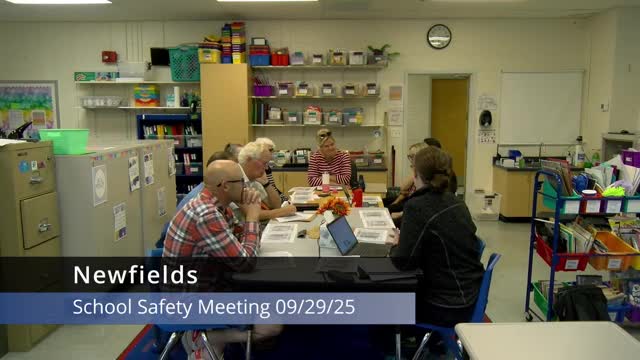
Summary
A Newfields School District planning group agreed to present two campus redesign concepts to the school board Oct. 2, recommending a smaller "Plan A" now with a phased "Plan B" if funding allows; estimated costs, responsibility for a pedestrian light and a bond timeline remain to be confirmed.
A Newfields School District planning group agreed Thursday to present two campus redesign concepts to the school board on Oct. 2, recommending a smaller, immediate plan while keeping a larger phased option if pricing allows.
The recommendation follows months of work on layouts that would move bus and visitor traffic to the rear of the school, relocate the crosswalk and ramp, remove one front stairwell, add or reconfigure parking (including designated handicap and visitor spaces), and improve pedestrian safety between the parking area and the school.
The smaller option, referred to in the meeting as Plan A, is estimated by the group's consultant to cost about $300,000 in construction; participants said approximately $100,000 already appears in the current school budget, leaving roughly $200,000 to fund. The group discussed an expanded Plan B that would add paving or other site work and could raise the total to a level several participants later described as in the $500,000–$600,000 range depending on final scope and sitework needs. The group did not take any formal vote; members instructed staff and consultants to confirm line‑item pricing before Thursday.
Why it matters: the plans aim to reduce interactions between children and vehicles at the school entrance by rerouting traffic, formalizing parking and drop‑off points, and improving the marked crosswalk and ramp. The group repeatedly framed the project as a child‑safety and operations improvement with implications for the town's capital planning and the district's budget.
Most of the meeting focused on cost, phasing and who pays for specific elements. Participants said the pedestrian crossing signal commonly discussed for the site would usually be paid by the municipality when it crosses a state road; the group estimated the light at roughly $35,000 if a basic solar pedestrian signal is used, and noted a more sophisticated, municipally‑integrated signal could approach $100,000. "These look great. No glaring issues," said Rich Kane, the district's safety and security coordinator, after reviewing the latest layouts and asking staff and the consultant about emergency access and bus circulation.
Members also discussed procurement and budget treatment. The group recommended that the school consider design‑build bids to limit separate engineering markups and asked the business administrator to confirm whether existing FY26 budget funds must be committed by June 30 (participants said a signed contract and work begun by June 30 is typically required to count the expense in that fiscal year). The group reviewed bond calendar dates cited from DRA guidance: Jan. 2 (first date to post bond notice), Jan. 9 (earliest bond hearing date), Feb. 16 (last date to post notice) and Feb. 23 (latest day to hold a public hearing) as the window to meet deliberative and ballot timelines for 2026. Several members said they would prefer a single bond for the full project if the final price remained in a low‑to‑mid hundreds of thousands, because amortizing the cost over 10 years would reduce the annual taxpayer impact.
On specifics of the design: the crosswalk would be moved roughly 10–20 feet, a ramp retained at a school‑side landing and the front stairwell near the main entrance would be removed under the preferred layout to avoid direct vehicle‑pedestrian conflicts. Bus drop‑off and pickup would be routed to the rear of the building to separate buses from parent drop‑offs. The group discussed reserved teacher and visitor spots in the existing lot, new handicap stalls adjacent to the ramp/multipurpose room for event access, and angled parking along the back where feasible.
Participants raised maintenance and operations questions to be resolved in later phases, including snow removal responsibilities (the town currently does not charge the school for plowing), whether the town or school will pick up the pedestrian signal cost, and stormwater/retention requirements if large paved areas are added. The consultant will confirm which portions of Plan B are paved versus gravel and the effect on water‑management costs; members noted gravel or engineered pervious surface options could reduce stormwater and plowing obligations but would change long‑term maintenance costs.
Next steps: staff and the consultant will supply a clearer cost breakdown before the Oct. 2 school board meeting so the board can review a recommended Plan A with Plan B presented as a phased or contingent option. The group asked the designer to add clear H (handicap) and V (visitor) labels and angled parking on the plans for the Thursday presentation and to produce a short communication plan so staff can share the designs with school employees and stakeholders ahead of deliberative sessions.
No formal action was taken by the planning group at the meeting; members said the intent is to solicit the school board's guidance on financing and scope and return with final bid‑ready drawings once the board sets a funding path.