
Morgan County planning commission recommends rezoning 158 acres for proposed data center; public raises water, noise and property-value concerns
Get AI-powered insights, summaries, and transcripts
Subscribe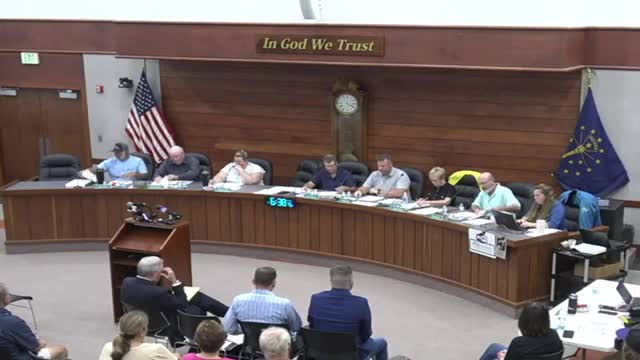
Summary
The Morgan County Plan Commission voted 5-2 to give a favorable recommendation to rezone about 158 acres near Keller Hill Road to a planned unit development for data-center use. The public hearing drew more than 60 speakers who raised questions about water use, diesel generators, noise, traffic and property values.
The Morgan County Plan Commission on Monday voted 5-2 to send a favorable recommendation to county commissioners for a rezoning request — PUD 2503 — that would rezone roughly 158 acres near Keller Hill Road to a planned-unit development intended primarily for data-center use.
The petition, filed by HDC Real Estate LLC and Woodland Caribou LLC and presented by attorney Joe Calderon, seeks to rezone about 120 acres north of Keller Hill Road and 38 acres to the south, a site generally referred to as 1570 West Keller Hill Road in Monroe Township. Calderon said, “the primary use that we have defined within the PUD is for data center use.”
The vote followed a two-hour public-comment period in which more than 60 residents, farmers and other community members raised questions about groundwater, wastewater, noise, traffic and the long-term local benefits of a large data center.
Why it matters: Residents told the commission that many nearby homes rely on private wells and voiced fear that large-scale water withdrawals or construction dewatering could damage their supplies. Neighbors also cited potential declines in property values and health concerns tied to continuous low-frequency noise and diesel generator emissions. The proposal includes development standards the applicants say exceed base industrial requirements, and staff recommended approval.
What the applicants proposed: Calderon and project engineer Matt Stipula described mitigation measures included in the draft PUD. The filing lists a 65-decibel maximum at the property line for worst-case operating conditions; Calderon said the PUD “did put in a maximum of, 65 decibels at the property line.” The proposal also calls for expanded setbacks (examples: 150-foot front buffers in some places versus a 50-foot minimum), berming and 10–15-foot landscape mounds for visual screening, and non-barbed ranch-style fencing.
On utilities and environmental review, Stipula said the cooling approach has not been finalized and is part of due diligence. “There is a study of the aquifer and its availability to provide the water,” he said, and if sufficient water is not available the project would pursue an air-cooled option instead. He also said any wastewater discharge would be routed to a treatment provider and noted on-site treatment is a possible option.
Public concerns: Speakers repeatedly asked who will buy and operate the site, where large daily water needs (speakers cited figures ranging from “1 to 3,000,000 gallons per day” up to “5,000,000”) would come from, and how treated or concentrated cooling water would be handled. Resident Bruce McLean, who lives across Keller Hill Road, said his daughter is developmentally delayed and that his family is “concerned how the noise and vibration from the cooling fans, the diesel generators, and the vibrations from the very large electrical transformers will affect her.”
Many residents pressed process and transparency issues. Several speakers asked whether county agencies and state regulators had reviewed the project; planning staff said they convened a technical advisory group including the county engineer, county surveyor, sheriff, fire chief, 911 dispatch and stormwater administrator and that those agencies “had no concerns” when consulted. Planning staff member Melody Parker told the commission that “All the notification was provided according to State Statute and to the Planning Commission's rules and procedures.”
Regulatory and fiscal context: The applicants and staff said the PUD and any resulting development would need additional permits and approvals from county, state and possibly federal agencies (including water and environmental permits) before construction proceeds. The applicant’s attorney said tax-abatement options and personal property abatements for data centers are governed by state statute; he noted real-property abatements are commonly limited to 10 years for improvements while certain data-center equipment can have longer personal-property schedules under state code.
Commission action: After public comment and staff reporting, the commission moved to recommend approval of PUD 2503 to the county commissioners; the motion passed 5-2. The commission recorded the tally without identifying individual commissioner votes in the meeting transcript. Staff noted the matter will be scheduled for the county commissioners’ consideration on October 6.
Context and next steps: If the site proceeds, project proponents said construction and any necessary infrastructure upgrades (roads, power lines, substations, water connections) will follow additional permitting and utility-provider decisions. The applicant said generator tests are routine and that testing is limited and included in the PUD’s noise standard; opponents said concerns about continuous noise, diesel emissions and cumulative county-wide impacts remain unresolved. County staff said the comprehensive plan is advisory and one of multiple factors the commission must consider under Indiana Code; they also said the county plans to update its comp plan in coming years.
The commission’s favorable recommendation does not approve construction; it forwards PUD 2503 to the Morgan County Board of Commissioners for final action following required reviews and permits.