
Lansing adopts 15‑year service‑charge PILOT for Evergreen Park to preserve workforce housing
Get AI-powered insights, summaries, and transcripts
Subscribe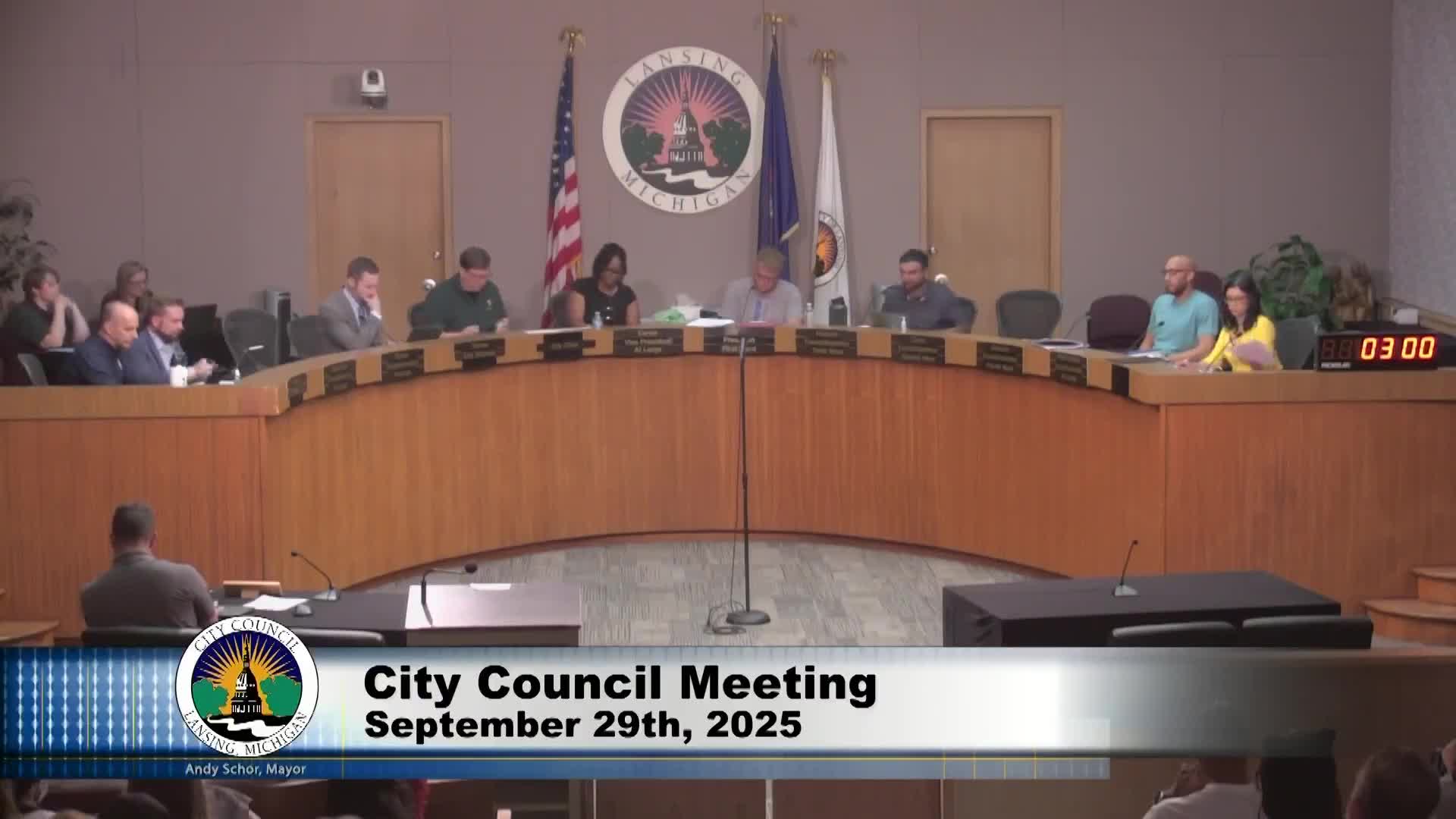
Summary
City council amended chapter 887 to add a section allowing a service charge in lieu of taxes at 8% for a 618‑unit property known as Evergreen Park Apartments and Townhomes. Council said the measure will preserve units at 'workforce' rent levels (80–120% AMI) for 15 years; vote passed unanimously with immediate effect.
The Lansing City Council unanimously approved an ordinance on Sept. 29 to allow a service charge in lieu of taxes for Evergreen Park Apartments and Townhomes, a 618‑unit multifamily property, as part of a 15‑year workforce‑housing pilot.
Council discussion described the ordinance as a pilot to preserve “workforce” housing defined at roughly 80 to 120 percent of area median income. Council Member Hussain said rents under the pilot were targeted at households earning the equivalent of roughly $20 to $30 an hour and emphasized the project would keep units affordable for workers rather than the deeper affordability tiers reserved for lower incomes.
The ordinance, read into the record as an amendment to Chapter 887 that adds a new section 887.01, authorizes a service charge equal to 8 percent of shelter rent for the 618 workforce units in Evergreen Park for a 15‑year term pursuant to the State Housing Development Authority Act of 1966. Hussain identified the applicant as Detroit‑based Great Water Opportunity Capital, which acquired the property in February 2024 and has invested in repairs.
According to council discussion, Great Water discovered numerous code tags upon acquisition: all 618 units were initially pink‑tagged for inspection and 118 were red‑tagged and deemed legally uninhabitable. Council Members said Great Water has invested “just a touch over $8,000,000” in critical repairs including roof and gutter work, parking‑area repairs, clubhouse and pool rehabilitation, and landscaping. Council members said only two red‑tagged units remained to be cleared and the owner expected full occupancy by mid‑2026, with code compliance possibly complete by April or May 2026.
Hussain summarized projected fiscal impacts presented to council: current property taxes for the site are “just under a million a year”; the pilot would yield an estimated $526,000 payment in lieu of taxes in its first year and could grow to about $1,500,000 in year 15 under the 80 percent rent scenario described by the applicant. He said the applicant noted property taxes constituted roughly 30 percent of current revenue and that additional capital investment would be required to sustain the property.
Hussain moved the ordinance; Council Member Jackson voiced concern about displacement risk for people who previously relied on deeper affordable rents at the property and acknowledged that workforce housing is not the same as deeper affordability. Clerk Jackson performed a roll call; Vice President Carter, Council Member Hussain, Council Member Jackson, President Koss, Council Member Pellegrino and Council Member Spadafore voted yes. The council then approved immediate effect; both votes passed unanimously.
The ordinance will be entered into the city code as Section 887.01 and take effect immediately per the council’s motion.