
Planning commission reviews Greeley urban forest strategic plan; staff warn pruning and enforcement capacity limited
Get AI-powered insights, summaries, and transcripts
Subscribe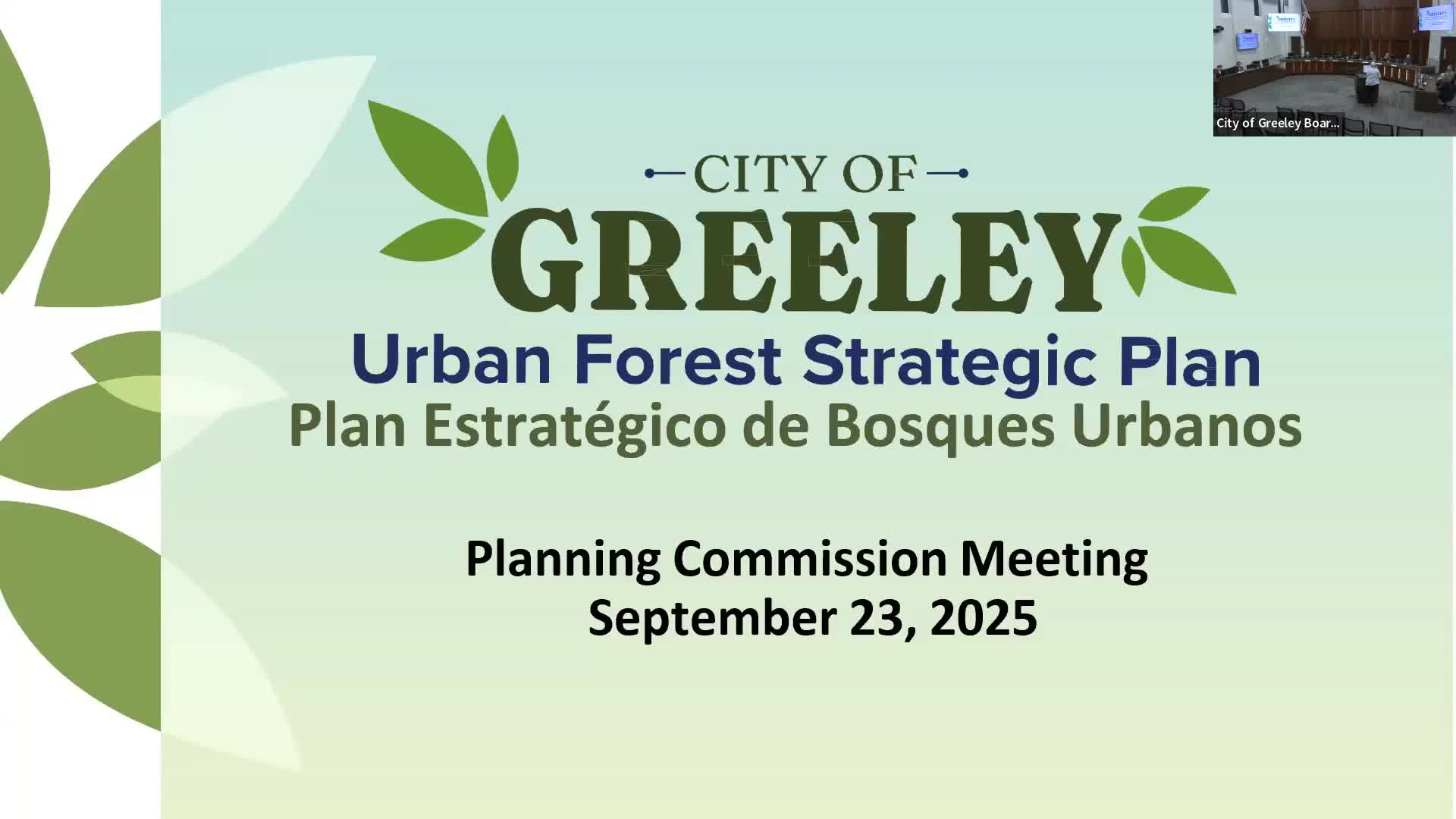
Summary
Consultants presented a proposed urban forest strategic plan that calls for canopy monitoring, species guidance and new programs; city forestry staff and commissioners warned the department’s current budget and staffing limit pruning, enforcement and long-term plan implementation.
At a Planning Commission workshop, consultant Dan Karcher of Davey Resource Group presented an urban forest strategic plan for the City of Greeley and described public engagement, canopy findings and recommended initiatives. The presentation and follow-up questions focused on how many trees the city has, how many more the plan models, and whether current staffing and budget will allow the city to meet the plan’s goals.
The plan is based on public engagement that the consultant said reached about 311 community members, stakeholder focus groups and a Speak Up survey. Karcher said survey respondents prioritized shade, improved air quality and beautification; the plan recommends measuring citywide tree canopy every five to 10 years, assembling a recommended species list and focusing new planting where trees will provide the greatest benefit.
The plan’s modeling and recommended initiatives, Karcher said, assume continued growth in residential canopy and additional plantings tied to new development. “We want to build urban forest resilience,” Karcher said, noting the need for species diversity to reduce risk from pests such as emerald ash borer. He also said the consultant will provide a Spanish translation of the plan and that implementation would be led by city staff.
Shyloh Hatcher, City of Greeley forestry manager, answered detailed operational questions about capacity. Hatcher confirmed the city’s inventory contains about 12,012 trees and described current and near-term pruning goals: “We gave ourselves a goal of pruning 300 trees on the parkways, and we’ll hit 500,” she said, adding that parks pruning capacity is smaller and that the city uses private contractors for much of its work. Hatcher also summarized historical inspection and pruning activity: inspection data started in 2020 and routine pruning historically has been limited by code and budgets.
Commissioners pressed on enforcement and long-term monitoring. One commissioner asked whether the city’s current site-plan and landscape code would be sufficient if the commission and staff continue to approve smaller, denser lots; Karcher said the canopy study can be drilled down to test whether existing code requirements will meet canopy goals or whether more on-site trees should be required. Another commissioner asked whether the city can require replacement trees when required trees die; Hatcher said that, in practice, removals have generally remained the homeowner’s responsibility and that stronger permit and enforcement regimes — like those in Austin or Atlanta — are politically and operationally difficult to adopt.
The plan includes several programmatic recommendations that the presentation highlighted: a regular canopy monitoring cycle, a recommended tree species list, expanded public outreach (including a continued “Share the Shade” program), free wood-chips distribution, an interdepartmental urban forestry working group, updated emergency plans addressing woody debris, exploration of a tree commission or committee, and regional partnerships with Front Range peer cities.
Staff and commissioners repeatedly returned to practical limits: equipment and staffing needs, the tradeoffs between parkway and front-yard plantings, HOA rules and irrigation patterns, and the long-term cost of inspection and enforcement. Hatcher warned that while the city has increased responsibility for parkway trees, much of the canopy remains on private land and “there is a weakness” in ensuring privately planted trees required by site plans remain in place over time.
Next steps discussed at the meeting: the consultant will supply a Spanish translation of the plan and make final edits before public review through the city’s Speak Up process; implementation and ongoing monitoring are to be carried out by City of Greeley staff and partners. The Planning Commission did not take formal action on the plan at the workshop.
Votes at a glance: The commission approved the minutes of the Sept. 9, 2025, meeting and approved a motion to continue the Prairie Hawk Subdivision preliminary plat (SUB2025-1), a proposal to subdivide a 23.99-acre planned-unit-development property into 11 lots, to Oct. 28, 2025. Both motions carried on voice votes; individual roll-call votes were not recorded in the transcript.
A staff update before the workshop noted that Brian McBroom will temporarily oversee the city’s economic development/urban revitalization work and invited commissioners to a West Greeley Catalyst groundbreaking at Highway 34 and County Road 17. The staff update also reported that the Cascadia planned-unit development recently passed city council on a 6-1 vote and will move forward.