
Liberty councilors ask staff to draft stronger exterior property-maintenance rules aimed at absentee landlords
Get AI-powered insights, summaries, and transcripts
Subscribe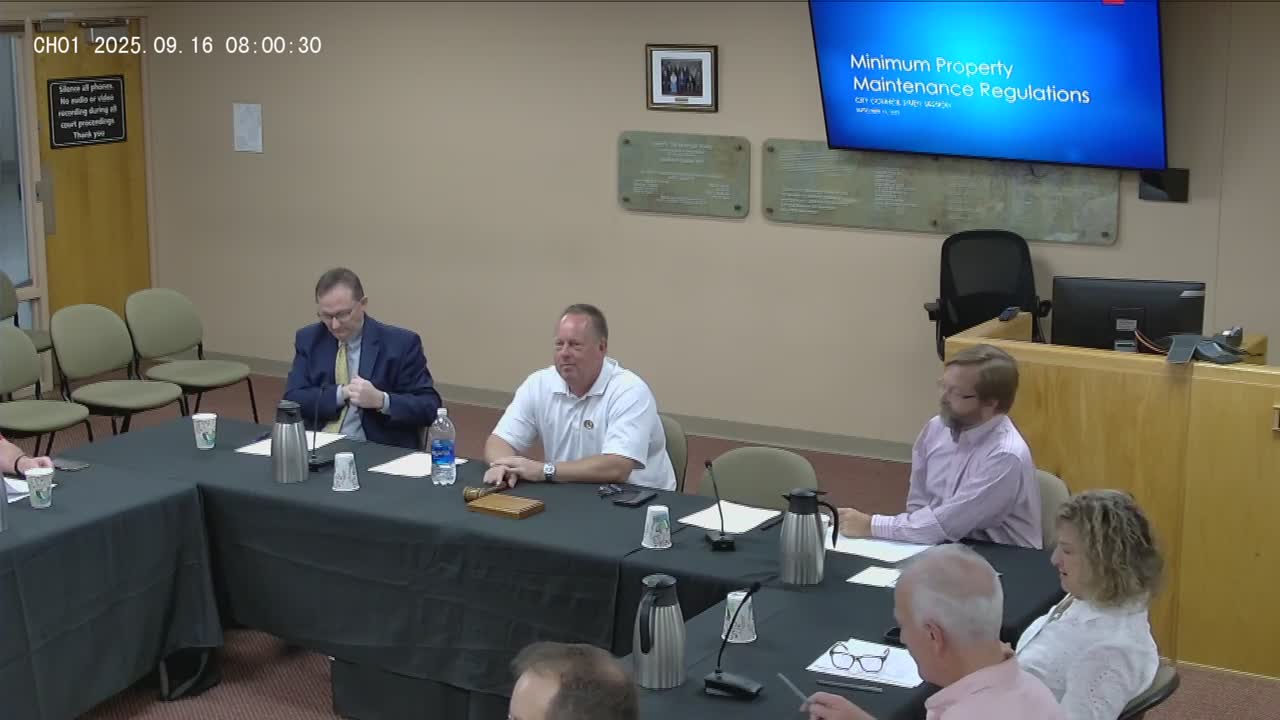
Summary
City staff presented proposed additions to Liberty's nuisance and property-maintenance code on Sept. 15 and council members directed staff to draft a narrow ordinance focusing on exterior conditions and absentee landlords, leaving interior inspections for a possible later phase.
Ms. Sharp opened a Sept. 15 discussion of Liberty’s nuisance and minimum property-maintenance code, telling the council that constituents had reported houses with peeling paint, broken vents and rotted windows that were lowering neighborhood values and making properties hard to sell.
The meeting focused on whether to add clearer, enforceable exterior standards to the city’s nuisance code and how enforcement would work, especially for absentee landlords who do not live in Liberty. Tiffany McGinnis, the city’s nuisance officer, explained the city’s current complaint-driven process: “If you email me an address, usually, I’ll touch base with the person. I’ll go out that day if possible. And if I can see it from the street, then I can address it,” she said, describing a notice period that typically gives 10 days to correct a violation, a common two-week extension on first requests, and a 30-day notice requirement between issuing a citation and a court date because of certified-mail procedures.
Council members and city legal staff discussed limits set by case law and equal-protection concerns. George Koepke, the city attorney, told the council that whether the city can treat rental properties differently depends on the ordinance structure: “If you’re working under a general, conditions ordinance … treatment has to be the same. … But you can separate the ordinances,” he said, noting that complaint-driven enforcement can create perceptions of selective enforcement and that a legal opinion will be needed.
Council members described two recurring problems: out-of-state investment owners who let properties deteriorate and owner-occupied homes where residents temporarily cannot afford repairs. The group agreed to focus first on absentee landlords and exterior, easily observable problems such as broken windows, holes in exterior walls, drooping gutters and obstructed sidewalks. Staff signaled they would prepare draft language that clarifies exterior-wall standards (for example: “Exterior walls shall be free from holes, breaks and loose or rotting material”), and the council asked staff to return with a proposed ordinance text and implementation options.
Participants emphasized keeping the first draft narrow and enforceable. Several members said interior defects that are only visible to tenants — such as inoperable toilets — raise different enforcement and privacy issues and should be left for later consideration or handled through a separate rental-registration or inspection program if legally permissible. The council heard that Liberty’s formal rental-inspection program is now voluntary after a lawsuit in another city, and that other jurisdictions require landlord registration and inspections tied to turnover or tenant complaints.
On enforcement tools, staff and legal counsel reviewed common remedies discussed in the meeting: notices, court citations, forced or “force” mowing with a lien for exterior maintenance, and a civil process to record liens and pursue judgments in Associate Circuit Court. Several council members urged the city to prioritize remedies that create financial pressure on absentee owners — for example, placing liens for city-funded cleanup — rather than micromanaging owner-occupied homes.
No ordinance was adopted at the meeting. Instead, the council directed staff to draft a limited, exterior-focused amendment to the nuisance/property-maintenance code targeting absentee landlords and to return with recommended language and enforcement procedures for the council to review at a later meeting.
Ending: The council characterized the planned ordinance as a first step. Members said a focused exterior-code amendment aimed at absentee landlords would be a manageable, enforceable start; staff will draft language and follow up with legal research and an implementation plan.