
Denver Department of Safety presents 2026 budget with delayed Dahlia opening, cadet hiring pause and 9‑1‑1 technology upgrades
Get AI-powered insights, summaries, and transcripts
Subscribe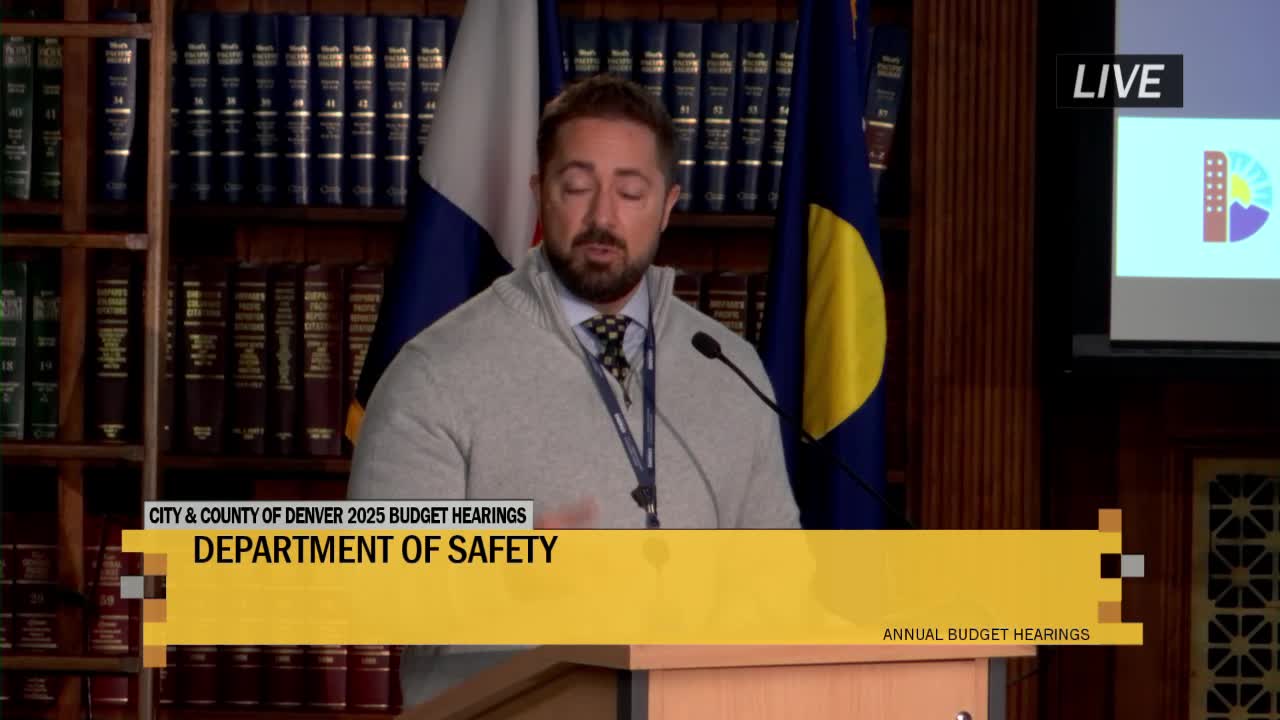
Summary
Denver officials presented the Department of Safety 2026 budget to the City Council Health and Safety Committee, citing personnel as 83% of the agency budget, a delayed opening of the new Dahlia community corrections facility that created $2.5 million in vacancy savings, a pause in new cadet hiring that yields $412,000 in savings, and planned technology upgrades to Denver 9‑1‑1.
Denver officials presented the Department of Safety budget and operations update at a Health and Safety Committee hearing, focusing on personnel costs, a delayed community corrections facility, reductions in safety finance staffing and a pause in cadet hiring intended to meet 2026 budget targets.
Darryl Watson, chair of the Health and Safety Committee and Denver City Council member for District 9, opened the session by noting, "Today is the second day of budget week," and said the committee would hear a presentation from the Department of Public Safety.
Alan Garnett, Director of Public Safety, summarized the agency mission and said the department's personnel budget accounts for the bulk of spending: "our personnel budget, which is $28,300,000, or 83% of our overall budget." Garnett said supplies and services make up the remaining roughly 17% of the budget.
The presentation identified funding sources as a mix of the general fund and special revenue streams, with the largest special‑revenue share tied to 9‑1‑1 emergency communications. Garnett said the department's general fund is projected to be approximately 1% lower year over year for 2026 and that total appropriations have decreased about 20% since 2023.
Nut graf: The hearing centered on how the department will preserve core safety services amid a tighter city budget. Council members pressed for detail on where reductions would fall, how a delayed community corrections facility will affect jail populations and wait lists, what the pause in cadet hiring means for recruitment pipelines, and what upgrades to Denver 9‑1‑1 will change in practice.
Major budget changes and operational impacts
• Dahlia community corrections facility delay: The department reported that the opening of the new community corrections facility at Dahlia is delayed to the fourth quarter of 2026. The delay produced approximately $2.5 million in vacancy and supplies savings for 2026. "Construction delays prevent us from occupying and operating the program until at least Q4 2026," Garnett said. The department said the delay also means the city will not begin receiving state funds tied to providing those community corrections services until the facility starts operation.
• Bed capacity and wait lists: The department said Denver's community corrections bed capacity has fallen from 748 in 2019 to about 273 today, with a targeted capacity of about 450 once Dahlia opens. Department staff said 130 individuals are approved and waiting for community corrections beds, with wait times up to six months; about 50 of those people are currently in Denver jails.
• Cadet program and hiring pause: The budget assumes pausing new cadet hiring in 2026. Garnett characterized the Public Safety Cadet Program as important for exposing recent high‑school graduates to careers in police, fire and sheriff's services. He said the city currently budgets about $1.5 million for the cadet program and that pausing new cadet intake and reducing on‑call cadet costs would produce roughly $412,000 in savings in 2026.
• Finance and HR staffing reductions: The Public Safety Finance Division showed a proposed reduction from a budgeted 18 FTE to 14.2 FTE for 2026, a savings of about $410,000. Department HR staff said the safety HR unit has 27 employees who handle specialized hiring, background investigations and leave management for sworn and civilian safety staff; HR leaders said those functions are distinct from general city HR because of sworn hiring and civil service interactions.
• Grants and major funding lines: Garnett and the department CFO identified major agency grants and allocations, including Caring for Denver ($1.5 million), Blythe discretionary community project ($800,000), and continuation funds tied to state youth detention ($1.5 million). CFO Shanae Cummings said some state allocations appear in the department budget as grants due to city financial system rules and that a formal transfer of some youth detention funds to the Office of Neighborhood Safety took place with a grant award effective July 1, 2025.
9‑1‑1 and dispatch technology
Andrew Dammer, Director of Denver 9‑1‑1, told the committee the department is replacing two major technology platforms: the 9‑1‑1 phone system and the computer‑aided dispatch (CAD) platform. Dammer said the phone system being replaced is about 23 years old and the new system will help triage call surges. "One of the challenges we have with the preponderance of cell phones is that we can easily get 50 or 60 9‑1‑1 calls in a matter of seconds," Dammer said. The new system can detect a geographic spike and play a message telling callers that the agency is aware of a reported incident, which should reduce the manual triage load on call takers.
Council questions and follow ups requested
Council members asked for additional data and follow up items, including: - Council member Paul Cashman asked for details about the cadence between safety and public health investments and noted concern about cutting some youth programs while funding cadet costs; the department said the HYPE program now sits under ONS and staff would provide details. - Council member Chris Hinds and others asked for recruiting and attrition data for police and sheriff academies and requested a breakdown showing how many recruits typically complete academies relative to retirements and separations; Jeff Holiday, Chief of Staff for Public Safety, agreed to provide that data. - Council member Janet Gonzalez Gutierrez asked how much of the $16 million identified for community corrections and pretrial services goes to treatment, case management and reentry supports versus confinement and monitoring; Greg Morrow, Director of Community Corrections, said he would provide a specific breakdown. - Several council members asked for written clarification about why certain state‑allocated youth detention funds appear as reductions in the Department of Safety book and were told the bookkeeping reflects transfers and grant award timing; staff agreed to provide written clarification to council.
Other program and policy notes
• Department priorities listed in the presentation included 9‑1‑1 emergency communications, street engagement, community corrections (pretrial and electronic monitoring), safety management and employee wellness. The department said it will not reduce core functions, community corrections facility staffing or employee wellness programs in the near term, but will defer some hires and reduce the DOS finance unit.
• Staff noted efforts to shift service models away from for‑profit contracted beds and to rebuild local capacity; the department projects a revised target capacity of roughly 450 beds after Dahlia opens (down from 748 in 2019).
• HR leaders said safety HR performs specialized background and investigatory work and onboarding for sworn employees and works closely with the Civil Service Commission and city Office of Human Resources.
Ending: Department leaders and council members said they will exchange follow‑up materials before the council's budget deadline; Garnett and other staff expressed urgency about opening Dahlia as soon as construction permits and timelines allow, and multiple members asked for a written accounting of program moves that appear in the budget book to ensure transfers are not interpreted as reductions.