Get Full Government Meeting Transcripts, Videos, & Alerts Forever!
Get email alerts on the Tenant Organizing topic
No spam. Unsubscribe anytime.
San Marcos adopts ordinance recognizing tenants’ right to organize; debate over property-manager liability fails
Summary
The San Marcos City Council adopted Ordinance 2025-43 on Oct. 8, 2025, adding a city code article to recognize tenants’ right to organize and establish penalties for violations. Council rejected an amendment to remove property managers from criminal liability and voted 7-0 to pass the ordinance on first reading.
The San Marcos City Council on Oct. 8 adopted Ordinance 2025-43 on first reading to add a new Article 4 to Chapter 46 of the San Marcos City Code formally recognizing tenants’ right to organize and establishing penalties for violations.
The ordinance, introduced by Council Member Mary Rodriguez and seconded by Council Member Garza, drew public comment from landlords’ and tenants’ advocates and about 40 minutes of council discussion focused on enforcement language that would apply to property managers and other agents.
Supporters said the ordinance fills gaps they view in state protections. Maxfield Baker of the San Marcos Civics Club said the draft “provides many more protections than state law currently does.” Public commenter Hannah Garcia, speaking for the Austin Apartment Association, urged amendments and warned the draft duplicates state law and could improperly make property managers personally liable. Garcia said, “Texas property code specifically provides that the landlord is the only party liable for violations,” and asked council to amend the draft to avoid imposing criminal or civil penalties on on-site managers who are agents of the owner.
During council debate, Council Member Lorenzo Gonzales moved to amend Section 46.127(b) to remove the words “or property manager” so that only owners would be explicitly named in that penalty subsection. Gonzales said the change would “not criminalize the property manager for enacting what the landlord wants” and would instead ensure the citation is issued to the owner. Council Member Mendoza seconded the amendment and both explained the intent was to place legal responsibility with the party that sets policy, not an employee following orders.
City legal staff and the city attorney responded that removing property managers from the criminal language would have only a minimal legal impact because, under the Texas Penal Code and standard enforcement practice, an agent acting on behalf of an entity can still be served or held liable in the right circumstances. The city attorney said the draft’s definition of agent and existing state law mean individual representatives could still face liability even if the phrase were removed.
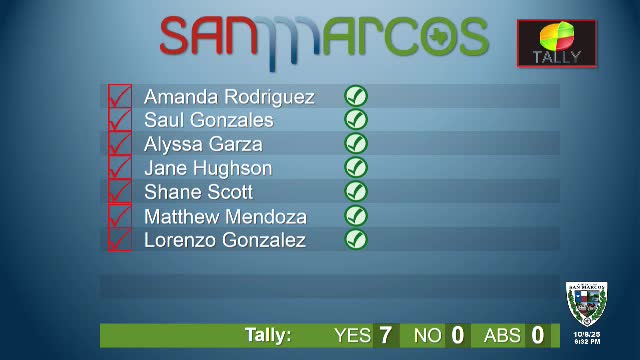
Council voted on the proposed amendment by push-button vote; the amendment failed, 5 no and 2 yes. After further discussion about enforcement procedure and outreach plans, the council voted on the main motion to adopt Ordinance 2025-43 on first reading; the motion carried 7-0.
Council and staff also discussed implementation details: the city’s code-enforcement staff said notifications to apartment complexes would be done by mailed notices and web postings, and that enforcement typically proceeds first with on-site parties and escalates to owners or registered agents if necessary. The city manager said one-time notification and training materials would be prepared for property owners and managers following passage.
The ordinance now moves to a required second reading before it becomes final; council members said staff will prepare outreach materials and implementation steps ahead of that reading.