Get Full Government Meeting Transcripts, Videos, & Alerts Forever!
Get email alerts on the Land Use Annexation Pud topic
No spam. Unsubscribe anytime.
Greeley council approves Cascadia annexations and PUD zoning despite public opposition
Summary
The City of Greeley approved two annexations and Planned Unit Development (PUD) zoning for the 833-acre Cascadia project after staff and the planning commission recommended approval; residents and petitioners urged delays and more public input, citing water, affordability and a nearby salvage yard.
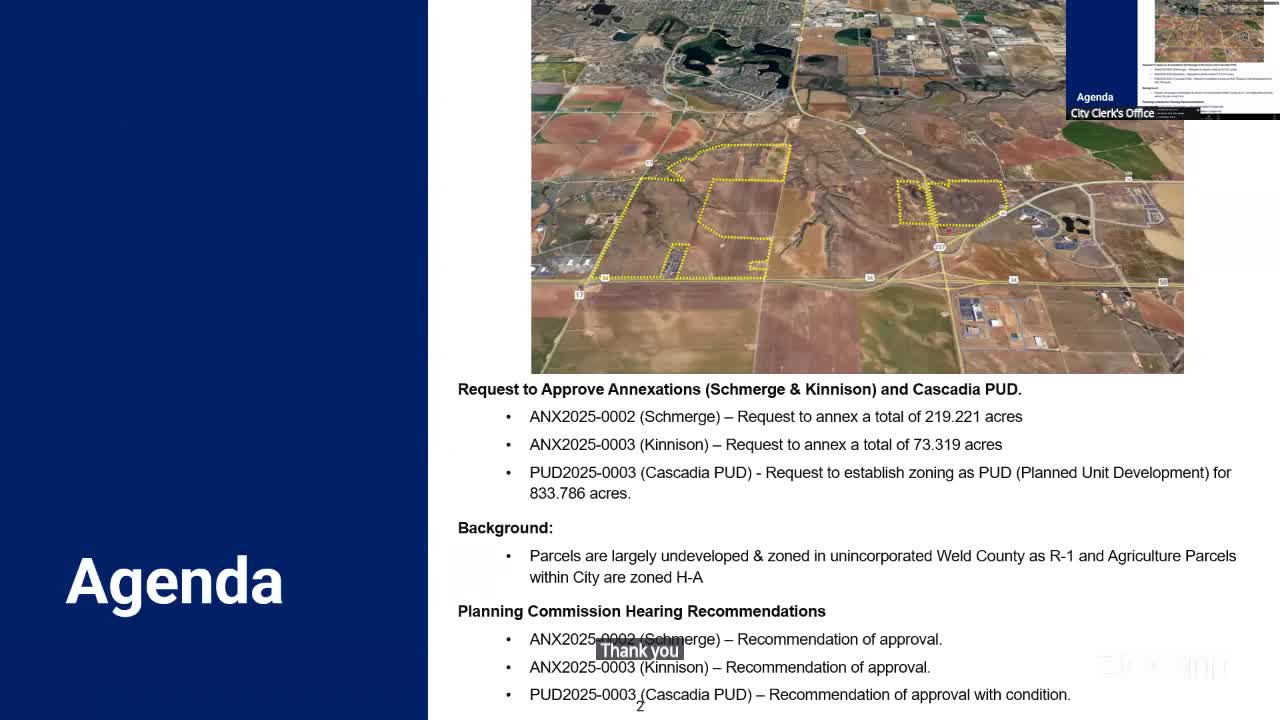
The City of Greeley council on Tuesday approved two annexations and PUD zoning to enable the Cascadia master-planned development, a project that would cover roughly 833.8 acres at the city’s western gateway and allow up to 3,401 residential units alongside commercial, entertainment and open-space elements.
City staff and the Planning Commission said the applications meet the city’s development-code criteria and comprehensive-plan goals, and recommended council approval. Brian McBroom, a city staff presenter, told council that "city staff and the Planning Commission do recommend approval of both of these annexations" after a multi-department review.
Supporters and the project team described the PUD as a long-range framework for mixed uses at the Highway 34/Highway 257 gateway. Martin Lynn of the Water Valley Company and Ryan McBreen of Norris Design said the PUD is intended to knit nine planning areas together and provide parks, trails, a transit hub and a catalyst area that includes an arena, hotel and water park.
But multiple residents who spoke during the public comment period urged the council to slow the process or put the matter to a public vote. Mary Metzgera, a resident and public commenter, said the project "consumes hundreds of acres and replaces farmland and open space with sprawl" and urged a binding community benefit agreement. Other speakers raised concerns about water supply, affordable housing, competing sports facilities nearby, and the proximity of an existing salvage yard to the proposed entertainment district.
Council members asked staff and applicants about several planning and infrastructure issues raised during the hearing: the required contiguity under state law (staff said the parcels exceed the 16% contiguity threshold), buffering and screening near the salvage yard, how Fourth Street would be routed relative to the Arroyo del Sol Natural Area, and how public infrastructure would be funded. Staff said that infrastructure capacity will be assessed as development moves forward and that General Improvement District (GID) financing is proposed as a mechanism to fund public infrastructure; staff also noted that GID ballot language under consideration would allow broad uses of tax revenue, including public safety purposes.
Council action came in three separate votes tied to the same project: approval of the Schmurke annexation (ANX2025-0002), approval of the Kennison annexation (ANX2025-0003), and approval of the Cascadia PUD (PUD2025-003). The two annexations passed unanimously; the PUD passed on a 6–1 vote. The council did not record a named no vote in the transcript for the PUD; the official tally announced at the meeting was 6 yes, 1 no.
The PUD identifies three broad character areas: a catalyst/entertainment district along Highway 34 that includes the city-owned "catalyst" parcel, Cascadia Ranch (a mix of residential types north of a future Fourth Street), and Cascadia East (a mixed residential and nonresidential area along Highway 257). The city staff presentation says the PUD would provide connections to regional trails and protect bluff topography through site planning standards; the project team said conceptual plans include multiple park spaces and trail alignments tied to the Oro/Arroyo del Sol natural-area corridors.
Council members who voiced reservations cited the salvage yard adjacency and long-term infrastructure and service needs; other members said a PUD gives the city more control over the project’s form than existing codes would. Several public commenters and petition organizers also argued the city’s handling of a citizen petition related to the project had denied voters an opportunity to decide the project.
With council approval, future steps for Cascadia include detailed subdivision plats, site plans, infrastructure design, and implementation of financing tools (such as the proposed GID) that would be subject to additional public hearings and approvals. City staff and the applicants said further reviews and conditions will follow through the subdivision and site-plan process, where buffering, phasing, utility capacity and other technical details will be addressed.
The approval effectively authorizes the framework for the mixed-use development but does not itself authorize specific buildings or infrastructure construction; those actions require subsequent land-use approvals and permitting.