
State Building Code Council approves FY26 budget, council and DES warn expenditure authority still needed
Get AI-powered insights, summaries, and transcripts
Subscribe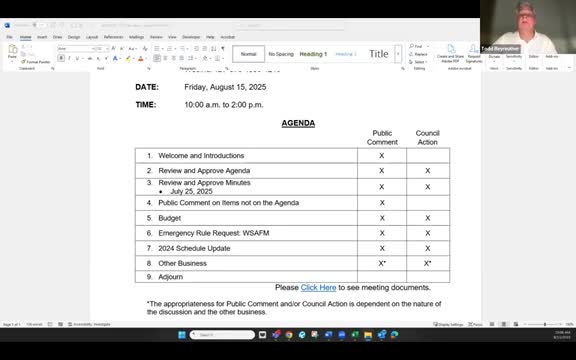
Summary
The State Building Code Council approved a fiscal year 2026 operating plan prepared by the Department of Enterprise Services but members and staff said the council lacks legislature-set expenditure authority to spend all funds in the account and will seek restored authority or other options to fund needed staff and contracts.
The State Building Code Council voted to approve a fiscal year 2026 budget prepared by the Department of Enterprise Services after a two-hour discussion on Aug. 15, 2025, in a virtual meeting. The motion, moved by Dan Young and seconded by Ben O'Mara, passed on a recorded roll call 6–2 with council members Tom Handy and Roger Haringa voting no.
The budget matter matters because the council’s operating fund — made up of building-permit fees and architect-license transfers — currently contains about $1.4 million in net position, but state law limits how much the council can legally spend unless the Legislature restores expenditure authority. Department of Enterprise Services budget operations manager Mike Diaz told the council that the fund balance is “about 1,400,000.0” as of June 30 and that FY25 actuals produced a net income in the low hundreds of thousands of dollars.
“That revenue comes in from cities and counties as they're selling permits, as well as architect license fees,” Mike Diaz said while presenting the workbook and the FY25 actuals, FY25 planned and the FY26 plan. Diaz said DES expects continued uncertainty in revenue because permit activity varies with market conditions.
Nut graf: The council approved a FY26 operating plan that keeps staffing at the six full-time equivalent positions currently budgeted, but council members pressed staff on the growing volume and complexity of code work and on options to fund additional staffing and consulting services. DES and council members emphasized that the council’s ability to spend the cash on hand is capped by legislative appropriation and that staff will ask the governor’s budget office and the Legislature to restore some of the expenditure authority removed in the prior biennial budget process.
Council members asked staff multiple questions about the fund and options to cover rising workload. Roger Haringa (council member) asked directly whether the council could simply spend down the balance: “The legislature says the state building code council cannot spend, … about 2,100,000.0 for the biennium for fiscal year 2627,” Diaz answered, explaining that regardless of account balance the council is limited to the expenditure authority set by the Legislature. Diaz said DES plans to submit a supplemental/supplemental decision package seeking restoration of previously reduced expenditure authority.
Several council members stressed staffing shortfalls. Tom Young, a residential builder and council member, said building activity is lagging because of mortgage interest rates and stressed that builders would oppose a fee increase; Representative Suzanne Schmidt, a legislative member present, said she was unlikely to support a request to raise fees or to get a larger share of existing fees during the current budget crisis in Olympia. “I will not support it, and I wouldn't support it in the legislature, nor would I support increasing fees,” Representative Suzanne Schmidt said during the discussion.
Council discussion focused on three practical options staff presented: (1) request restored or additional expenditure authority from the governor and Legislature via a DES decision package; (2) increase the permit-surcharge fee that feeds the account (a politically fraught option several members said would be resisted by builders and some legislators); or (3) change the council’s scope or schedule (push deadlines) so staff and the volunteer technical panels can meet statutory obligations within the current budget.
Staff and several council members emphasized the operational strain of the current code cycle. Dustin (SBCC staff) and others described large volunteer time commitments and concentrated working sessions required to meet the 2024/2026 code-adoption schedule. Diaz told the council that FY25 expenses were under budget largely because of vacancies and because one-time appropriations (for residential housing work, legal services and an embodied-carbon study) did not carry forward into FY26.
The motion to approve the FY26 budget was moved by Dan Young and seconded by Ben O'Mara. The roll-call tally recorded during the meeting was: Ty Mentzer (yes); Ben O'Mara (yes); Pete Rieke (yes); Katie Sheehan (yes); Dan Young (yes); Tom Young (yes); Tom Handy (no); Roger Haringa (no). The motion carried 6–2. Dustin and DES staff said they will file the FY26 plan with the Office of Financial Management by the submission deadline and will pursue a supplemental request to restore expenditure authority.
Looking ahead: staff said DES will prepare a decision package for the governor’s budget and will work with legislative members and local government stakeholders to supply data about permit deposits and workload. Council members urged staff to compile clearer permit-reporting data from jurisdictions and to quantify volunteer-hour commitments for future budget requests.
Ending: The council’s approved FY26 plan keeps staffing at the currently budgeted six FTEs and maintains program priorities, but unresolved expenditure-authority limits and staffing gaps mean the council and DES will seek legislative action or other revenue options in the next budget cycle.