
Spokane County officials outline new endorsed mobile rapid response team, MDU dispatch and state coordination work
Get AI-powered insights, summaries, and transcripts
Subscribe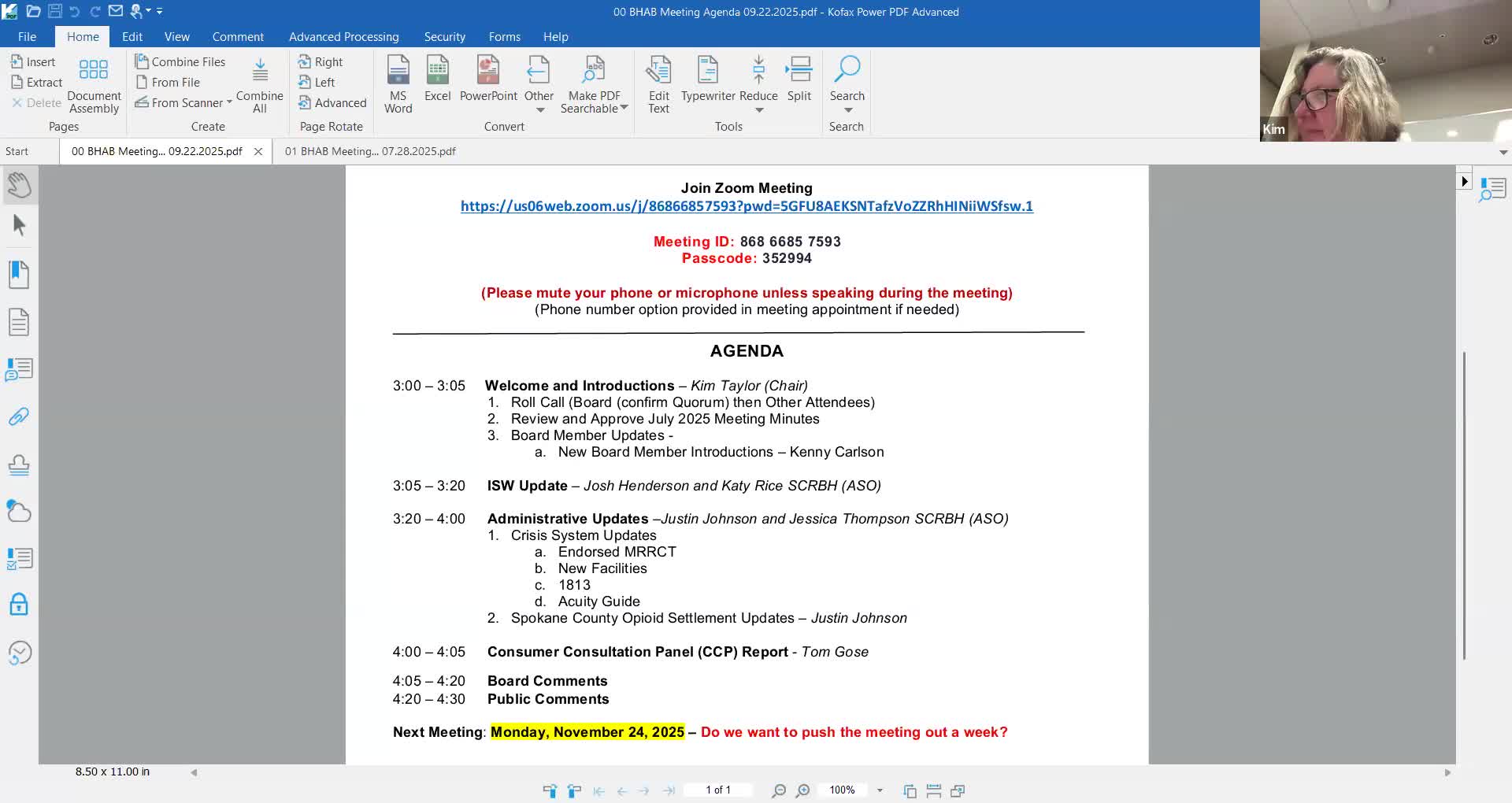
Summary
Frontier Behavioral Health received endorsement for a mobile rapid response crisis team in Spokane County; county staff described an MDU dispatch unit, guidance to use 988 as the "front door," and ongoing state-level work on data standards required by House Bill 1813.
Jessica Thompson, behavioral health supervisor at the Administrative Services Organization (ASO), told the Spokane County Behavioral Health Advisory Board that Frontier Behavioral Health received notification, effective Aug. 1, to operate an endorsed mobile rapid response crisis team for Spokane County.
"They will be able to operate this specific mobile rapid response crisis team for our Spokane County 24/7 and be able to respond to behavioral health emergencies within 1 hour," Jessica said. She added that the endorsement allows Frontier to operate up to five vehicles that can assist with transporting people to stabilization services as needed.
The nut graf: ASO staff said the new team and a centralized mobile dispatch unit (MDU) are intended to provide faster triage and more coordinated dispatch across crisis teams, while state-level work on care-coordination standards under House Bill 1813 will require electronic data-sharing standards by Jan. 1, 2026.
Jessica said law enforcement coordination and training are in progress. When safety concerns exist, behavioral-health responders will still work alongside law enforcement; Jessica said Frontier will use existing trainings and hold offline meetings with sheriff and city leadership, then cascade to direct staff once new team members are hired. She said about 20 new positions are planned for the teams and that onboarding with law enforcement will occur as those staff come on board.
Board members asked how community members and providers should request mobile crisis dispatch. Jessica said people in crisis should call 988 to reach behavioral-health responders. She added that community providers and law enforcement have access to an MDU referral line for direct dispatch and that the ASO will publicize the referral pathways after teams are fully staffed.
The ASO also reported work with the Washington State Health Care Authority (HCA) and managed care organizations to implement the electronic care-coordination data-sharing standards mandated by House Bill 1813. Jessica said the ASO is participating in that process and providing regional feedback on a state-developed acuity guide intended to help triage behavioral-health crisis responses.
On facilities, Jessica said MultiCare Deaconess Hospital has a Commerce grant to open an inpatient psychiatric hospital at its Deaconess South location that will provide voluntary and involuntary services and is planned to open in late 2026 or early 2027. She also said the Mann‑Grandstaff VA Medical Center in Spokane is exploring accepting involuntary veterans into its inpatient psychiatric unit, though no date has been set and federal rules and jurisdictional limits will affect how the VA implements any change.
Questions from board members highlighted operational constraints: a sheriff's office representative asked whether law enforcement would be briefed about the new teams; Jessica said trainings and coordination meetings are ongoing. A veteran-services participant noted that voluntary placement processes at the VA can be difficult in practice, and ASO staff acknowledged federal jurisdictional complexities and possible limits on bed availability if the VA must accept overflow from other VA regions.
Staff described the MDU as a centralized dispatch and triage unit that can route callers from 988 to the most appropriate crisis team and track referrals; one presentation slide reviewed to the Citizens' Community Panel (CCP) noted that the MDU handles hundreds of episodes monthly and assigns many referrals to MCAT programs.
ASO staff said 988 remains the recommended community entry point for immediate behavioral-health help; provider and law-enforcement referral lines provide faster dispatch for those making direct referrals.
The ASO requested questions and said it will ensure law enforcement and community providers are informed once teams are staffed and onboarding is scheduled.