
La Marque council pushes staff to pursue short-term financing while committee refines police station plans
Get AI-powered insights, summaries, and transcripts
Subscribe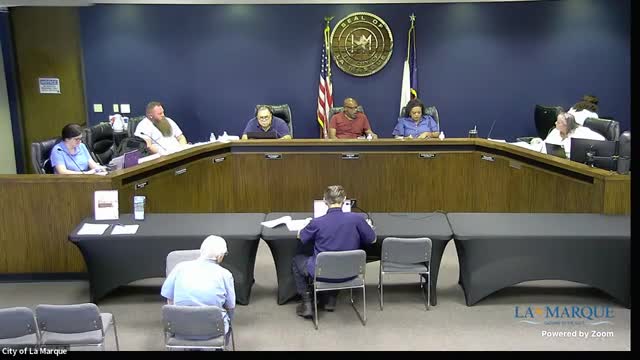
Summary
After hours of discussion about timing and scope, the La Marque City Council instructed bond counsel and its financial adviser to return with options to advance a proposed public-safety facility: staff should explore short-term financing for design work and a staged build strategy that could later be financed with a CO or voter-approved GO bond.
Council members, staff and the city—s advisers spent much of the afternoon debating how to finance and size a new La Marque police and public-safety facility and whether to put a general obligation bond on an upcoming election.
Brad Angst, the city—s financial adviser, described a structure that could fund up to about $17.5 million in new general-obligation debt without increasing the city—s current debt-service tax rate, assuming conservative growth in the tax base. He told the council his analysis factored in current debt-service schedules and forecasted revenue growth.
The council—s public-safety committee described two competing priorities: deliver a modern, functional police station that includes holding or detention capacity; and reduce program scope to lower the upfront cost. Architect Castle Long told the committee that the detention component is among the most expensive parts of the program and that removing it helped fit a design into a $17 million box, but committee members said a facility without detention capacity would not meet the department—s needs.
After several hours of debate — and repeated calls from council members and public-safety committee members that the police department—s current building is unsafe — the council directed bond counsel and the city—s financial adviser, without objection, to return with options to advance the project to the next stage. Council members asked staff to analyze near-term financing paths that would allow architects to produce bid-level drawings: a short-term tax note for design and preconstruction work, followed by a certificate of obligation (CO) or a later, voter-approved general obligation (GO) debt issuance for construction, depending on council direction and voter preference.
Bond counsel Jonathan Frels explained the calendar constraints: the city can still call a May election if council chooses, but there are scheduling deadlines in February for a November ballot. Several council members and the public-safety committee said a May election often yields a higher passage rate for municipal bonds in local experience; others warned May elections draw smaller, different electorates. Multiple council members urged unity across the council and the community before placing a large bond issue before voters.
The council—s procedural outcome was not a bond approval. Instead, in an unopposed direction, council asked staff and their financial and legal advisers to return with specific financing steps — including a tax-note path to fund detailed design work and the procurement approach to get guaranteed construction pricing — so the council would have accurate bid-level pricing before deciding whether to pursue a CO or ask voters to approve a GO bond.