
Healey announces plan to use Citizens Energy model to reinvest transmission profits to lower bills
Get AI-powered insights, summaries, and transcripts
Subscribe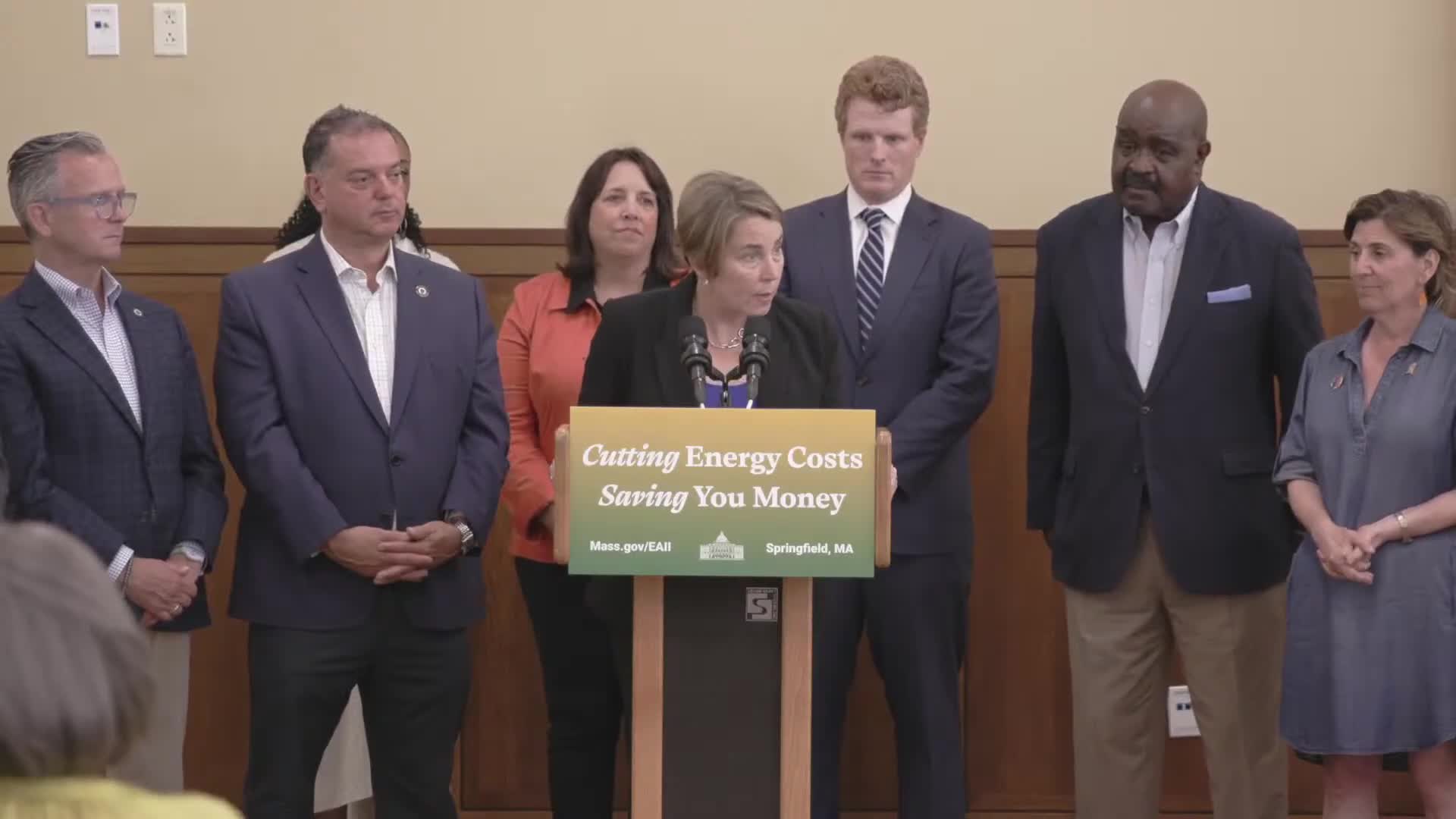
Summary
Gov. Maura Healey announced a legislative push and a partnership with Citizens Energy to let investors return profits from transmission and distribution projects to local ratepayers as a way to reduce electricity costs; she cited prior statewide rebate work and a proposal projecting about $13 billion in additional cost reductions.
Governor Maura Healey announced a plan in Springfield to use a financing model pioneered by nonprofit Citizens Energy to lower residents’ electricity bills by reinvesting profits from transmission and distribution projects back into local communities.
Healey, joined by Lieutenant Governor Kim Driscoll and Citizens Energy President Joe Kennedy at the Ray Jordan Center, said she has filed legislation intended to remove “unnecessary extra charges” from electric bills and allow organizations to invest in delivery infrastructure so some profits can be returned to ratepayers. “We launched a whole energy affordability agenda, making energy less expensive,” Healey said. “We saved people across Massachusetts about $6,000,000,000. . . . I filed a major piece of legislation. I'm working with all these gentlemen here to get it done to further lower our cost by $13,000,000,000.”
The proposal would build on work by Citizens Energy, which Kennedy said has used a model in other states to partner with transmission developers, finance projects and direct a portion of the financial returns to nearby communities. “We take at least half of our profits and turn them back over to local communities where that infrastructure is built,” Kennedy said, describing examples in California where projects provide recurring bill relief and community benefits.
Kennedy described an operational California line that delivers roughly $300 a year to 12,000 low-income households for 18 years and other projects that fund electric-vehicle charging or human service organizations. He said Citizens Energy has returned more than $600,000,000 in benefits nationwide over several decades and that the group seeks to adapt its model to financing the lines and substations that move power from generators to customers.
Healey and Kennedy said the largest portion of many customers’ bills is not generation but the costs of transmission and distribution — “the big towers” and local power lines — and that lowering the financing and delivery costs could reduce overall bills if profits are shared with communities. Healey also repeated two operational items she said were underway statewide: a heat-pump discount rate she said would begin Nov. 1 for households with a heat pump, and previously distributed rebates and other programs she said together have produced about $6 billion in savings statewide.
The governor described the announcement as a legislative and executive push rather than a concluded program: the proposal will require state action and implementation details, and she framed it as a way to increase supply and remove charges that she called “unnecessary.” No formal vote or regulatory approval was announced at the event. Bud Williams, state representative, offered brief remarks in support, saying, “When we fight, we win.”
Officials said they would continue working with the legislature and state energy staff to refine how investments, returns and community rebates would be structured; Healey and her team also named the state’s Secretary of Energy and Environmental Affairs, Rebecca Tepper, and staff in the Office of Energy Transformation as participants in implementation planning. The governor and Kennedy said the approach would be scaled across the Commonwealth if authorized.
Next steps described at the event included the filed legislation and follow-up work between the governor’s office, Citizens Energy and state energy staff. Officials said they would be available to answer additional questions after the announcement and that further details would be developed in coordination with legislative partners.