
Healey-Driscoll administration highlights Project Safe Neighborhoods grants at Lynn public-safety roundtable
Get AI-powered insights, summaries, and transcripts
Subscribe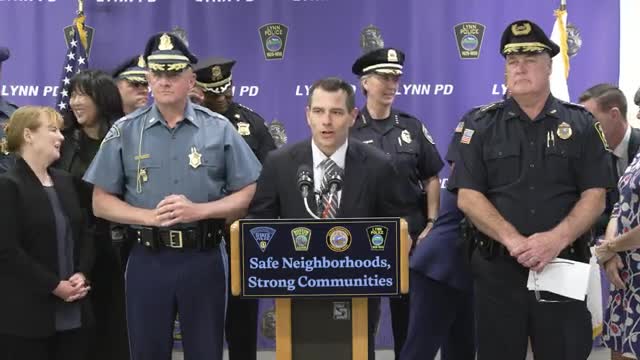
Summary
Governor Maura Healey and state and local law enforcement officials gathered in Lynn to discuss Project Safe Neighborhoods grants, technology investments and youth-focused prevention programs; officials credited the grants with dozens of arrests and removing illegal guns from the streets but made no new policy announcements.
Governor Maura Healey and state and local public-safety leaders held a roundtable at the Lynn Police Department to discuss Project Safe Neighborhoods grants, investments in investigative technology and youth-focused prevention programs. The session, hosted with Lynn officials and law enforcement leaders, reviewed recent enforcement results and emphasized continued collaboration among state police, municipal departments and prosecutors.
The meeting centered on the Healey-Driscoll administration's push to pair enforcement with prevention. “The importance of investing in public safety, investing in law enforcement, investing in the technology and the resources that help, investigate and hold people accountable, and the importance of investing in community prevention programs,” Governor Maura Healey said, summarizing the administration's approach. She said the administration has organized three convenings across the state and has prioritized funding for programs aimed at gang activity, firearm offenses, drug distribution and human trafficking.
Essex County District Attorney Paul Tucker and Massachusetts State Police Colonel Jeff Noble described the grants and partnerships as central to recent enforcement activity in Lynn. “That's why I can stand here today and say that the streets of Lynn are safer,” Tucker said, citing coordinated work among state police, Lynn police and prosecutors. Noble described the administration's policy as “Build strong partnerships, stay engaged with our community partners, and deliver services that make a difference.”
Officials cited specific enforcement results tied to the program. Healey said that in the first six months of the year the program produced nearly 500 arrests, removed 54 illegal guns, seized about 30 kilograms of narcotics and recovered more than $240,000 in illicit proceeds. Chief Reddy of the Lynn Police Department credited those grants with enabling joint investigations and with funding programs aimed at creating safe spaces and positive engagement for young people.
Speakers repeatedly framed technology and forensic tools as a key part of modern investigative work. “The way you solve crime today is through technology. Cameras matter,” Healey said, and other officials discussed the role of vehicle data, phone records and newer forensic techniques such as forensic genealogy in building cases. Officials also warned that technology is expensive and noted state and federal funding as necessary to continue that work; Healey said recent federal funding cuts of about $7,000,000 reduce available resources.
While the discussion focused on results and tools, participants stressed community trust and prevention. Noble said success depends on “trust earned day after day, interaction after interaction between law enforcement, service providers, and our community.” Several speakers highlighted programs that pair troopers or officers with young people through mentorship, athletics and trauma-informed victim services.
No formal votes or motions were taken at the roundtable and officials did not announce new funding commitments or policy changes during the session. The meeting functioned as a public convening to review outcomes from Project Safe Neighborhoods grants, to identify needs for continued investment in technology and prevention, and to underscore the administration's ongoing collaboration with municipal leaders, district attorneys and nonprofit service providers.
Officials said the work will continue and encouraged recruitment into law enforcement careers. Healey closed by saying law enforcement is an honorable profession and urged interested people to consider careers as troopers or local officers.