Get Full Government Meeting Transcripts, Videos, & Alerts Forever!
Get email alerts on the Labor Firefighters Cba topic
No spam. Unsubscribe anytime.
La Marque and Local 3282 continue bargaining over 48/96 schedule, certification pay and investigator on‑call pay; July 3 meeting set
Summary
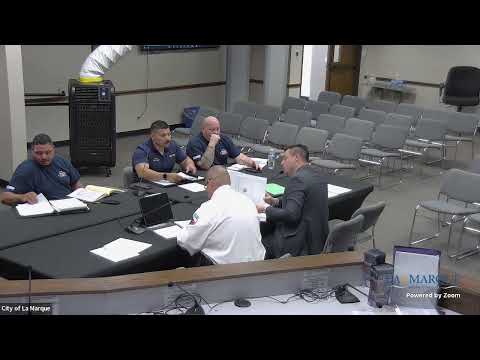
La Marque officials and representatives of La Marque Professional Firefighters Local 3282 met June 16 to continue negotiations over the fire department’s collective bargaining agreement, discussing a proposed move from the current nine‑day/Kelly‑day rotation to a 48/96 schedule, pay for new and existing certifications, weekend on‑call pay for arson investigators and related staffing and operational impacts.
La Marque officials and representatives of La Marque Professional Firefighters Local 3282 met June 16 to continue negotiations over the fire department’s collective bargaining agreement, discussing a proposed move from the current nine‑day/Kelly‑day rotation to a 48/96 schedule, pay for new and existing certifications, weekend on‑call pay for arson investigators and related staffing and operational impacts.
The discussion focused on three items central to the union’s package: (1) switching to a 48/96 schedule to reduce mandatory daily Kelly‑day staffing and overtime costs, (2) clarifying certification pay for hazmat roles and a recently introduced fire‑marshal certification, and (3) a proposed two‑hour weekend on‑call payment for investigators (identified in the meeting as arson investigators). City and union negotiators also reviewed a proposal to keep unused quartermaster (uniform/boot) allowances in a department fund rather than returning them to the general fund.
Why it matters: The schedule and pay changes affect daily staffing, overtime costs, equipment maintenance routines and how emergency medical and fire response teams are paired during high call volumes. Union leaders said the 48/96 model is increasingly common in the fire service and could reduce overtime and sick‑leave use; city staff and the fire chief sought written protocols and preliminary implementation plans before committing to a contract change.
Scheduling and overtime figures discussed Union representatives presented a feasibility and cost summary showing historical cost tied to Kelly days. For the 10/1/2023–10/1/2024 fiscal period the packet showed 1,860 Kelly‑day hours and a calculated cost of $70,082.01 (base pay caveat noted). For the current fiscal year (10/1/2024 to present) the packet showed 972 Kelly‑day hours and a calculated cost of $37,034.68. The packet broke those totals out by rank: firefighters (previous year: 105 days, 1,260 hours; current year: 54 days, 648 hours), engineers (previous year: 12 days, 144 hours; current year: 2 days, 24 hours) and captains (previous year: 38 days, 456 hours; current year: 25 days, 300 hours). Negotiators noted the fiscal totals are calculated at base pay and that overtime and step‑up payments can increase actual cost.
Switch to 48/96 and operational implications City and union participants spent the bulk of the meeting on the proposed 48/96 rotation, which places crews on duty for two consecutive 24‑hour days followed by four days off. Union representatives argued the schedule reduces daily Kelly‑day gaps (the union’s term for mandatory days off that can force overtime), lowers long‑term wear on equipment by reducing daily full checkouts, and improves firefighter recovery time. The negotiation packet characterized the modified work‑week as a 106‑hour pay period (2756 hours per calendar year) for operations personnel and projected a reduction in overtime liability if the department can maintain minimum staffing without daily recall.
City staff and the fire chief raised implementation questions the council and public should see in advance: written protocols for how overtime will be assigned under 48/96, limits on how many personnel may be allowed off at once, how the department would manage stretches that could still produce a 72‑hour work block, and the budgetary effect of accruals if employees use less sick leave but bank more hours for future payout. The city emphasized that some costs are a long‑term liability (unused sick time accrual) even if short‑term overtime falls.
Staffing and equipment management Negotiators discussed recent changes to staffing that affect the schedule conversation. The city said its budget added three engineer positions mid‑year, bringing engineer positions from three to six (one engineer assigned to each engine per shift). Command staff and line personnel described improved maintenance and equipment oversight since engineers became permanent positions: consistent checklists, a single point of responsibility for each apparatus and fewer “lost in the cracks” maintenance issues. The chief and union representatives said engineers allow quicker turnover between medic and engine assignments during heavy call periods and reduce the need to reassign personnel mid‑shift.
Certifications, hazmat and fire marshal pay Union negotiators asked for clarification of new certification pay items in the packet. The parties clarified that the packet lists a new hazmat certification pay separate from a hazmat incident‑commander rate; the meeting made clear that the two certifications are distinct (a hazmat technician performs hands‑on mitigation; a hazmat incident commander leads and manages a hazmat incident) and that the pay provisions are not to be compounded if a single member holds both credentials. The chief said La Marque does not maintain a staffed dedicated hazmat team; the department relies on regional partners (League City, Harris County, Fort Bend County, Houston) for dedicated hazmat resources, so local hazmat‑trained personnel primarily provide perimeter, scene stabilization and support until a dedicated team arrives. The packet also includes a recently introduced Texas Commission on Fire Protection (TCFP) fire‑marshal certification and corresponding pay; negotiators clarified which staff are TCFP‑certified and which perform fire‑marshal duties as assigned.
Investigators and weekend on‑call pay The union proposed and discussed adding two hours of guaranteed overtime pay for investigators who are on call over a weekend, regardless of whether they are called to respond. City negotiators and the city attorney suggested clarifying language so the payment explicitly applies to arson investigators (the only investigator role the department currently staffs on call). The chief and union agreed that the two‑hour on‑call payment was intended to offset family‑time loss for investigators covering arson duties.
Quartermaster fund and uniform allowances Negotiators discussed using unused boot/uniform allowances to replenish a department quartermaster fund rather than returning the funds to the city’s general fund. City staff indicated the proposal is under consideration and asked for specific language to implement the change within the fiscal year.
Next steps and scheduling Negotiators agreed to continue bargaining and asked staff to provide more detailed, written implementation guidance before any final agreement on the 48/96 schedule. The parties tentatively set a follow‑up negotiation session for July 3, 2025, at 9:00 a.m., subject to confirmation. The meeting closed with the presiding officer adjourning the session.
What was not decided No final contract language was adopted at the June 16 session. Negotiators deferred final agreement on the 48/96 schedule, certification pay compounding, and precise overtime assignment rules pending further documentation and a subsequent meeting.