Get Full Government Meeting Transcripts, Videos, & Alerts Forever!
Get email alerts on the Outdoor Lighting topic
No spam. Unsubscribe anytime.
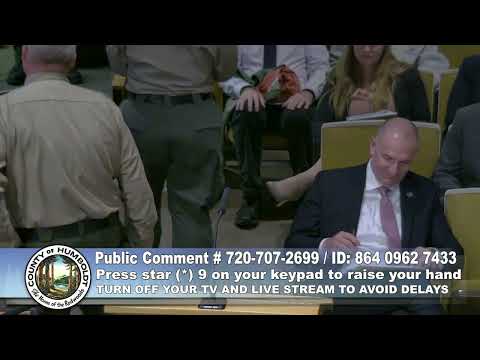
Humboldt County adopts outdoor lighting rules after hours of debate; vote 3-2
Summary
The Humboldt County Board of Supervisors approved inland and coastal outdoor lighting ordinances 3-2 on Tuesday, adopting new limits on lumens, shielding and color temperature and directing staff to refine exemptions and return with a street-lighting amendment.
The Humboldt County Board of Supervisors on Tuesday adopted new indoor and coastal outdoor lighting ordinances aimed at reducing light trespass, protecting night skies and reducing impacts to sensitive biological resources. The measures passed on a 3-2 vote after more than two hours of staff presentation, public comment and board deliberation.
Planning staff said the ordinances require downward-directed, fully shielded fixtures or, as an alternative, warm-color (2,700 kelvin maximum) fixtures with shielding; set lumen limits for common uses; and establish enforcement for new and nuisance lighting. Rianne Meakin, associate planner in the Humboldt County Planning and Building Department, told the board, "We are not trying to prohibit lighting. We are simply trying to minimize unnecessary lighting of areas that transpires onto neighboring properties." Meakin presented both an inland and a coastal version; the coastal ordinance substitutes the term "environmentally sensitive habitat areas (ESHA)" where the inland version refers to "biological resources."
The ordinances set residential outdoor lights at a 1,100-lumen maximum and commercial/industrial lights at a 3,200-lumen maximum. Meakin said the higher lumen thresholds respond to locally available fixtures and were adjusted from earlier drafts presented to the Planning Commission.
The Planning Commission recommended adoption in May by a 6-0 vote. Dozens of residents and local organizations spoke at Tuesday’s hearing. Mark Wilson, vice president of Astronomers of Humboldt, told the board his group supports the ordinance and called it a way to "put Humboldt County in the forefront" of night-sky protection. Representatives of Humboldt Waterkeeper urged staff to remove the draft’s allowance for translucent fixture covers, arguing such covers can still emit upward or sideways light and therefore undermine shielding objectives.
Board members debated exemptions, enforcement and how the ordinance should treat athletic-field lighting, string lights, motion-activated security lights, flags and municipal street lighting. Supervisor Lori Wilson told the board the issue had long appeared in planning work and stressed safety and environmental concerns. "The brighter the light is, the harder it is to actually see anything that's not in the light directly," she said, arguing that very bright, blue-white lights can reduce safety and create strong shadows.
Supervisor Michael Bone pushed for clear, enforceable limits and time controls on late-night recreational lighting; several board members said they favored a 10 p.m. cutoff for most recreational or nonessential lighting. After discussion the board directed staff to return with a separate, more detailed street- and parking-lot lighting ordinance (staff indicated a target of returning by the end of the calendar year) and to develop a targeted approach for athletic fields rather than a wholesale exemption. The board also instructed staff to refine the coastal version by removing the translucent-cover alternative in coastal areas and to limit the string-light exemption by time (board direction: string lights not to be allowed to remain on past 10 p.m.).
On a separate motion, the board adopted the Planning Commission’s recommendation with the changes enumerated in the debate and included in the board motion. The motion passed 3-2 (tally recorded by the clerk 3 yes, 2 no). No formal numeric penalties were adopted at Tuesday’s hearing; staff told the board enforcement will be mostly complaint-driven and handled through the county’s established code-enforcement process, with initial outreach and education followed by remedies if a nuisance is found.
The ordinances include preexisting-lighting language: fixtures installed before adoption and consistent with rules at the time may remain in place unless they become the subject of a nuisance complaint or are substantially altered. The board directed staff to clarify that county-specific ordinances (for example, cannabis greenhouse lighting or sign illumination rules) continue to apply and to provide educational outreach for contractors, designers and local suppliers so residents can buy compliant fixtures.
The board’s final action included: approval of inland and coastal ordinance language with the modifications directed by supervisors to better protect ESHA/biological resources in coastal areas, a requirement that athletic-field lighting either come back for conditional use review or be handled through a more detailed street-lighting amendment, and limits on several exemptions to prevent light trespass onto neighboring properties, the night sky and sensitive habitat. The board also asked staff to consult with municipal jurisdictions and return with outreach recommendations.
The vote was the last substantive business before the board closed for scheduled closed-session items.
Less-critical next steps set by the board: staff will prepare ordinance language reflecting the board’s directed changes, develop a street-lighting amendment to address municipal and county fixtures, and prepare an outreach and compliance plan that includes guidance for local hardware and lighting suppliers and for contractors and designers.
Votes at a glance
- Adopt inland and coastal Outdoor Lighting Ordinances (planning commission recommendation, with board-directed modifications): Passed 3-2 (tally recorded 3 yes, 2 no). Outcome: approved. Notes: staff directed to return with a street-lighting amendment and athletic-field detail; translucent-cover option to be removed for coastal ESHA areas; string-light exemption limited by time (until 10 p.m.).
What it means
County planning staff said the rules are designed to be implementable at the building-permit stage for new projects and complaint-driven for existing fixtures; the board emphasized education and voluntary compliance as the first enforcement step. Several environmental and astronomy groups praised the ordinance as a step toward protecting migratory birds and local night skies; business and resident speakers urged clarity and predictable rules for contractors and operators.
An adopted ordinance text and an implementation plan will be posted to the county website after final edits and clerical updates are completed.
Ending
Board members thanked staff and the community for extensive public input. The board’s final adoption leaves the county with a baseline outdoor-lighting standard for unincorporated Humboldt County and a clear direction to return with further detail on street and athletic-field lighting and a public outreach plan.