
City attorney trains Milton Board of Adjustment on Sunshine Law, public records and ethics
Get AI-powered insights, summaries, and transcripts
Subscribe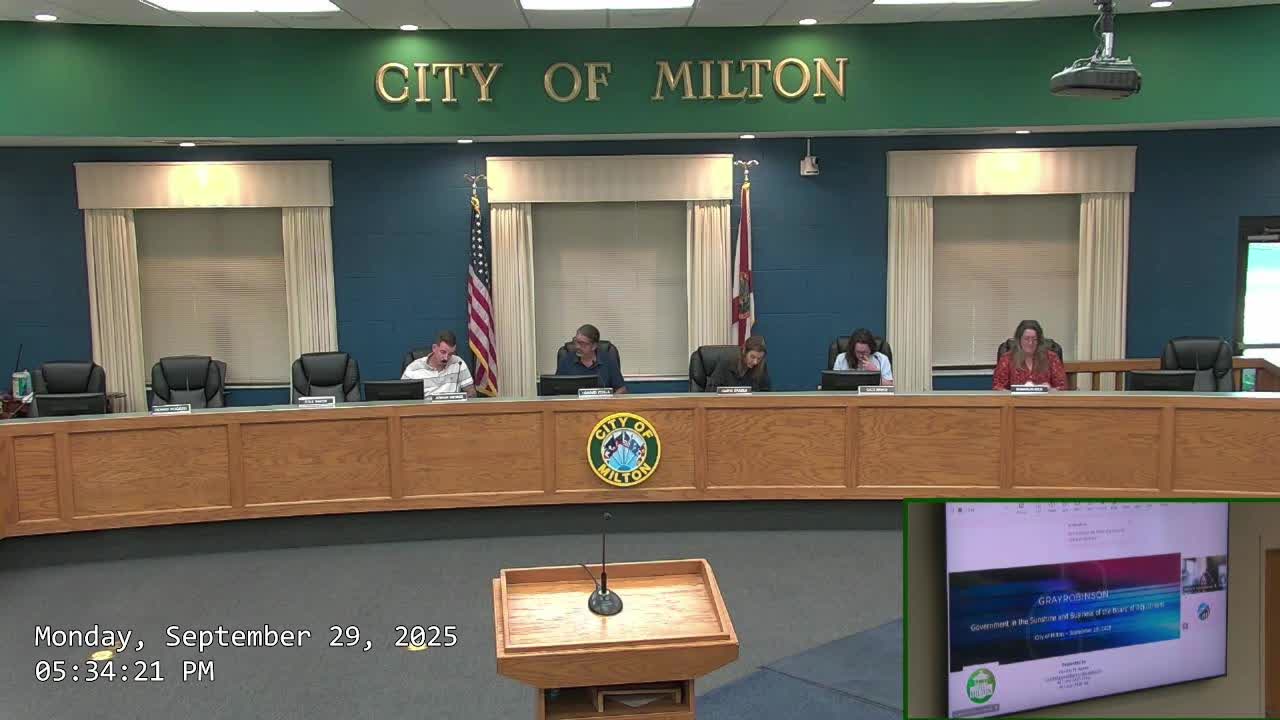
Summary
At its Sept. 29 meeting, the Milton Board of Adjustment received a legal training from Heather Ramos of Grey Robinson, the city’s contract legal firm, covering Sunshine Law, public records, financial-disclosure requirements and procedures for variances and special exceptions.
At its Sept. 29 meeting, the Milton Board of Adjustment received a legal training from Heather Ramos of Grey Robinson, the city’s contract legal firm, covering Sunshine Law, public records, financial-disclosure requirements and procedures for variances and special exceptions.
Ramos told the board that ‘‘meeting must be open and accessible to the public,’’ and that the Sunshine Law is triggered when two or more members of a public body discuss city business. She said such discussions require official notice and minutes, and cautioned members against using texts, emails or staff intermediaries to coordinate positions outside a noticed meeting.
The training also covered public-records obligations. Ramos said records are not limited to formal documents and ‘‘include text, emails ... voicemail, photographs’’ and social-media posts when they relate to city business; she added that there is ‘‘no unfinished-business exemption’’ for drafts. Ramos warned of enforcement consequences for violations and noted that members should forward any records they receive in an official capacity to the city recorder.
Ramos reviewed ethics and disclosure requirements commonly used by board members. She said board members ‘‘must file Form 1’’ to disclose certain assets and liabilities and a Form 1F in their final year of service, and advised caution about participating in votes that would produce a financial benefit for themselves, relatives or close business associates. She described gift rules, saying gifts over $25 must be disclosed and could trigger additional filing requirements.
On land-use procedure, Ramos explained the board’s role in quasi-judicial hearings for special exceptions and variances. She described a special exception as a use authorized in a zoning district only when the listed standards are met, and a variance as a limited deviation from zoning requirements that must not be contrary to the public interest and must arise from conditions peculiar to the property. Ramos said the board must rely on competent, substantial evidence, swear in witnesses as needed and avoid undisclosed one-on-one ‘‘party communications’’ that could raise due-process concerns.
Ramos provided practical examples—parking and screening conditions, dumpster placement and height or setback variances—and told members she would supply handouts and a procedural checklist for chair duties during quasi-judicial hearings. She said the slide deck used in the presentation would be made available to the board and that the meeting recording is posted to the city website.
The training ran through the city’s unified development code, public-records responsibilities and the city’s ethics filings; Ramos answered board questions and offered to provide follow-up materials.
The board agreed to receive the presentation materials and said they would follow up with staff as needed.