
Howard County officials update school-capacity projections, weigh redistricting and construction costs
Get AI-powered insights, summaries, and transcripts
Subscribe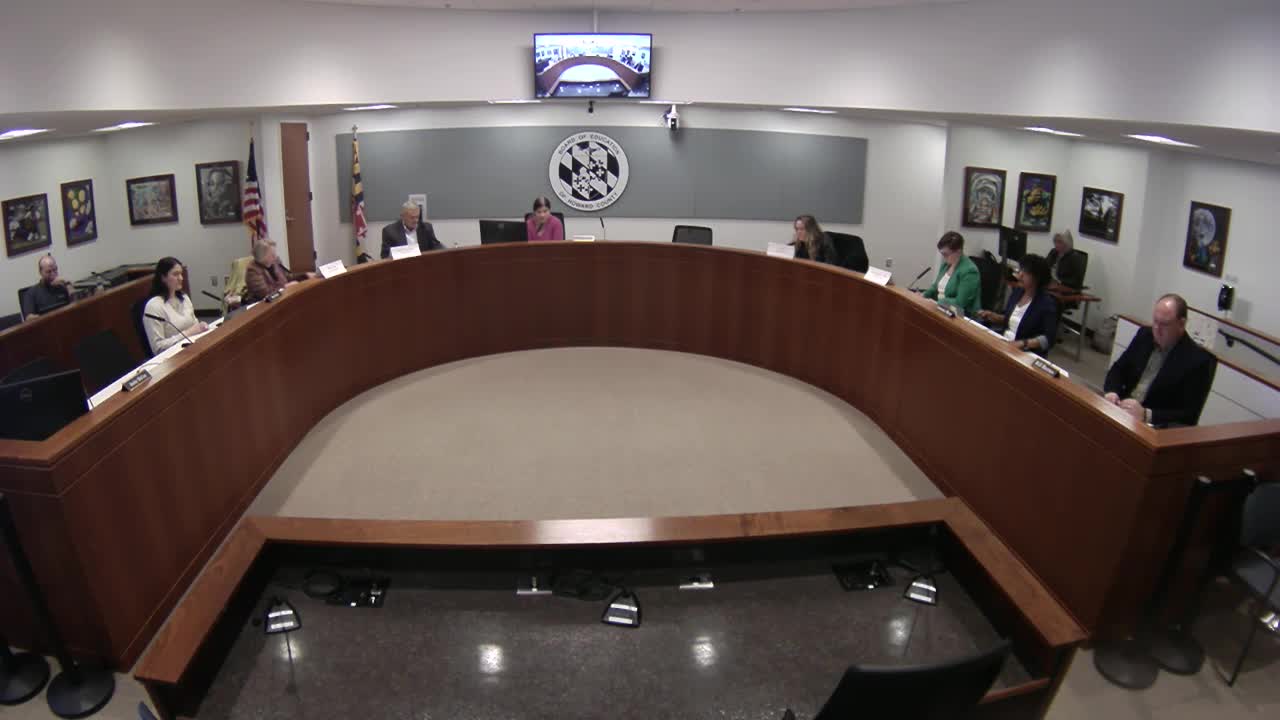
Summary
At a joint Oct. 14 meeting, Howard County school staff and council members reviewed updated capacity projections from the Educational Facilities Master Plan, discussed high school and middle-school cost estimates, portable classroom counts, redistricting scenarios and short-term transportation costs; no formal votes were taken.
Howard County leaders and school officials on Oct. 14 reviewed updated enrollment and capacity projections and discussed near-term options — including redistricting, added buses and construction — to address overcrowding in several elementary and middle schools.
The discussion, held at a statutorily required joint meeting about the Adequate Public Facilities Ordinance (APFO), centered on charts from the Howard County Public School System's (HCPSS) Educational Facilities Master Plan showing schools that reached about 95% utilization in recent years and are projected to exceed 110% utilization within the next five to ten years. Tim Rogers, manager of school planning for HCPSS, said the materials presented to the board and council include a first chart (95% in 2024 and projected to exceed 110% by 2029) and an updated chart that moves the window to 2025 and 2030.
Why it matters: Overcrowded schools affect classroom space, the use of portables and transportation. Officials said the charts show a cluster of elementary and middle schools that need solutions, and staff described how such needs feed into budgeting, redistricting and long-range planning.
What officials said and asked - Tim Rogers, HCPSS manager of school planning, summarized the two charts and the district's intent to use them to inform discussion and next steps. Rogers told the joint meeting, "At this time, we are here to answer any questions or continue this discussion." - Dan Lubel, executive director of capital planning and construction for HCPSS, explained project-cost estimates for two large high-school projects. Using updated figures presented to the board, Lubel said the preliminary cost estimate for the Oakland Mills High School renovation/addition is about $160,000,000 and Centennial High School's comparable estimate is about $156,000,000. "If we were looking to build a new facility, we would have to add on additional... dollars for the site improvements," Lubel said, and added: "I would anticipate a new facility in today's dollars would be approximately 180 to $190,000,000 for a total project." - HCPSS Chief Operating Officer Cornell Brown said preliminary estimates reflect square footage and recent market bid data; final project budgets will be set after feasibility studies and design. He emphasized that construction-market volatility makes estimates provisional.
Numbers and near-term operating impacts discussed - HCPSS staff said five elementary schools and four middle schools met the 95%/110% threshold on the APFO charts as presented. - Updated high-school estimates presented: Oakland Mills (renovation/addition) $160,000,000; Centennial (renovation/addition) $156,000,000. District staff warned estimates can change with project scope and market conditions. - Dunlog/Dunlough Middle School (projected replacement/renovation) was listed in planning materials with an FY27 estimated project cost of about $93,500,000. - Portable classrooms: staff said the district has roughly 235 portables in total, with about 220 used as classrooms. Not all portables are classroom space; some serve other functions. Staff told the meeting that portables are moved between sites and are generally not resold. - Redistricting transportation costs: staff estimated that the superintendent's proposed redistricting scenario would require about two additional buses (approximately $200,000 annually), consultant concept 1 would add three buses (about $300,000), and consultant concept 2 would add five buses (about $500,000). Exemption policies (for example, protecting rising fifth-graders from reassignment) would add further temporary bus costs.
Discussion points and concerns - Several council members and board members pressed for clarity on what drives cost differences between projects, the timeline for feasibility and design work, and what solutions short of full replacement might extend building life (for example, targeted HVAC or controls upgrades). - Council members raised neighborhood turnover (house resale/turnover) as a major driver of enrollment increases that does not stem from new development; HCPSS staff said their enrollment projections combine cohort survival rates with recent resale data from the Maryland Department of Planning to model turnover-driven enrollment. - Members urged stronger coordination between APFO planning, attendance-area assignments and transportation to reduce "hazard busing" (busing created when walking routes are unsafe). Council members suggested using crossing guards or targeted sidewalks instead of bus routes where feasible.
Decisions and next steps - No formal motions or votes were recorded on APFO-related actions during the session. Officials said the Educational Facilities Master Plan and the district's long-range master plan will continue to guide project prioritization and that feasibility studies and updated cost estimates will be developed for major projects before final budget requests. - Staff said the educational sufficiency study and consultants' reviews (discussed separately at the meeting) will produce more detailed program and facility-condition information to refine priorities and budgets.
Ending note: The meeting combined statutory APFO discussion with broader capital- and program-planning issues. School staff and council members repeatedly urged that projected costs are preliminary, that market escalation is possible, and that any major construction decisions will follow feasibility work and further board and council deliberations.