Kyrene board authorizes use of updated boundary maps for public hearings on proposed closures amid enrollment decline
Loading...
Summary
The Kyrene Elementary District governing board on Sept. 29, 2025 directed district staff to use updated maps for regional public hearings on proposed school closures and boundary changes as staff cited a multi‑year funding shortfall tied to declining enrollment.
The Kyrene Elementary District governing board on Sept. 29, 2025 directed district staff to use updated school‑boundary maps for regional public hearings on proposed closures and boundary changes, Superintendent and staff told the board at a virtual retreat.
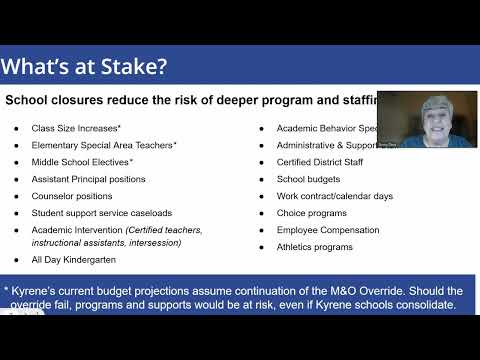
Board members were presented with updated financial modeling showing a cumulative five‑year state funding shortfall of about $6.7 million tied to enrollment declines and were reminded that the district’s maintenance-and-operations (M&O) override — roughly $14.6 million in total funding for the district — is up for renewal on the November ballot. Mr. Herman, the district finance presenter, told the board, “by the time you get to the fifth year and you’ve added up all the individual years, it’s about $6,700,000.”
The board’s decision at the retreat was a direction to proceed to statutorily required regional public hearings using the maps now on the table; it was not final approval of closures or permanent boundary changes. President Walsh summarized the board’s direction: “these are the maps you can use for the public hearings,” and asked staff to continue public and board discussions before any final action.
Why it matters: Kyrene’s projected enrollment losses have recurring budget impacts the district says cannot be closed with one‑time funds, capital dollars or carryforward balances. The district presented a model that separates potential savings into personnel reductions (positions that would not move to another school) and ongoing day‑to‑day building operational costs (utilities, custodial, insurance). Herman told the board the personnel impact was modeled at roughly 7.8 full‑time equivalents (FTE) per elementary school and 13.4 FTE per middle school for positions that would not relocate with students.
Key recommendations and changes presented - Dual language: The district recommended keeping both existing dual‑language elementary schools as boundaryless, open‑enrollment sites (no assigned boundary and no district transportation). Staff said keeping both sites preserves program continuity and avoids creating a dual‑language pathway that could be difficult to staff. Those two schools were named in the presentation as Lagos (West side) and Norte (East side). - Gifted services: The board and staff agreed to convene a gifted advisory process after January 2026 to evaluate districtwide gifted options and retention strategies. Current self‑contained gifted classrooms would remain in operation while the committee and any audit proceed; staff cautioned that small self‑contained classes may require “guesting in” students if enrollment falls below staffing targets. - Kyrene Traditional Academy (KTA): The superintendent recommended KTA remain open and continue its traditional program through the 2026–27 school year while the board and KTA representatives consider longer‑term options; the district does not recommend making KTA boundaryless at this time. - Map and closures: The updated recommendation reduced the number of elementary schools slated for closure from seven (in an earlier committee recommendation) to six because Norte would remain open; the presentation assumed Millennio would remain closed unless repurposed. Staff proposed condensing implementation into a two‑year timeline. As presented, anticipated closures were: 2026–27 — Estrella, Colina, Millennio and Menitas; 2027–28 — Ochimol, Mariposa, Kyrene Traditional Academy (KTA) and Pueblo. Staff emphasized these are implementation proposals tied to the public‑hearing process and not final board approvals. - Transportation: Staff noted existing transportation rules (for example, many elementary students within a mile do not receive bus service) and said the district will analyze route impacts from boundaryless choice sites. For reference in the presentation, Lagos historically had about 15 in‑district bus riders and about 30 open‑enrollment bus riders; Norte’s combined bus number was described as about 57. - Special education capacity: Dr. Lane (district special education leadership) told the board staff are reviewing capacity at receiving schools so current programs for students with disabilities (including preschool and other levels) can be accommodated in whatever buildings remain open.
Board direction and next steps Board members asked clarifying questions and offered public‑facing guidance; no roll‑call vote on closures was recorded during the retreat. The board authorized the superintendent to use the updated maps for regional public hearings required by statute; staff listed a likely public‑hearing window including a statutorily noticed hearing on Nov. 18 (with a possible move to Dec. 2 depending on board changes and timelines). The superintendent and finance staff said they will provide school‑level savings breakdowns if the board requests them before hearings and will continue refining transportation and facility analyses.
Board members repeatedly emphasized minimizing student disruption where possible: one board member noted the updated plan reduced split cohorts from five schools to two. Several trustees expressed support for forming the gifted advisory committee and for holding further conversations about KTA and other choice programs before any final decisions.
What remains unresolved: The board’s direction authorizes hearings and continued study but does not finalize closures, repurposing, or the district’s long‑term program placements. The timeline, building repurposing options and the final list of schools to be closed or repurposed will return to the board for subsequent votes after the public‑hearing period and additional staff analysis.
Public‑hearing notices, full slide decks and the district’s statutory disclosures about M&O spending were cited by staff as upcoming materials for community review.