FDLE tells Senate committee privacy rules and lab capacity limit access to hospital toxicology and slow DNA turnaround
Get AI-powered insights, summaries, and transcripts
SubscribeSummary
Deputy Commissioner Vaden Pollard told the Florida Senate Criminal Justice Committee that state and federal privacy laws restrict access to hospital-held toxicology and medical records, and that DNA analyses in FDLE's laboratory averaged about 208 days last quarter, with sexual assault kits averaging under 90 days.
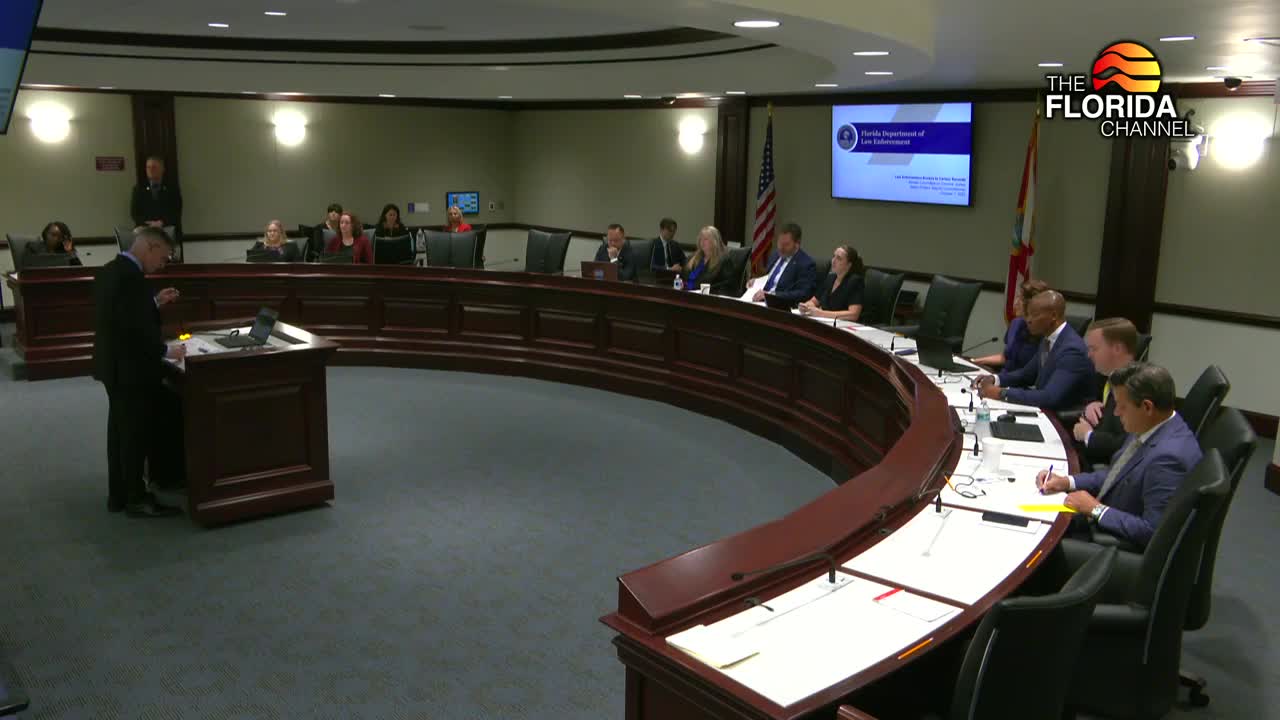
Senator Martin, chair of the Senate Criminal Justice Committee, invited Vaden Pollard, deputy commissioner for investigations and forensic services at the Florida Department of Law Enforcement, to brief the committee on how legal privacy rules and lab capacity affect homicide and other violent-crime investigations.
Pollard summarized how evidence collection, medical- examiner autopsies and statutory privacy regimes interact with investigators' ability to obtain toxicology and medical records. He said autopsy toxicology collected by a medical examiner is generally available to law enforcement while hospital-held toxicology and most medical records require a subpoena or court order. "Autopsy information is indispensable both medically and legally," Pollard said, explaining that hospital-derived lab results are treated as medical records and release requires legal process under state law and HIPAA.
The presentation stressed two legal constraints prosecutors and investigators face: the Fourth Amendment line on obtaining blood from living suspects (citing Missouri v. McNeely for the warrant requirement absent exigency) and federal confidentiality rules for substance-use treatment records under 42 CFR part 2. Pollard said part 2 places stricter limits than HIPAA and that, where both apply, the stricter rule controls. He also noted that Florida statutes cited in the briefing include the medical-examiner jurisdiction statute and the statutory process for subpoenas to obtain medical records.
Committee members asked detailed follow-ups about what a standard toxicology panel includes, when DNA testing is ordered, and where FDLE's turnaround times stand. Pollard said toxicology panels are tailored to the investigative question: a warrant or subpoena will specify the testing sought (for example, to detect illegal substances, medications believed to cause impairment, or to obtain DNA). He said, "The toxicology results will run a panel across for illegal substances" and that panels typically focus on substances suspected to explain impairment rather than listing every prescribed medication absent authorization.
On laboratory backlogs and DNA turnaround, Pollard gave quarterly averages: "The average turnaround time right now is based off last quarter 208 days," he said. He contrasted that with sexual-assault evidence kits, where FDLE's target and reported averages remain under 90 or 120 days depending on statutory and operational expectations. He explained that FDLE defines backlog as evidence taking more than 30 days to analyze and that case priority can shorten turnaround in "rush" cases to as little as 24 hours.
Senators pressed operational implications: if a rape victim's kit waits weeks or months for analysis, the suspect remains unidentified and potentially at large. Pollard and committee members discussed workforce limits as the central restraint: hiring and retaining qualified forensic analysts is the primary way to reduce DNA turnaround. Pollard said the disciplines are separate — DNA profiling and toxicology are done by different lab units — and increasing toxicology testing would not directly consume DNA analysts' time but would increase demand on toxicology staff.
The committee also asked about mental-health records and the Baker Act. Pollard said Baker Act evaluations and many mental-health or substance-use treatment records are also protected and generally unavailable to investigators without court orders or patient consent, with narrow exceptions for imminent threats. He described FDLE's behavioral threat assessment and management work and said risk-protection orders (often called red-flag laws) have been used by law enforcement and, when properly supported by investigation and court process, can both remove weapons access and create pathways to evaluations and services.
No committee action on legislation was taken during the presentation. Senator Bernard moved to adjourn at the end of the hearing; the meeting was adjourned by voice motion.