District outlines discipline rules, alternatives and staffing gaps; COMAR imminent-threat standard noted
Summary
Talbot County Public Schools staff delivered a detailed presentation on Oct. 13 explaining Maryland discipline regulations, the district's current disciplinary data, and the alternative programs used to keep students engaged in school.
Talbot County Public Schools staff delivered a detailed presentation on Oct. 13 explaining Maryland discipline regulations, the district's current disciplinary data, and the alternative programs used to keep students engaged in school.
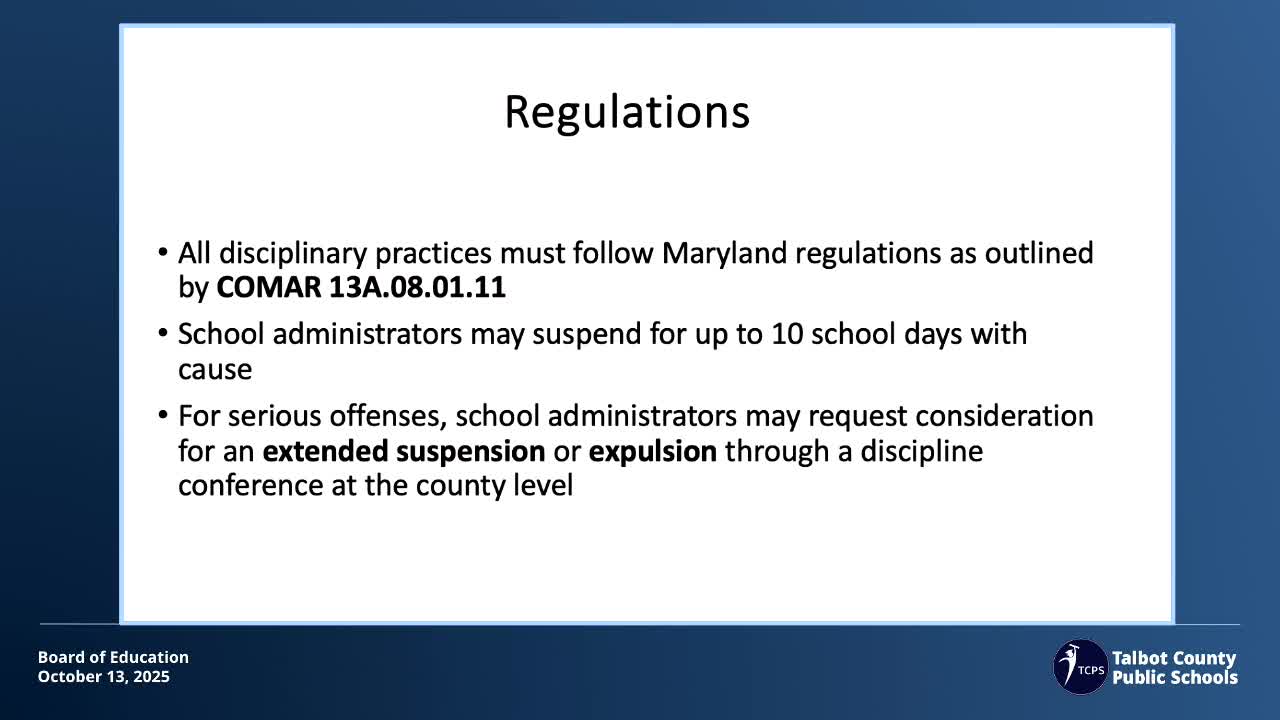
Darlene Spurrier, the district official who led the briefing, opened with the state regulation that governs discipline. "In the state of Maryland, basically, school administrators can suspend for up to 10 days with cause," she said, and described the higher standards required for extended suspension and expulsion. "Imminent threat of serious harm is a very high standard," Spurrier said, adding that expulsions are limited to cases in which a student would pose such a forward-looking threat if returned to school.
Spurrier walked board members through the district's reporting categories and recent data. She said the district reports out-of-school suspensions and that year to date the system had recorded 46 out-of-school suspensions and zero expulsions. Arrests on school property, typically handled by the school resource officer, have declined; Stall-on-campus arrests were two year-to-date. She explained the separate category of "reportable offenses," which are offenses committed off school property that the district can consider in school discipline decisions; reportable offenses are limited to a list of statutory offenses and must be evaluated to determine whether they create an imminent threat to the school community.
The presentation emphasized the difference between forced disciplinary removals and voluntary alternative placements. Spurrier said any removal of a student from the regular program for behavioral reasons is subject to COMAR rules and, when imposed without parental consent, constitutes disciplinary action with defined time limits (short-term: 1'3 days; long-term: 4'10 days; extended: 11'44 days; expulsions: 45+ days). By contrast, ALA 1 (school-based alternative placements) and ALA 2 (the district-level program at TCEC) operate with parental consent and are intended as rehabilitative, instructional settings that allow the district to provide instruction while addressing behaviors.
Spurrier described the district's in-school intervention rooms and alternative placements. "Checkmate In" rooms operate at Easton Elementary, Easton Middle and Easton High; ALA 1 programs are co-located at the same schools where possible and require parental consent and team approval. ALA 2 is based at the district center (TCEC) and has certified teachers and an instructional assistant. Students may move between those settings as data and behavior indicate; the district may offer ALA 2 in lieu of an extended suspension so students remain engaged in instruction instead of sitting at home.
Board members asked about disproportionality and data analysis. Spurrier said the state monitors discipline disproportionality for racial subgroups and special education; the district is returning to state measurement after a COVID hiatus and will be held harmless this year but will be monitored going forward. "When we look at disproportionality, it's not about not suspending students because they belong to a certain subgroup," Spurrier said. "It's really about if you've got students who are committing the same offenses, are you treating them the same way?" She said the district reviews discipline and referral data monthly and conducts semester-level drills to identify tiered needs for MTSS (multi-tiered system of supports).
Spurrier also reviewed tier definitions: tier 1 (universal supports), tier 2 (targeted interventions), and tier 3 (intensive, usually 1'5% of students). She presented tiered counts and said the high school had five students meeting a higher-threshold criterion for tier 3 (three or more out-of-school suspensions) year to date; raising the threshold to two or more suspensions would increase that count to seven. She said, last year, 20 students across middle and high school were in ALA programs at some point, and currently four special-education nonpublic placements were active.
Other topics included bullying reporting, social-media-related incidents, and tardiness. Spurrier encouraged reporting and said the district prefers that families and students file reports rather than leave incidents unreported: "We don't ever want a student sitting in silence," she said. The board discussed spikes in classroom tardiness at Easton High (one snapshot showed 25% of students tardy to school) and the limits on suspensions for attendance-only problems.
On staffing and program improvements, staff suggested possible enhancements: a dedicated transition specialist to follow students through alternative placements; certified teachers assigned to intervention rooms; and revamping MTSS through a contracted consultant to create more consistent tiered interventions across schools. Spurrier said the district had previously used an AWARE grant to fund a behavior intervention specialist and that the grant had expired.
No formal board action was taken; staff said they will return with more detailed semester data, proposed staffing or program options, and recommended steps to reduce classroom disruption while preserving students' access to instruction.