Get Full Government Meeting Transcripts, Videos, & Alerts Forever!
Get email alerts on the Municipal Budget topic
No spam. Unsubscribe anytime.
Denison reviews FY26 budget options, considers 1¢–6¢ property tax increases to cover shortfalls
Summary
Denison City Council met for a budget workshop to review preliminary Fiscal Year 2026 financial projections and options to raise the city property tax rate between 1¢ and 6¢ to cover operating shortfalls, support street and park maintenance, and address rising utility and equipment costs.
Denison City Council met for a budget workshop to review preliminary Fiscal Year 2026 financial projections and options to raise the city property tax rate between 1¢ and 6¢ to cover operating shortfalls, support street and park maintenance, and address rising utility and equipment costs. Staff noted the preliminary general fund reserve would fall below the council’s target for FY26 and outlined which services each incremental penny would support.
Laurie, staff member and budget presenter, said the general fund is projected to end FY25 with about 61 days of reserve and if current projections hold the preliminary FY26 budget would end with roughly 56 days—below the city’s reserve requirement. “We are looking at ending with 56 days of reserve, which is below our reserve requirements,” Laurie said, adding that the presentation also shows transfers into the general fund and items that remain unfunded.
The nut graf: The council spent the workshop asking staff questions about how specific revenue and transfer sources would be applied and how much each additional penny would generate. Staff emphasized that the council must decide a final rate before budget adoption in mid-September, but that an interim change may be legally possible between the council’s September 2 meeting and the Sept. 15 adoption date.
Most important items and projected costs
Laurie outlined key cost pressures the budget must absorb. Major drivers include a required local match for a SAFER grant that will fund 21 new firefighters and will require “almost $500,000” of local match, large increases in auto and heavy equipment maintenance (budgeted at $392,000 but estimated to reach $960,000), and a projected increase in retirement/TERS contributions of about $424,000 for FY26. Laurie also singled out rising electricity and chemical supply costs for the utility fund and growing debt-service payments tied to recent capital issuances.
Staff said several large, one-time or dedicated transfers will affect the general fund. The CIP-funded radio core project will require roughly $470,000 to be transferred into the general fund this year to pay for radio-system channels needed for emergency response. The city also plans transfers from the hotel occupancy tax (HOT) fund—about $750,000—to support the tourism division, and an approximately $290,000 annual aquatic transfer from the parks fund to cover pool operating losses.
What each penny would buy
Laurie presented a chart showing incremental uses for each penny increase. Staff estimated a single penny yields about $261,000 in new revenue (based on the city’s taxable base). A 2¢ increase would fund additional street work; 3¢ would add gateway corridor improvements and a Main Street maintenance worker; 4¢ would support an IT technician and a communications/media coordinator; 5¢ would add part-time mowing/maintenance and other parks needs; and 6¢ would add communication specialists and two additional dispatchers, among other items. Laurie said the average homeowner currently pays about $1,529 in city property tax; one penny would cost that average homeowner about $21 a year (about $1.79 per month).
Council questions and staff clarifications
Councilmembers asked for details about mowing and park maintenance costs, including the need for a second mowing crew, equipment replacement (commercial mowers and maintenance cycles), and whether some projects could be done in-house with recently purchased equipment such as an asphalt zipper. Laurie said mower replacement on a scheduled rotation can be less costly than ongoing repairs and that a rotating replacement cycle could be about $40,000 in the year it turns over.
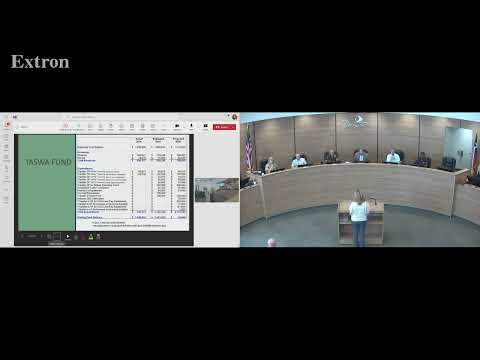
On revenue sources, staff noted the FY26 budget relies more heavily on TASWA funds and transfers to cover COLA and market adjustments for employees because the general fund alone cannot absorb those increases. Laurie said some line items shown in the presentation included offsets (for example, certain enterprise program costs have auction revenue offsets) and apologized for two figures that should be disregarded as presented; she said she would follow up with corrected detail.
Timing and process
Bobby, staff member facilitating the meeting, and Laurie both told the council no decision was required at the workshop and that the council had until Sept. 2 to provide guidance so staff could finalize materials before the formal budget adoption on Sept. 15. Laurie said she would verify whether the council could legally change a proposed rate between Sept. 2 and the Sept. 15 adoption meeting; staff were also asked to provide the same budget information in formats preferred by individual councilmembers.
What was not decided
The council did not take action or vote on any rate at this workshop. Several councilmembers said repeatedly that raising taxes again after recent increases would be difficult politically and for residents. Council discussion noted uncertainty in property valuations and the local tax base, and the possibility that some capital projects or utility-rate changes could be needed to reduce reliance on property taxes.
Next steps
Staff will return with clarifications on several line items, confirm the legal mechanics for changing a proposed tax rate between the Sept. 2 guidance meeting and the Sept. 15 adoption meeting, and provide supplemental breakdowns on transfers and offsets. Councilmembers were asked to provide preferences to staff by email or at the Sept. 2 meeting so staff can present a final recommended rate for adoption on Sept. 15.
Ending
No votes or formal directives were recorded during the workshop. The council adjourned after a brief closing and prayer; staff and council will reconvene in early September for final direction ahead of the Sept. 15 budget adoption meeting.