Get Full Government Meeting Transcripts, Videos, & Alerts Forever!
Get email alerts on the Social Services Zoning topic
No spam. Unsubscribe anytime.
Titusville council directs staff to draft zoning language for food pantries after providers and churches weigh in
Summary
Council directed staff to rewrite a draft ordinance so food pantries are permitted in appropriate zoning districts without unintentionally barring church‑run operations.
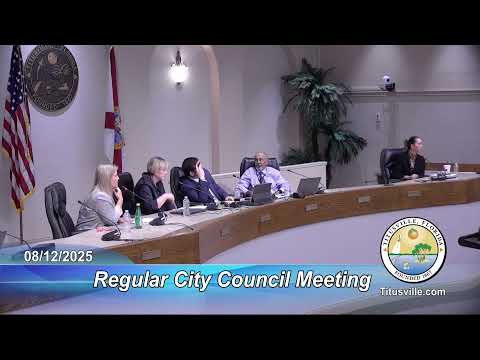
Titusville councilors on Aug. 12 directed staff to return with a revised ordinance that would clarify how food pantries are permitted in local zoning districts while avoiding unintended restrictions on church‑run pantry operations.
Why the issue came up
Council asked staff in June to research zoning barriers after at least one church was told it could not relocate its pantry to a nearby commercial unit. City staff found there is not a single consistent way food pantries have been permitted over the years: some operate as accessory uses of churches, others as conditional or retail‑like uses, and some have operated in mixed commercial districts.
Staff recommendation and council response
Community development staff presented a first draft that would add the term “food pantry” to the existing definition of “community service” so pantries would be permitted in zones where community service uses already are allowed. The draft also contained specific conditions for downtown mixed‑use (DMU) areas; staff said that narrow, DMU‑only approach was intended to limit new conditions that could make existing pantries nonconforming.
Religious‑based providers and hunger‑relief organizations said the city’s earlier draft raised practical and legal concerns. Wayne Cook, pastor at First United Methodist Church, told council that food pantries differ from soup kitchens and that many pantries operate from churches in residential areas; he warned that overly broad distance or hour restrictions could, in practice, bar longstanding church pantries. Stephanie Palacios, director of government relations for Second Harvest Food Bank of Central Florida, said 11 pantries in Titusville rely on the food bank and together distributed more than half a million meals to residents last year; she offered Second Harvest as a partner in designing workable rules.
Council direction
Council members and staff agreed not to impose extensive, prescriptive conditions that would create barriers. Members Stoeckle and Moscoso and Vice Mayor Cole all urged a light regulatory touch and recommended that the simplest, quicker fix would be to capture food pantries within the existing “community service” use and to treat downtown projects consistently with community commercial standards. Council asked staff to consult providers (including Second Harvest and local churches), to avoid creating new nonconforming uses, and to return with a revised draft before advertising for public hearing.
Ending
Staff said it will meet with providers to refine the draft ordinance and return the revised language to council for review before formal advertisement. Council did not adopt an ordinance on Aug. 12; instead it gave staff direction to proceed with stakeholder outreach and code changes intended to preserve current pantry operations while enabling relocations into commercial spaces when appropriate.