
Lowell subcommittees refer Markley Group’s request for nearly 97,000 gallons of additional diesel storage to full council for public hearing
Get AI-powered insights, summaries, and transcripts
Subscribe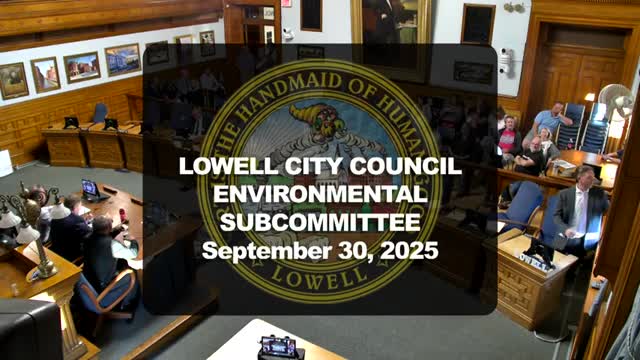
Summary
Attorney William Martin, representing the Markley Group, presented a request to add roughly 96,700 gallons of emergency diesel storage to support backup generators at the Markley data center; after extensive public comment the joint Environmental/Flood Issues and Neighborhood subcommittees voted to refer the petition to the full City Council for a public hearing.
Attorney William Martin, representing the Markley Group, presented a request to the joint Environmental and Flood Issues Subcommittee and the Neighborhood Subcommittee to add emergency diesel storage to support additional backup generators at the Markley data center in Lowell. The petition would add 14 tanks of 6,000 gallons and two tanks of 6,350 gallons, stated in the presentation as a total additional storage of about 96,700 gallons.
The petition drew lengthy public comment from neighborhood residents and environmental advocacy groups who urged the city to deny any expansion of diesel storage and to require a community benefits agreement before approving further permits. Residents cited concerns about respiratory health, noise, stormwater impacts and transparency. Several speakers asked for independent air-monitoring, regular public reporting of generator runs and limits on future expansion.
Why it matters: The Markley site sits in a dense, residential area near schools and parks. Neighbors and some councilors said the cumulative local impacts of noise, dust, drainage and stored fuel warrant a public hearing and deeper community engagement before the council considers permitting additional fuel storage.
Key points from the presentation and agency staff - Attorney William Martin and Markley consultants said the facility is primarily electrically powered and that diesel is maintained only for emergency backup. Martin said testing occurs “five minutes a week and then there’s a two-hour test annually.” - Aaron Fernandez, director of design for Markley, said the company sizes on-site fuel to hold 24 hours of fuel for each engine and explained alternatives such as hydrotreated vegetable oil and natural-gas infrastructure were not yet feasible in the local market or would require more complex on-site storage. - VHB consultants (Heidi Richards, Tom Brooks, Vince Tino, Bill Taber) described noise mitigation (acoustic enclosures, silencers, sound walls, $15 million in mitigation investments cited) and said MassDEP and local permits for air emissions and noise remain in force. Vince Tino said MassDEP plan approvals require adherence to operational limits and that the most recent permit reduced non-emergency hours from 100 to 70 per year per generator. - Bill Taber described tank construction: UL‑142 listed steel tanks, concrete pads, steel dikes sized to 110% secondary containment, leak and level alarms tied into building management systems and overfill protection. - Steve Samba of Sanborn Head and Associates provided a preliminary health-risk summary based on the VHB modeling and said modeled concentrations “are below the screening criteria” and he did not expect the predicted emissions to contribute to increased community health risk as modeled.
Public concerns and requests Residents and community organizations asked the committees to: withhold any new approvals until a binding community benefits agreement is negotiated; require independent air-quality monitoring and public reporting of generator use and emissions; ensure dust control and removal of an on-site dirt pile; fix permanent fencing and drainage problems affecting adjacent streets; and require clearer, timely advance notice of testing or maintenance that will produce noise or emissions.
City staff responses and next steps - Catherine Moses, City sustainability director, said the city has met twice with Markley and stressed that while conversations have begun, “greater transparency” and a time‑bound transition plan away from fossil-fuel backup would be needed. She said she had not been notified in advance of the present expanded storage request appearing on the council agenda. - Fire Department staff (Chief of Fire Prevention Jason Carverill) said certain generators were allowed initial test fuel amounts (the chief noted four generators were permitted test fuel of 1,500 gallons each for initial testing). The department described an emergency response plan coordinated with Markley and said the tanks have statutory containment measures. - Aaron Fox, executive director of water and wastewater, said the city has met with Markley about a drainage issue on Bourne/Andrew Street; utility engineers determined Markley’s private drainage system lacked capacity for the city’s proposed discharge, and the city is pursuing infiltration/green-infrastructure solutions.
Formal action Councilor Guccia (chair of the Neighborhood Subcommittee) moved to refer the petition to the full City Council for a public hearing at the earliest possible date; Councilor Robinson seconded. The subcommittees approved the referral by roll call (affirmative responses recorded from Councilor Belanger, Councilor Robinson, Councilor Yam, Councilor Gaetje, Councilor Balanja and Councilor Genes). The motion passed and the item will be scheduled for a public hearing before the full council.
Context and background Markley acquired the former Prince Macaroni site in 2015 and, according to the presentation, has invested more than $350 million on the property and paid more than $3 million in permit and inspection fees. The site has previously received planning-board approvals, stormwater permits, conservation-commission reviews, and multiple MassDEP air permits for the generators. Presenters said earlier planning-board documents showed up to 31 generators as a potential layout; the current applications, the presenters said, would bring the site to about that scale as customer demand grows.
What remains unresolved Residents asked for independent monitoring, a binding community benefits agreement, clearer public reporting on generator hours and fuel usage, and completed on-site mitigation (permanent noise attenuation equipment and remediation of the dirt pile and fence) before the city approves any more diesel storage. City staff agreed to gather and provide some documentation for the public hearing (including existing DEP reporting on generator run hours and emissions) and to continue meetings between city sustainability staff and Markley.
The referral means the council will hold a full public hearing before taking any vote on the permit. The subcommittees did not vote to approve the fuel-storage permit at tonight’s meeting; they referred the matter to the full City Council for hearing and further consideration.