Get Full Government Meeting Transcripts, Videos, & Alerts Forever!
Get email alerts on the Right Of Way Vacation topic
No spam. Unsubscribe anytime.
Titusville planners deny request to vacate portion of Orange Street right of way
Summary
The Planning and Zoning Commission unanimously recommended denial of a request to vacate about 12,610 square feet of Orange Street right of way after staff found the vacation inconsistent with the city comprehensive plan and commissioners raised unresolved title, access and maintenance questions.
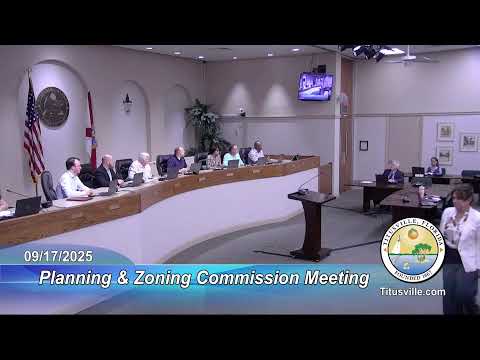
The Titusville Planning and Zoning Commission on Sept. 17 voted unanimously to recommend denial of a petition to vacate a 50-by-252-foot portion of Orange Street between South Brown Street and South De Leon Avenue.
Staff recommended denial, citing a finding that "the proposed vacation is inconsistent with the comprehensive plan, specifically transportation element policy 1.6.0.2," which requires that vacating right of way not prevent reasonable connections for existing and future pedestrian and vehicle circulation. Christy Anderson, senior planner, told the commission the section provides a pedestrian connection to the Florida Coast-to-Coast Trail and serves existing driveways that must be maintained.
Why it matters: commissioners and members of the public pressed for clarity on who would receive ownership if the public right of way were vacated, what existing easements cover utility and drainage needs, and how maintenance and public access would be guaranteed if the city relinquished responsibility. Those unresolved questions — together with staff’s consistency determination — prompted the commission to recommend denial and send the item to city council on Sept. 23.
During the public hearing, Bruce Moya of MBV Engineering, representing the applicant, said the requested vacation largely formalizes the way the area is currently used and that the applicant would record utility and access easements so the public could continue to traverse the corridor. "It would relieve the city of the obligation to maintain this," Moya said, adding the owner intends to grant the city easements for utilities and access and to maintain the present ability of people to get to properties that currently rely on the paved surface.
Residents and commissioners pressed for documentary evidence that an adjacent property owner supports transferring the vacated land to the applicant. Michael Gross, who identified himself as the property owner of several lots in the area, told the commission the parcels were "all one originally" and said the ownership history is complex. Commissioner Emma Grodd and others noted past vacates (resolutions dating to 1974 and 1988 were discussed in staff materials) and urged staff and the applicant to verify which plats originally dedicated the right of way before any transfer of title.
The commission discussion repeatedly returned to maintenance and enforceability of easements. The city attorney and commissioners emphasized that even if an applicant records an irrevocable public access easement, long-term upkeep and enforceability — and who would sign maintenance obligations — must be documented and recorded to avoid future access problems. Staff said past vacations had included drainage and utility easements and that further title research and documentation could be supplied to city council.
The formal motion before the commission was to follow staff's recommendation and deny the vacation request; the motion was made by Member Grama and seconded by another commissioner. The roll call vote recorded unanimous support for denial; the denial was forwarded to city council, which is scheduled to consider the matter on Sept. 23.
Clarifying details recorded in the hearing: the parcel under consideration contains approximately 12,610 square feet; the right of way segment measures roughly 50 feet by 252 feet. Staff noted the portion of Orange Street in question includes an existing sidewalk network and provides direct access to the Florida Coast-to-Coast Trail. Records presented at the hearing referenced Resolution 56-1974 and Resolution 53-1988 and an ordinance adopted in 2014 (Ordinance 49-2014) that added review criteria for vacation requests.
Looking ahead: commissioners suggested the applicant and staff confirm plat history, the exact scope of any existing easements and obtain documentary confirmation from adjacent property owners if a subsequent title allocation is intended. The commission's denial means the application will be forwarded to city council with the commission's recommendation to deny, along with the record compiled at the public hearing.