
Dublin City Schools: statewide report card strong overall, early‑literacy rating dips after assessment change
Get AI-powered insights, summaries, and transcripts
Subscribe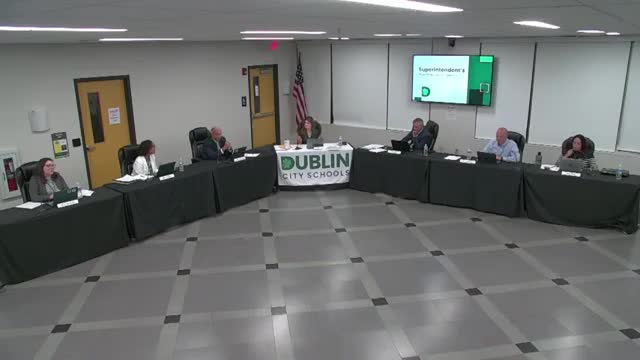
Summary
District officials told the board Dublin earned roughly "four and a half stars" overall and an achievement index of 97.6, with 78.7% of students at or above proficiency; early‑literacy fell from four to three stars after the district switched its reporting assessment from NWEA MAP to DIBELS.
At the board meeting, the district’s academics team briefed members on the recently released Ohio state report card, describing Dublin City Schools’ overall performance as strong while noting a decline in the early‑literacy component after a planned assessment change.
Department of Academics representative Missus Marple said the district’s overall rating was "four and a half stars," with a district performance index of 97.6 and 78.7% of students at or above proficiency in the achievement measure. She cautioned that the state report card is a single snapshot built from multiple data sources and that some measures reflect multi‑year cohorts.
Why it matters: The state report card is one indicator the district uses to inform instruction, resource allocation and intervention. The early‑literacy decline was expected by district staff because the district changed its reporting tool for early reading assessments.
Marple said the district deliberately switched its early‑literacy reporting assessment from the NWEA MAP to DIBELS (the district referred to it as DIBELS/MCAS in discussion) to better measure foundational reading skills. That change contributed to a drop from four stars to three stars in the early‑literacy component; the district had modeled and anticipated a decline when it made the change. "We actually anticipated a bigger dip, so it's good news that it only dipped to three stars," Marple said, adding that the district expects the new assessment to provide better data for instruction going forward.
Marple outlined how the report card measures several areas: achievement (focused on math and English language arts), progress (growth measured over three years), gap‑closing for student subgroups, graduation rates (reflecting the class of 2024 for this release), and a new postsecondary readiness component that combines college, career, workforce and military readiness. She said the district is continuing to collect graduate data and that the college/career measure should improve as data collection matures.
Board members praised teachers and staff for the results. One board member thanked Marple and her team and asked the board to convey appreciation to classroom teachers, noting that gap‑closing work was strong.
What’s next: The academics team said it will continue to use multiple data sources (including MAP growth assessments) to inform instruction and interventions, and that the district expects the class of 2025 metrics to further inform postsecondary readiness measures in future report cards.