Get Full Government Meeting Transcripts, Videos, & Alerts Forever!
Get email alerts on the Tourism topic
No spam. Unsubscribe anytime.
Clackamas County tourism office outlines funding, data and marketing programs for Mount Hood region
Summary
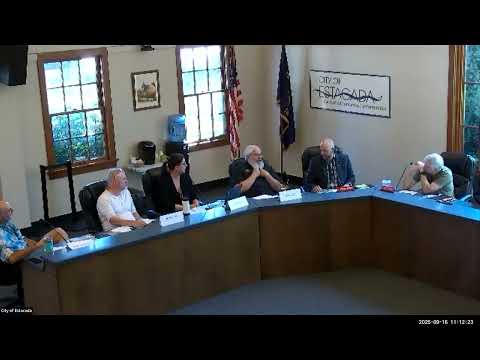
At an Estacada Economic Development Commission meeting, Jim Austin of the Clackamas County Office of Tourism described how the county's transient lodging tax funds marketing, grants and data-driven visitor management in the Mount Hood Gorge region and offered to return with updated data.
Jim Austin, community relations and development lead for the Clackamas County Office of Tourism, told the Estacada Economic Development Commission that the office’s work is funded entirely by the county transient lodging tax and that the department runs both marketing and destination-development programs for the Mount Hood Gorge region.
"One hundred percent of our funding comes from the county's 6% transient lodging tax," Austin said, summarizing the program's revenue source and the funding flows that support visitor marketing and development grants.
Austin said the tax is collected under Clackamas County Ordinance 8.02, approved by a countywide vote in June 1992, and described how the ordinance distributes receipts: a portion retained by lodging operators for collection costs, 2% for county administration, a fixed annual amount to the county fair and the remainder to a tourism development fund administered by the county. The fund finances marketing, partner training, event sponsorships and a Strategic Investment Program (SIP) for projects such as small trailheads, ADA docks and other visitor infrastructure.
Why it matters: the county office uses those earmarked funds for marketing and targeted development intended to increase visitor spending while trying to manage crowding at sensitive sites. Austin said the office uses a mix of cooperative advertising, travel-writer and influencer visits, and paid promotions, and it supports local partners with trainings, familiarization (FAM) tours and event sponsorships.
Austin described the county’s Tourism Development Council (TDC), a nine-member advisory group appointed by the Board of County Commissioners that helps set priorities. He named several current TDC members and their business affiliations and said the TDC operates under an MOU with the county.
On data and visitor management, Austin said the office uses commercial mobility and vacation-rental data products — he mentioned Datify (sometimes referenced as DataFi), Placer.ai, AirDNA and a new aggregation tool, Symphony — to observe visitor flows, geofenced point-of-interest visits and lodging trends. He cautioned that these datasets rely on samples and opt-ins and that comparison across providers is necessary: "we look at both and say the truth probably lies in the middle," he said.
Austin also explained the legal and operational distinction between residents, local day users (often called “floaters” in the meeting), and visitors as used for tracking and grant eligibility. He said state law and the county’s approach effectively define lodging-based visitors as those staying fewer than 30 nights and, for some analytics, as travelers coming from more than 50 miles away.
On grants and investments, Austin said the department will open another cycle of the Strategic Investment Program with about $500,000 available for projects that create or improve visitor assets. He cited past SIP projects (schoolhouse roof repairs, campground reopenings) and described a recent partnership that helped leverage U.S. Forest Service funding to reopen local campgrounds after wildfire closures.
Commissioners and staff asked for follow-up material. Austin agreed to return in several months with updated year-end metrics and visitor-profile data if the commission wanted a deeper dive.
Ending: The commission thanked Austin and discussed next steps for local tourism planning, including additional data requests and coordination on potential grant applications.