Get Full Government Meeting Transcripts, Videos, & Alerts Forever!
Get email alerts on the Wireless Infrastructure 2317 Maple topic
No spam. Unsubscribe anytime.
Planning commission recommends denial of new Verizon tower proposal after neighbors object to proximity
Summary
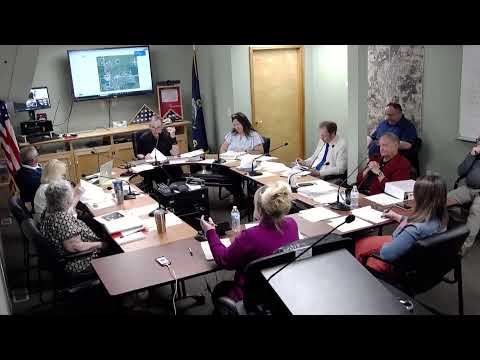
The Fort Scott Planning Commission voted 4–1 to recommend denial of a Verizon request to place a 184-foot wireless tower on the Judy property at 2317 Maple Road (Case No. 1049).
The Fort Scott Planning Commission voted 4–1 to recommend denial of a conditional-use application by Verizon to place a 184-foot communication tower on the Judy property at 2317 Maple Road (Case No. 1049).
Curtis Holland, attorney for Verizon, told the commission the company had moved the proposed location to the northwest corner of the Judy parcel after the prior application was denied. "We moved it as far north from the Merriman property as possible," Holland said, and staff confirmed the new site sits roughly 286 feet from the Merriman property and would therefore clear the city’s stated setback requirement (tower height plus 50 feet would be 234 feet). Holland also described other site distances: roughly 53 feet from the north property line and about 73 feet from the westerly property line, and he said the new location is more heavily treed and better screened.
Residents and nearby property owners continued to object to the proposal. Mike Rogers, who owns adjacent rental property, said he had invested in the nearby house and plans to develop land north of his parcel; he told the commission that the proposed tower footprint would be too close to his property and could limit future development. "If the cell phone tower were to fall or something happened to it, it could fall on a future [structure]," Rogers said—an expressed concern that staff and the applicant described on the record as a perception rather than an engineering reality: staff noted such towers are engineered to current standards and do not typically fall onto neighboring properties.
Another resident, Nick Johnson, and community members represented by Matt Witt reiterated that written objections filed earlier still stood against the proposal. Several speakers said the application would provide network coverage for the broader community, but neighbors said the burden of siting should not fall on a residential area. Commissioner discussion touched on whether placement in a different part of the Judy parcel (for example, a northeast corner) would reduce visibility for some neighbors but could increase visibility for others; Verizon said alternative locations either reduced coverage or placed the tower closer to other homes.
The commission considered federal and state legal limits on what local governments may consider when weighing wireless facility siting, including that purely aesthetic or speculative engineering arguments carry limited weight. The applicant said Verizon’s federal license and engineering needs drove siting choices and that the company had sought to reduce impacts by moving the facility nearer treed property lines.
After discussion the commission approved a motion to deny the conditional use permit. The final roll call count was 4 in favor of denial and 1 opposed (Chair Mark McCoy cast the sole "no" vote). The Planning Commission’s recommendation will be forwarded to the Fort Scott City Commission, which has final authority over land use approvals within the city’s extraterritorial jurisdiction.