Get Full Government Meeting Transcripts, Videos, & Alerts Forever!
Get email alerts on the Public Safety Building topic
No spam. Unsubscribe anytime.
La Marque committee reviews new public safety building options, jail capacity and bonding scenarios
Summary
City of La Marque public-safety committee heard cost estimates for replacing the police station and detention space, discussed retrofit vs. new construction and modular options, and received bond-capacity scenarios from the city's financial advisor; no formal vote was taken.
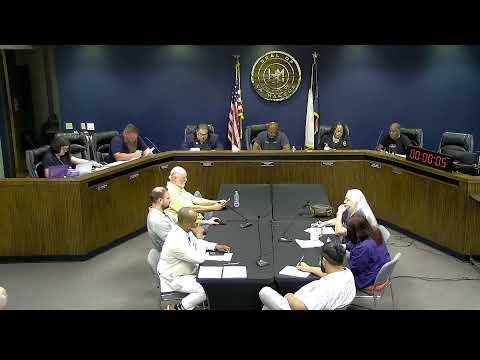
The City of La Marque Public Safety Committee on Monday heard presentations on options and financing for a new public safety facility and replacement detention space, including preliminary cost estimates, modular construction options and bond-capacity scenarios, but took no formal votes.
The committee heard from the project architect, Mr. Long (presenter), who gave a broad order-of-magnitude cost estimate and described how a replacement would meet current detention standards, and from Brad Angst of Stifel Public Finance, who reviewed multiple bond-financing scenarios and the projected tax impact for homeowners.
Mr. Long, the project's architect (presenter), said the team used $650 per square foot for “hard cost” assumptions and estimated “about $20,000,000 give or take, order of magnitude cost” for new construction while stressing that the figure contains many unknowns and is “by no means the final number.” He cautioned the committee against treating the number as fixed: “This is a very broad stroke…there's lots of unknowns in this. This is by no means the final number,” he said.
On detention capacity, Mr. Long said the project would replace the city’s existing beds “in kind, but at the current standard,” and listed program elements that would be included under modern standards—single cells rather than bunk beds, booking areas, a padded cell, ADA-compliant cell, separate men’s and women’s spaces, showers and a detox area with a decontamination shower. Regarding the existing inventory he said, “I want to say it's 6, 6 men and 4 women is what you have for a total of 20 beds,” a formulation that contains inconsistent figures and that the committee requested staff to clarify with records and a structural analysis.
Committee members and police staff pressed on operational need and cost tradeoffs. Sergeant Cantu and Chief Smith discussed daily jail counts and how facility standards affect the ability to detain people locally; Chief Smith said county jail populations have decreased in recent years, while committee members said ensuring adequate detention capacity affects community safety and the city’s ability to process arrestees locally. Council members and staff raised concerns about rising construction costs, steel and labor availability, and a compressed schedule if the city seeks a November ballot placement.
Several members and the architect discussed rehabilitation of the existing building versus full replacement. Mr. Long said retrofit rarely pays off for buildings of this age and condition except in unusual cases (for example, fixed infrastructure like rail lines or immovable stadiums). He described a range of alternate delivery methods—pre‑engineered/modular buildings, prefabricated modules and emerging 3‑D printing techniques—and said some jurisdictions have used modular solutions successfully for rapid, lower‑cost delivery. The committee discussed local examples cited during the meeting (University of Houston–Clear Lake, Waller County) and asked staff to gather more detailed proposals and vendor contacts.
Brad Angst, the city’s financial and bond advisor with Stifel Public Finance, presented bond-capacity scenarios spread over a five‑year issuance window and explained the tax-rate impacts the committee would face under different choices. Angst said holding the current tax rate steady would support approximately $17,500,000 in borrowing capacity over five years; a 1‑cent increase in the tax rate would support about $23,000,000, a 3‑cent increase about $31,000,000, and a 5‑cent increase about $39,000,000. He offered an illustrative taxpayer impact for the 1‑cent scenario: “a 1¢ increase annually equates to about $15 a year for a $150,000 home.” Angst also noted the city’s preliminary assessed valuation from the Galveston County appraisal district showed modest change and that bond issuance can be staged over several years if voters approve a proposition.
Committee members and staff identified next steps rather than taking formal action: collect precise structural and geotechnical analyses for candidate sites; obtain refined cost estimates from multiple delivery methods (traditional design‑bid‑build, modular/prefab, and other alternatives); have the city finance officer (Seifert) and Stifel refine financing scenarios; and assemble vendor information that Mr. Long and other members said they would provide to staff. Multiple participants emphasized the goal of having a proposition available for a November ballot (committee discussion referenced “November ’26” as the intended target), while acknowledging the planning, design and construction timeline typically spans two to three years after an election.
The session closed with no vote. Committee members asked staff to return with clarified jail‑bed counts, a more detailed cost breakdown (hard costs, soft costs and site work), and formal proposals for modular/prefab vendors and financing scenarios at a future meeting so council and the public can review a final recommendation before any ballot decision.