
Estacada council moves to tighten odor rules, make processing conditional and refer production ban to voters
Get AI-powered insights, summaries, and transcripts
Subscribe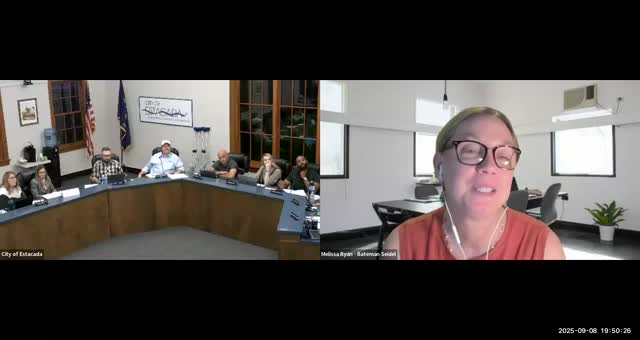
Summary
Estacada ' The City Council voted to direct staff to draft three ordinances addressing odor and land-use concerns tied to cannabis operations: odor-control code amendments, a zoning change making processing a conditional use, and a production ban to be referred to voters.
Estacada — The City Council voted to direct staff to pursue three parallel steps to address ongoing complaints about odor and other impacts from cannabis operations in the city's industrial area: (1) draft code amendments to increase odor control requirements and inspections and to update cannabis definitions; (2) prepare a text amendment that would reclassify cannabis processing as a conditional use in the industrial zone; and (3) prepare ballot measure language for a prohibition on new cannabis production, to be referred to voters at the next statewide general election with a delayed effective date tied to license-renewal timing.
Council took the actions after a public hearing that included staff, attorneys, business owners and residents discussing odor, enforcement and state licensing rules. The city's interim legal team and staff emphasized uncertainty about how the Oregon Liquor and Cannabis Commission (OLCC) would treat renewals if the city adopted a ban.
Why it matters: Councilors said they wanted to show progress on recurring odor and compatibility complaints while preserving options for existing businesses and giving voters the final decision on whether new marijuana production should be allowed in Estacada's industrial park.
Council directed staff first to draft code changes focused on odor control and definitions so those rules can be put in place quickly. Separately, council asked staff to prepare a zoning text amendment that would require processing operations to obtain conditional-use approval going forward. Finally, the council directed staff to draft an ordinance banning new cannabis production and to refer that ordinance to the next statewide general election; council members asked that the ordinance include a delayed effective date so it would not unexpectedly interrupt current license renewal cycles.
During the hearing staff referenced an email from an OLCC senior policy analyst (Amanda Borop) describing how the agency might approach renewals, but city attorneys told council that the agency's informal view is not the same as a binding legal interpretation. Interim City Attorney Melissa Ryan said the city should understand that relying on an informal agency view carries legal risk: "The policy analyst did say that this situation where a city has previously allowed marijuana businesses and then adopted a ban has happened only a handful of times in the state, so no one is sure how it works." Council members requested follow-up with OLCC and a more formal clarification if possible.
Council also recorded the number of existing cannabis license holders in the city as eight; councilors discussed the risk that a sudden prohibition could push existing processors out of business if state licensing rules prevent renewals after a ban takes effect. To reduce that risk while preserving the citizen vote, councilors supported the conditional-use path and a ballot referral with a delayed effective date aligned to license-renewal timing.
Actions at the meeting: the council approved three separate motions directing staff to (1) draft code amendments on odor control and definitions, (2) prepare a zoning text amendment reclassifying cannabis processing as a conditional use, and (3) draft an ordinance banning new cannabis production and refer that ordinance to the next statewide general election with an effective date timed to after current license-renewal deadlines. All three motions carried on voice votes.
What happens next: Staff and the city attorney will return with draft ordinance and ballot language; council asked for additional follow-up with OLCC about license renewals and requested language that explicitly describes how existing licensees would be treated if voters approve a prohibition. Council scheduled further review and deliberation on Oct. 13.
Ending: Councilors and members of the public said they hoped the combined approach ' tightened rules, conditional permitting, and a voter decision ' would address community concerns without unexpectedly removing protections for businesses that are following the law.