Board member raises alarm about school-insurance deductibles; training changes draw pushback
Loading...
Summary
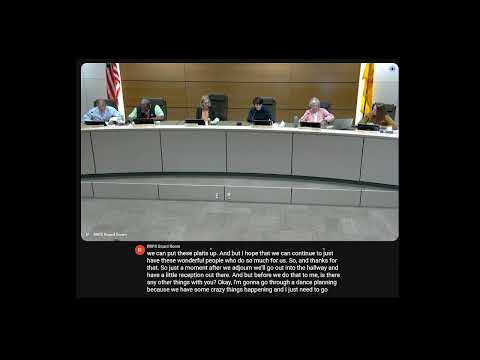
At the Rio Rancho Public Schools Board meeting Oct. 13, Board member Gary Tripp reported on two state-level issues: proposed insurance deductibles for certain child-abuse claims and controversy over Public Education Department approval of alternative school-board training providers.
At the Rio Rancho Public Schools Board meeting Oct. 13, Board member Gary Tripp reported on two state-level issues discussed at a New Mexico School Boards Association meeting: proposed insurance deductibles for certain child-abuse claims and controversy over the Public Education Department permitting alternative providers for mandated school-board training hours.
Tripp summarized debate around a resolution (referred to as resolution 29 at the NMSBA meeting) and said the legislature had provided a special appropriation of $28,900,000 to respond to large claims. He said members at the state meeting discussed new proposals from the public-school insurance authority to assign tiered deductibles — tied to school size — for cases involving sexual or physical abuse claims.
District chief counsel Lauren Hatch told the board the memorandum of coverage (the insurance policy document) has not yet been issued for the year, so the full scope is still unknown. Hatch said the highest deductible tier the district falls into would be $500,000, and that the district may need to maintain or increase reserves to cover such deductibles. “$500,000 is hard to come up with on the spur of the moment,” Hatch said.
Superintendent Bisou Cleveland and other speakers urged distinguishing between districts that follow required hiring and reporting procedures and those that do not. Cleveland said the district promptly reports concerns to law enforcement and the state when they arise and argued for a two-tiered approach: different consequences for willful failure to follow procedures versus situations in which the district had conducted thorough vetting and reporting.
Tripp also reported a separate controversy over training: the Public Education Department recently approved additional companies to provide required school-board training hours, a change some rural board members view as eroding local autonomy and the peer-to-peer interaction that comes from attending NMSBA conferences. Tripp said some colleagues fear that if training revenue declines, the New Mexico School Boards Association could lose advocacy capacity at the Legislature.
Ending: The board recorded the report and discussed monitoring the legislative session. No formal board action was taken at the Oct. 13 meeting on either the deductibles or training approval; counsel and district leadership said they would continue to follow developments and work with state partners as the legislative session approaches.