Fort Wayne controller projects $8.8 million shortfall for 2026 budget as SB 1 and circuit breaker cuts take effect
Loading...
Summary
Controller Pat Roller presented a lean 2026 budget Oct. 7 to the Fort Wayne Common Council committee, citing state estimates tied to Senate Bill 1 and property tax "circuit breaker" caps that produce an $8.8 million gap; officials propose using reserves and cash-funded CIP items while preserving core services and staffing increases.
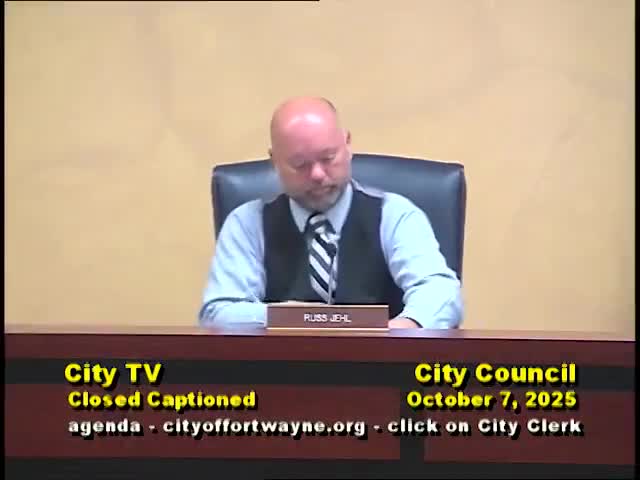
Controller Pat Roller told the Fort Wayne Common Council committee on Oct. 7 that the proposed 2026 city budget faces an $8.8 million shortfall driven largely by state-calculated property-tax reductions and changes under Senate Bill 1.
"It was a privilege to work for Mayor Tucker, and her leadership and decisiveness was critical to putting this budget together," Roller said as he introduced the spending plan, which keeps 2026 expenses at or below approved 2025 levels while preserving planned pay increases and public-safety hiring.
Roller said the Department of Local Government Finance (DLGF) has estimated a 2026 circuit-breaker (property-tax cap) revenue loss of $25,100,000 — up from last year’s estimate of $11,500,000 — and noted the actual 2025 revenue loss exceeded that year’s estimate by $2,100,000. Using the DLGF estimate, Roller said the city would need to borrow or use roughly $8.8 million in cash reserves to balance the budget as presented.
Why it matters: The DLGF estimate and Senate Bill 1 together change how property-tax and income-tax revenues flow to the city, putting near-term pressure on general-fund and other property-tax–supported accounts and forcing officials to weigh one-time cash use against preserving services.
Key numbers and trade-offs - Controller Roller said divisions initially turned in budgets that left a near-$30 million shortfall before the mayor and staff worked to reduce expenses. - The proposed budget preserves a two-tier salary increase: 2.0% for employees earning under $70,000 and 1.5% for those earning over $70,000 (as described by Roller). - Health-insurance per-person funding was increased in the presentation, described as an increase "by $13,500 to $15,000" for per-head and retiree coverage in the fund. - The self-insurance liability fund recommendation from the Sturgio Group increased by $680,000 in the budget. - The plan adds 10 police officers (reflecting an ongoing COPS grant expiration) and said the state raised the PERF contribution for sworn police and firefighters to 23.3% of base pay. - Capital project highlights in the presentation included about $32 million for streets, roads and bridges, roughly $4 million for trails, $5 million for sidewalks and alleys and $4 million for parks projects.
Roller and Mayor Tucker emphasized preserving vital services Roller repeatedly said divisions trimmed spending and identified roughly $10 million in alternative funding sources and another approximately $10 million of nonoperating items that could be appropriated using cash in 2026. He noted several of those cash items are CIP projects and partial lease-payment timings that the administration expects will be managed during the year.
Mayor Merrick Tucker, who joined the session, thanked council members for the review and said the administration is pursuing revenue-replacement options while looking for operational efficiencies.
"We can't cut our way out of this situation, so we have to create opportunities for revenue to come into our city," Mayor Tucker said, adding the administration is examining revenue-generation projects and internal reorganizations to preserve services.
Council questions and process notes Council members pressed Roller on whether the city must adopt the DLGF estimates or could present a budget using alternative assumptions; Roller and other staff said the council may act as it wishes, but the administration used the state estimate to avoid being short if the state's number proves correct. Councilman Hartman asked whether there would be harm in using a more optimistic revenue figure; Roller said relying on a lower DLGF estimate previously produced shortfalls and the city is operating from estimates until final numbers are known in spring 2026.
The committee opened the statutorily required public hearing on the city appropriation ordinance (A250925) — which covers the fiscal year Jan. 1–Dec. 31, 2026 — and closed the hearing after three calls with no members of the public speaking. The committee then moved to hold final passage of the ordinance for one week to allow required updates and formal passage at the next meeting.
What is unresolved Roller and council members acknowledged significant uncertainty: DLGF estimates will not be finalized until spring 2026, state legislative changes may alter future revenue flows, and some cash uses in 2026 are intended as one-time measures the administration hopes to replenish later if state numbers improve.
Next steps The committee held the appropriation ordinance for one week (vote 8–0) to allow the city to prepare revised schedules and return for final passage. Department-level budget hearings and committee reviews will continue in the coming meetings.
Ending: council and administration framed the 2026 budget as a constrained, short-term response to state-driven revenue shifts, while saying they will seek revenue opportunities and careful use of reserves as they work toward a more stable multiyear plan.