
Council committee hears nominations for Boston Arts Commission, discusses public-art priorities
Get AI-powered insights, summaries, and transcripts
Subscribe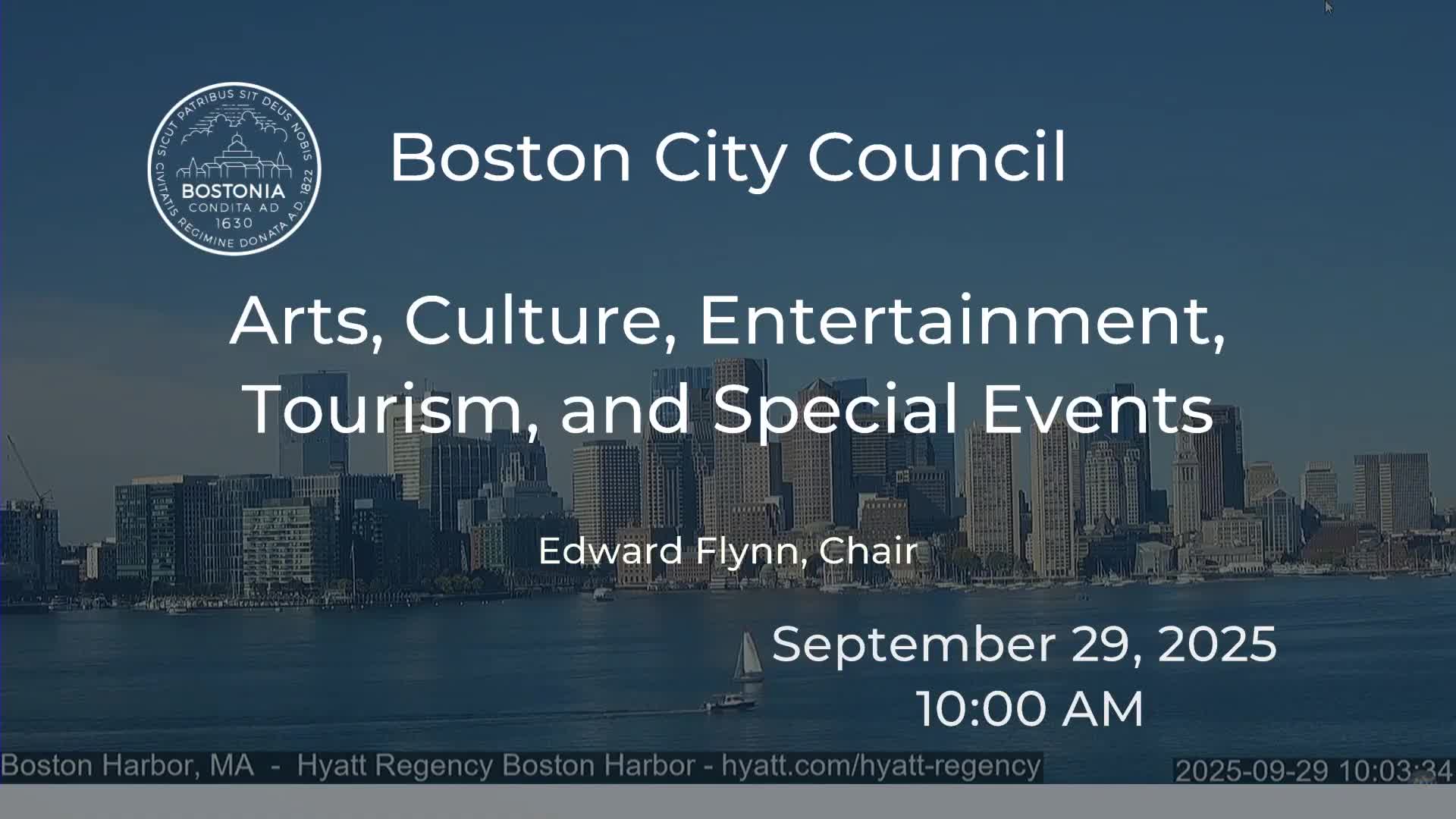
Summary
At a Sept. 29 Boston City Council committee hearing, three mayoral nominees for the Boston Arts Commission described community outreach, signage and anti-vandalism priorities; no confirmation vote was taken at the hearing.
City Councilor Edward F. (Ed) Flynn, chair of the Boston City Council Committee on Arts, Culture, Entertainment, Tourism and Special Events, opened a Sept. 29 hearing on three mayoral nominations to the Boston Arts Commission and said the commission’s work must reflect Boston’s communities. "It's critical that the city of Boston fosters the creation and collection of artwork that reflects the people, ideas, histories, and future of Boston," Flynn said.
The hearing considered the mayor’s messages to confirm Napoleon Jones Henderson, Ian L. Tiver and Caitlin Gould Lowry as commissioners; no confirmation vote was held at the hearing. Flynn said he expects to file a report and bring the nominations to a council vote on Wednesday and said he would recommend unanimous approval.
Why it matters: The committee hearing focused on how the commission will expand public art that is visible in neighborhoods, connect schools and community centers to arts programming, and protect and interpret existing work. Committee members and nominees discussed projects that affect daily public space — murals, painted utility boxes, park installations and museum-led public art — and the practical steps the city is taking to label, conserve and educate about that work.
Nominees’ backgrounds and priorities
Napoleon Jones Henderson, an artist and longtime Boston resident who taught at MassArt, told the committee he has spent most of his career engaging neighborhoods through his studio and public projects and described using his collection and studio as resources for emerging artists. "I have spent the better part of now 51 years here in the city of Boston," Henderson said, explaining his community-based practice and the role open studios play in connecting young people to art.
Caitlin Gould Lowry, director of exhibition planning at the Isabella Stewart Gardner Museum, said she brings logistics and planning experience and emphasized showing up in communities and listening to what residents consider meaningful public art. Ian L. Tiver, who leads contemporary art at the Museum of Fine Arts, Boston, described efforts at the MFA to diversify commissions and make publicly accessible work that meets people in their neighborhoods.
Public-art programs, signage and vandalism
Committee members and nominees discussed existing and recent projects: the Boston Public Art Triennial; the Paintbox program (the painted utility-box program, first funded in 2008); a New Red Order installation in Quincy Market; a Nicholas Galanin piece in Evans Way Park; John Wilson’s sculpture at Roxbury Community College; and Napoleon Jones Henderson’s public work (referred to in the hearing as "Roxbury Rhapsody").
Karen Goodfellow, director in the Mayor’s Office of Arts and Culture working with the Boston Arts Commission, said the commission has recently contracted a consultant to study and develop signage for public artworks and is planning hiring for a staff position focused on two-dimensional work and murals. "We actually just very recently contracted ... for someone to help us develop signage," Goodfellow said, and she noted the project is led by the commission’s public art registrar, Paul Zotov.
Panelists discussed interpretive materials such as plaques and QR codes that tell the story behind pieces. Councilor Erin Murphy raised vandalism and graffiti concerns; Goodfellow said the commission’s public-education approach distinguishes graffiti as an art form while protecting commissioned works and that the office routes conservation requests through 311 and conservators to avoid damage from inappropriate cleaning methods.
Education and neighborhood access
Nominees and councilors emphasized expanding youth access and neighborhood visibility. Ian L. Tiver described a recent MFA program that worked with roughly 193 Boston schoolchildren and community centers to create museum-facing public programming, saying the project brought students and artists together across 12 community sites and the museum.
Napoleon Jones Henderson described the Roxbury Open Studios (the hearing referenced the 26th annual event) as a direct way for families and young people to see how artists live and work; committee members noted Henderson’s open-studio hours run Saturday and Sunday from 11 a.m. to 5 p.m. and encouraged the nominees to continue visible, neighborhood-based engagement.
Next steps
No confirmation vote took place during the committee hearing. Flynn said he will file a report and likely bring the three nominations for a council vote on Wednesday and will recommend approval. The committee took no formal action during the Sept. 29 hearing.
Ending
The hearing closed after the nominees offered brief closing remarks reiterating the importance of neighborhood access to art and the role of public art in bringing residents together. The committee will consider the nominations at the full council session later in the week.