Get Full Government Meeting Transcripts, Videos, & Alerts Forever!
Get email alerts on the Economic Development topic
No spam. Unsubscribe anytime.
Gulfport council tables citywide tax-abatement ordinance after extended debate over terms
Summary
The Gulfport City Council paused consideration of a proposed ordinance that would let the city grant ad valorem tax abatements for capital projects of $10 million or more, after council members disagreed over length and percentage of abatement and whether the city should require a direct return to municipal coffers.
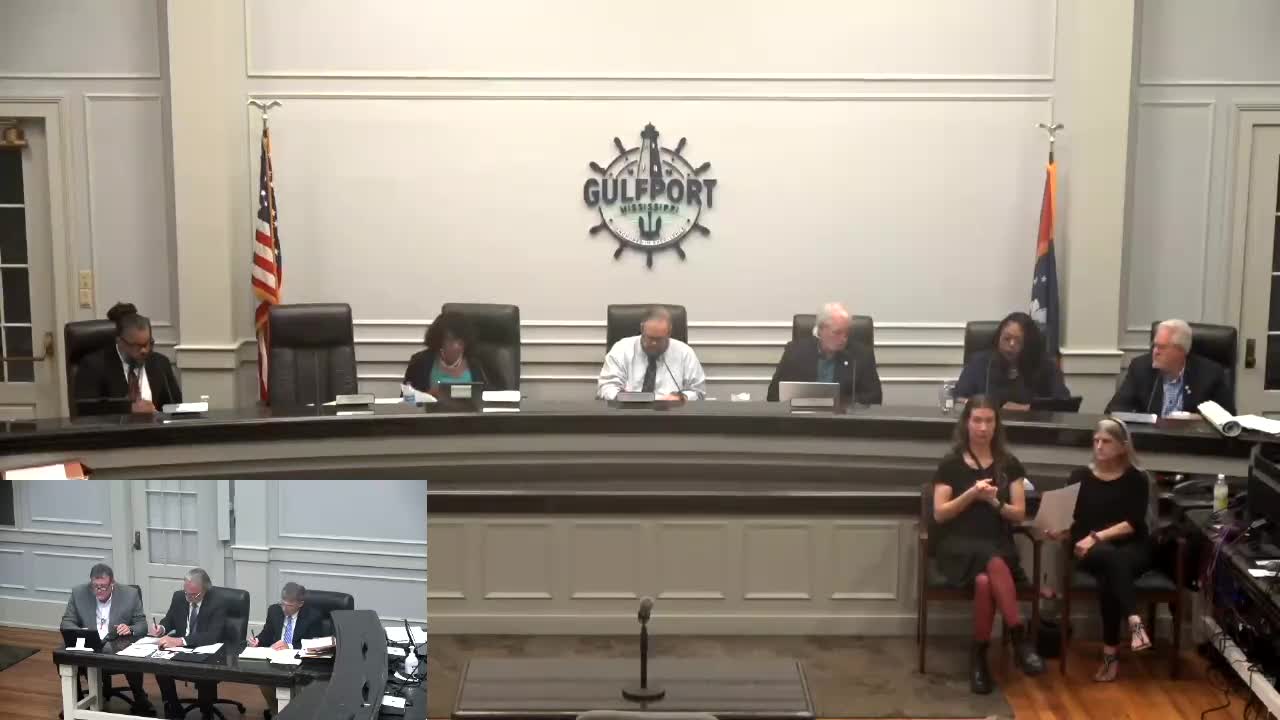
The Gulfport City Council on Thursday tabled consideration of an ordinance that would authorize the city to grant ad valorem property tax abatements for capital improvements of $10,000,000 or more, after about two hours of debate about the size of incentives, job commitments and how the city should compete with neighboring jurisdictions.
The ordinance on the floor would give the city authority to abate only its own ad valorem real-property taxes for qualifying projects. Under state law as explained in the meeting, the abatement period for a project could not exceed seven years; the draft ordinance itself would have a 10-year sunset unless renewed.
Council members split on how generous Gulfport should be to prospective developers. Mayor Hugh D. Keating and other supporters said a near-100% temporary abatement is commonly used by neighboring cities and is needed to attract major retail and mixed-use projects. “If you don’t give them the 100%, they’re not going to come,” the mayor said, arguing the city would gain sales tax, jobs and other long-term benefits if a large project locates in Gulfport.
Opponents and amendment authors said the city needs guaranteed, near-term returns to municipal budgets that were recently tightened in the annual budget process. Councilmember Ella Holmes Hines proposed an amendment to limit the abatement to five years and to 50 percent of the city’s ad valorem tax; that amendment was seconded and extensively debated. Councilmember Carissa Corbett proposed 75 percent as a compromise in later discussion. Councilmember Butler and others urged some contribution back to the city during the abatement period — suggestions ranged from a modest annual payment to a fixed percentage diverted to a local fund.
Council discussion included several clarifications on scope and mechanics: the $10,000,000 threshold applies to capital improvements (not the price of land); school-district and county property taxes would not be affected by a city-only abatement unless those taxing jurisdictions separately agreed; and developers typically run demographic and incentive comparisons when choosing locations, which affects Gulfport’s competitiveness with D'Aberville and Biloxi, both of which offer generous incentive packages, council members said.
Council members also attempted to quantify potential fiscal impact. A council member’s calculation on the record showed that a $10,000,000 project, with commercial property assessed at 15 percent of true value and taxed at 34 mills, would generate about $51,000 in city ad valorem tax annually; a 50 percent abatement would therefore reduce those receipts by roughly $25,500 per year for the abatement term. Council discussion emphasized that sales taxes and job creation from a large project could offset the forgone property tax over time, but council members disagreed on how much the city should forgo up front.
After extended debate and multiple proposed amendments, a motion to table the ordinance for further review passed unanimously. The council president called for additional review so members could weigh competitiveness, the length of any abatement, and possible contractual commitments from developers (for example, job-creation targets or community contributions) before returning the item to the dais.
The tabling preserves the council’s options: if the ordinance returns, council members said they may consider a shorter term with higher direct payments to city coffers, a higher project threshold, or a staged approval tied to performance metrics.
Ending: The council did not adopt any form of the ordinance at this meeting; city staff and the administration were asked to provide additional comparative data on incentives offered by neighboring jurisdictions and options for requiring developer commitments if the ordinance is reconsidered.