
Pueblo West board votes 3-2 to accelerate construction of indoor pool despite staff warning on fire-tax risk
Get AI-powered insights, summaries, and transcripts
Subscribe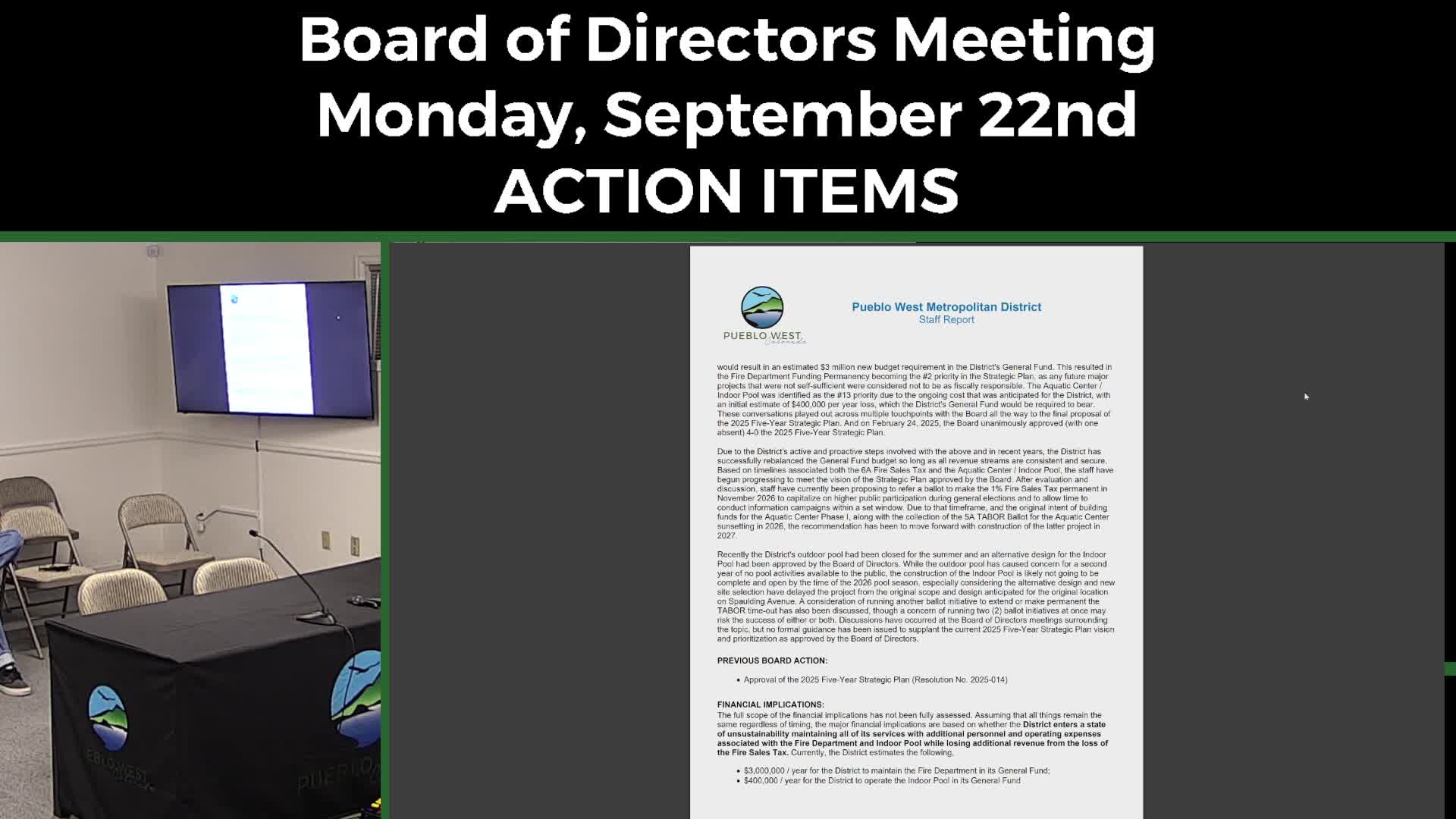
Summary
The Pueblo West Metro District board voted 3–2 on Sept. 22 to accelerate construction of an indoor aquatic center before securing a permanent funding solution for the fire department sales tax, despite staff warnings that the pool could add an estimated $400,000–$500,000 a year in operating costs and widen the district’s budget shortfall if the fire-tax revenue sunsets.
The Pueblo West Metro District board voted on Sept. 22 to accelerate construction of an indoor aquatic center before the district secures a permanent funding mechanism for its fire-department sales tax, a controversial decision that divided the five-member board and drew sustained public and internal debate.
The motion to “accelerate the construction of the indoor pool ahead of securing the fire department funding permanency” passed by roll call: Director Potter — yes; Director Roberts — yes; President Vickers — yes; Director Pasternak — no; Vice President Axworthy — no. Christian J. Hein, the district manager, presented staff analysis that recommended against accelerating the project until the district identified a solution for a fire-tax sunset.
“What I would share is that the indoor pool is sustainable by itself,” Hein said in his presentation, “but as soon as 6A sunsets, if there is no solution for it, you see that reverse…we’re taking on effectively a $2.2 to $2.3 million expense above revenue.” He recommended contingency planning if the board chose to accelerate the project.
Why it mattered: Staff projected that operating the indoor pool could cost roughly $400,000–$500,000 a year. The district manager warned that if the fire sales tax were to sunset without a permanent replacement, the general fund could face a material deficit that would exceed current contingency capacity and require program cuts.
Key points from debate and staff analysis - Strategic-plan context: Hein noted the district’s five-year strategic plan (adopted earlier in 2025) prioritizes securing fire-department funding permanency ahead of the aquatic center; the plan tied the aquatic project to other items such as the administration building and the 6A fire sales tax. - Fiscal picture: Hein told the board the general fund currently tracks about $1.2 million–$1.5 million in revenue over expenses, but the 6A sunset could require the district to cover an ongoing shortfall; staff estimated the full fiscal impact could be in the low millions by 2031 if unresolved. - Alternatives and mitigation: Board members asked staff to develop contingency plans, and staff said it would return with a project-prioritization list and recommended capital projects to pause should the board want to limit general-fund exposure.
Board positions - In favor: Director Potter, Director Roberts and President Vickers said they supported moving forward with construction now, citing the community benefit, the long wait since the outdoor pool closed and the available capital set aside for the project. Several supporters said they believed voters would ultimately support a permanent fire-tax measure if needed. - Opposed: Vice President Axworthy and Director Pasternak expressed concern the project could create an unsustainable operating burden if the fire sales tax did not pass in future ballots. Axworthy called the decision “a bad business decision” and said he would vote no.
Outcome and next steps The board’s decision to accelerate the project instructs staff to proceed with steps consistent with that direction; staff said it will accelerate contingency planning and return with guidance on which capital projects should be paused if the board wants to limit general-fund exposure. Hein said staff will ask for specific direction on which 2026 projects to postpone should the board require that step.
Ending: The vote was narrow and divisive. Staff analysis remains on the record: constructing the indoor pool is feasible with current capital but creates a multi‑hundred‑thousand‑dollar annual operating obligation. Board supporters said they will press ahead; staff will bring contingency planning and a prioritized list of capital projects back to the board for further direction.