
Dunedin Commission OKs first reading of revised historic‑preservation code, narrows emergency power for city manager
Get AI-powered insights, summaries, and transcripts
Subscribe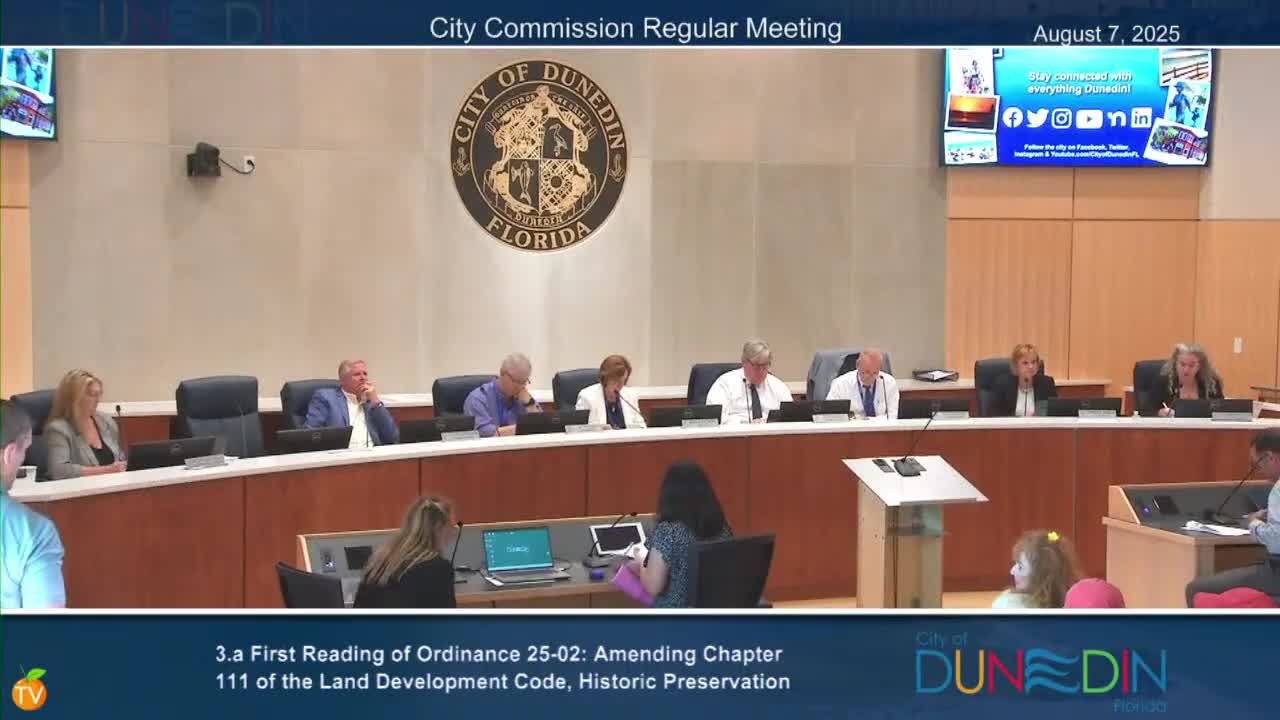
Summary
The Dunedin City Commission voted 4–1 on Aug. 7 to approve first reading of Ordinance 25‑O2, rewriting the city’s historic‑preservation rules to clarify landmark and district procedures and the COA process.
The Dunedin City Commission voted 4–1 on Aug. 7 to approve first reading of Ordinance 25‑O2, a comprehensive rewrite of the city’s historic‑preservation rules. The ordinance revises Chapter 1‑11 of the Dunedin Land Development Code to clarify how individual properties and whole districts can be designated as local landmarks or landmark sites, to add a process for historic districts, and to update the certificate‑of‑appropriateness (COA) matrix used when designated properties seek exterior changes.
Why it matters: The code change affects who can propose a historic designation, how quickly an application stops permits, and what kinds of exterior work will require review. Supporters said it helps preserve neighborhood character and can support local property values; opponents warned the ordinance could limit owners’ ability to repair or rebuild and that a city‑initiated district could be used without owners’ consent.
Staff and consultant presentation: Frances Leong Sharp, Planner II and staff liaison to the Historic Preservation Advisory Committee, presented staff’s administrative and procedural changes and summarized the Local Planning Agency (LPA) review history. Consultant Blair Knighting (Kimley‑Horn) reviewed major edits: creation of a “landmark site” category in addition to landmark buildings; clarification that COAs apply only after designation; a more detailed COA matrix that reduces items the commission must review; and a pathway to form historic districts when all property owners in a proposed district give consent or when, under a narrow legal standard, the city manager initiates an application because “failure to designate a proposed district would result in irreparable harm to the character of the city.”
Major points from the hearing: The LPA recommended approval by a 5–1 vote with a condition that the language allowing the city manager to initiate a district be removed. Commissioners and staff described the difference between a professional staff recommendation, the LPA’s citizen advisory recommendation, and the commission’s role as final decision‑maker. City Manager Jennifer (role provided in the record) told the commission that she would not take the step lightly: she said initiating a district application "would be the last thing that I pick up to do" and emphasized that any manager would answer to the commission and professional codes of conduct (ICMA) if they acted improperly. The city attorney explained "irreparable harm" as a legal standard typically used in injunction proceedings and said the term was chosen to provide a clear legal threshold.
Public testimony: The meeting drew lengthy public comment. Homeowners along Victoria Drive, Bell Tree and other neighborhoods said they favor voluntary, owner‑initiated preservation but oppose any mechanism that could pause permits or limit repairs without owners’ consent. Tom Bowers and others described the cost and personal investment in maintaining older homes; Nancy and Rob (last names in record) asked how permit pauses would affect storm repair and insurance. Supporters including Terry Hopkins and representatives of the Dunedin Boat Club urged the commission to preserve historically significant properties, noting possible economic and cultural benefits.
Commission action and amendment: After extended questions and a late, commission‑approved amendment requiring that the city manager must notify the full commission at a public meeting before filing any city‑initiated historic‑district application, the commission approved first reading 4–1. The roll call was: Mayor Franey — yes; Vice Mayor Gao — yes; Commissioner Walker — yes; Commissioner Dugard — yes; Commissioner Sandbergen — no. The commission also asked staff to prepare precise notice language (how the city manager would notify the commission and public) for final (second‑reading) consideration.
What the ordinance does now (as approved on first reading): - Codifies a local landmark and landmark‑site designation path and a historic‑district process. - Limits who may apply for a historic district to either (a) 100% of the property owners in the proposed district, or (b) the city manager under an explicit, legally defined “irreparable harm” standard — but only after public notice to the commission (amendment). - Clarifies COA procedures, adds a contributing/non‑contributing column to the COA matrix, and narrows items reserved for direct commission review (for example demolition above a numeric threshold remains a commission decision). - Allows administrative COA approvals for routine repairs and moves many discretionary approvals to the Historic Preservation Advisory Committee or staff, per the updated matrix.
Next steps: The ordinance returns for a second reading (final vote) on Sept. 4 where commissioners will consider the technical notice language requested at first reading and any edits requested by staff. If adopted, the code revisions will be codified into Chapter 1‑11 and the related COA matrix.
Ending note: Commissioners and members of the public repeatedly framed the issue as a balance between property‑owner rights and community efforts to manage growth and preserve Dunedin’s historic character. The commission’s amendment — requiring a public commission notice before any city‑manager initiation — was intended as an additional safeguard in that balance.