Get Full Government Meeting Transcripts, Videos, & Alerts Forever!
Get email alerts on the Drainage Watershed Survey topic
No spam. Unsubscribe anytime.
Vermillion County drainage board approves watershed survey contract, tables retaining-wall work
Summary
The Vermillion County Drainage Board approved a contract to map and define a local watershed and held off on redesign work for a retaining wall at County Road 300 West and 1500 North pending watershed results and downstream clearance.
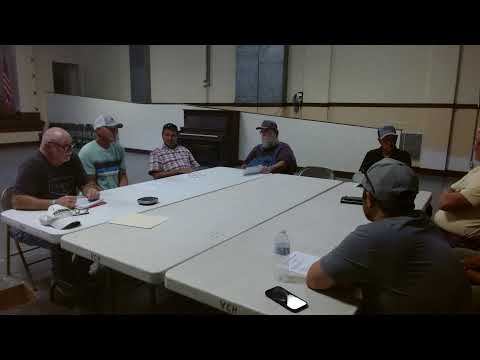
The Vermillion County Drainage Board on Oct. 15 approved a contract to establish a watershed boundary and parcel acreage for a regulated drain and tabled further redesign work on a roadside retaining wall near County Road 300 West and 1500 North.
Board members voted to hire HWC to prepare a watershed boundary and parcel table for the Brouse/Ralph's Green area at a quoted cost of $5,500, and the board accepted a separate DES quote of about $7,200 to complete associated work that may cross a state line. The board also discussed larger design quotes for a retaining wall at 300 W and 1500 N, where engineering estimates ranged from roughly $15,000 to $25,000 depending on scope; the board voted to table further retaining-wall work and focus first on establishing the legal outflow and watershed elevations.
The watershed work the board approved will produce a survey-grade watershed boundary and an exact acreage table for each parcel in the sub-watershed. Board members said the acreage and accurate watershed limits are needed before assessments or formal regulated-drain actions can proceed. One board member noted that establishing the watershed also creates a regulated-drain account and can make the drain eligible to receive Tax Increment Financing (TIF) district proceeds and grant funding.
Board discussion focused on whether it is prudent to spend money now on a full retaining-wall redesign or to first confirm downstream capacity and the legal outflow elevation. Members repeatedly emphasized that any effective remedy likely requires both an engineered surface solution and subsurface tile work, and that without a clear outflow the county risks spending on a fix that will not resolve upstream standing water.
The board motioned and approved tabling the retaining-wall design until the watershed and outflow elevations are established; a separate motion to proceed with the $5,500 watershed boundary work was also moved and seconded and carried. Board members discussed options for piecemeal survey work (hydraulic analysis and survey as first steps) so the county can determine whether a more costly redesign or tile installation would be effective.
The board also noted possible right-of-way and property-permission issues. Members said a large tile across private fields would require either landowner agreement or future permitting steps; one property owner near the retaining wall, identified in the meeting as Mr. Wilson, has expressed resistance to some options that would run pipe through his yard.
Next steps listed in the meeting record: HWC will perform the watershed-boundary work and parcel acreage table; DES (or another selected vendor) will provide the hydraulic analysis and any out-of-state coordination required; the board will wait for survey results, establish the elevation at the end of the legal drain, and then revisit design or construction of the retaining wall if necessary.
Votes at the meeting produced two formal outcomes recorded in the transcript: the board approved the watershed survey engagement (moved and seconded; outcome: approved) and the board voted to table further action on the retaining wall (moved, seconded; outcome: tabled).