
Spartanburg council adopts local hate-intimidation ordinance on second reading
Get AI-powered insights, summaries, and transcripts
Subscribe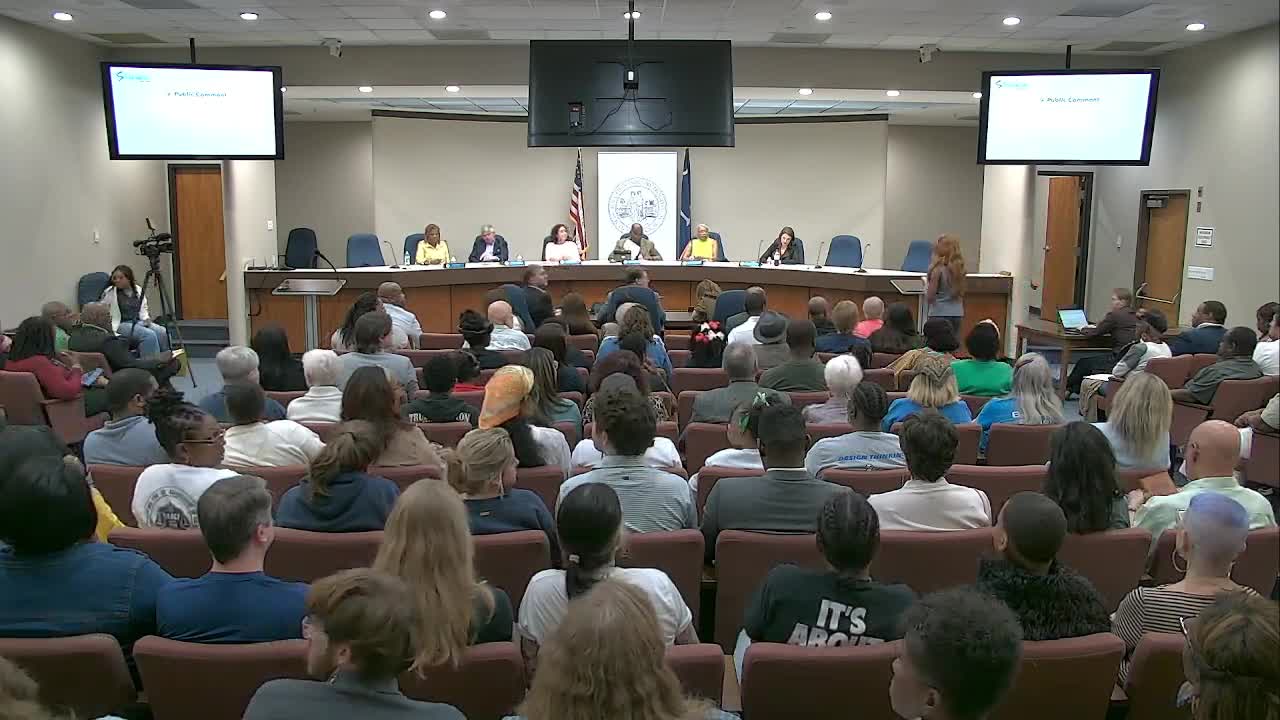
Summary
On Oct. 13, 2025 the Spartanburg City Council approved a second-reading ordinance creating a separate offense for crimes motivated by race, religion, sexual orientation, disability and other protected characteristics; council removed language referencing suspension of penalties by completion of education or counseling after staff recommendation.
Spartanburg City Council on Oct. 13 approved a local ordinance creating a separate offense of "hate intimidation" punishable by up to 30 days in jail, a fine of up to $500, or both.
The ordinance, introduced at second reading and carried by majority vote during the meeting, defines the offense as committing an underlying violation of the city's code "with the intent to harm, injure, or intimidate another person or persons in whole or in part because of ethnicity, race, color, creed, national origin, religion, ancestry, sexual orientation, gender, gender identity, or the physical or mental disability of the victim." City Attorney Robert Cole recommended striking a sentence in the draft that said a court could suspend fines or jail time upon completion of education, counseling or community service; council accepted that change before the vote.
Why it matters: supporters said the ordinance fills gaps where state law does not provide local protections, while opponents raised questions about who would design any post-conviction education and whether the text could be read as creating a government-run program. The council removed the sentence to avoid the appearance that the city would be prescribing educational programs and because the municipal judge already has statutory discretion to suspend sentences.
Council heard more than a dozen public commenters during the meeting. Supporters described the ordinance as protection for residents targeted because of identity; opponents pressed for clarity on implementation. Courtney McLean, who identified her address and said she was speaking in support, told council, "By passing this local hate crimes ordinance, this isn't just policy, but it is a public declaration that we will not tolerate hate in our streets, in our schools, in our churches, or in our neighborhoods." Sarita Edgerton, who said she spoke against the ordinance at the prior meeting, urged clarity about who would decide the content of any education component, reading language from the proposed ordinance and asking, "Who gets to decide what that education is?"
City Attorney Robert Cole, presenting the ordinance for second reading, said staff recommended removing the sentence about suspension of penalties because the municipal judge already "does that all the time with or without that language" and the clause could be misread as authorizing a city-run educational program. "If we've got a potential language that causes a potential misunderstanding or potential confusion and it does nothing, it seems to me that the best thing to do is simply take that out," Cole said.
Councilwoman Smith asked whether striking that sentence changed the ordinance's substance; Cole replied it did not, and reiterated that the ordinance's definition of the offense and the penalties in the draft would remain. Cole summarized the penalty as "up to 30 days in jail and up to $500 and or any combination thereof." He also said participation in any alternative sentence would be voluntary and within the court's discretion.
Opponents and some public commenters requested more detail about post-conviction education or counseling. Cole and council members emphasized that the court—not the city council—would determine any alternative sentencing offered in a given case.
The council made a motion to adopt the ordinance as amended; the motion was seconded and the mayor called the voice vote. The record shows the motion carried (vote recorded as "Aye"; no roll-call count provided at second reading).
Next steps: council approved the ordinance on second reading and the amended text removing the suspension language; the city will publish the final ordinance and the municipal court retains discretion over sentencing options in convicted cases. Public commenters and council members urged the city to continue community engagement and to clarify, where possible, how victims and defendants can expect the ordinance to operate in practice.
Ending note: the ordinance was one of several significant items on the Oct. 13 agenda, which also included a development agreement for a downtown Main Street project, a settlement related to the clock tower lawsuit, and several procurement actions.