Franklin County schools warn free-meal program may be unsustainable as meal reimbursements fall
Summary
District food-service leaders told the Franklin County Community School Corporation board that falling participation in free/reduced meal paperwork and higher food costs have pushed cafeteria accounts toward a shortfall and may force an end to the Community Eligibility Provision if participation doesn’t improve.
Franklin County Community School Corporation officials warned the board of trustees on Oct. 13 that the district’s Community Eligibility Provision (CEP) — which currently provides free school meals to all students — may not be financially sustainable unless more families complete free/reduced meal applications and student meal participation increases.
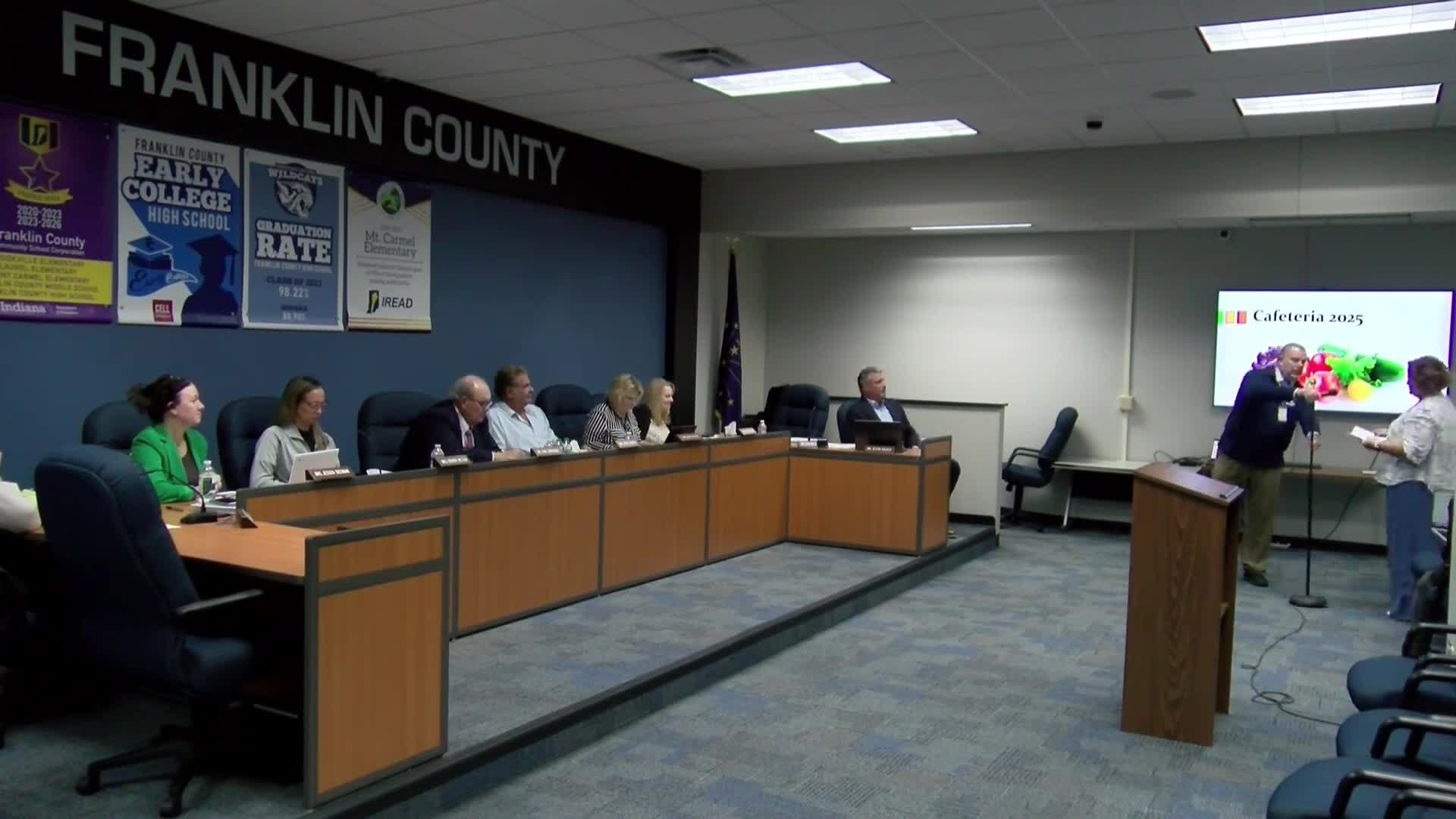
The warning came during a presentation and extended discussion led by food services director Jessica DeFossett and joined by Superintendent Dustin Gehring and other district staff. DeFossett said the district has seen a sharp drop in families completing free/reduced paperwork while food prices and operating costs have risen, producing a large shortfall in the cafeteria fund.
Why it matters: CEP gives every student a free tray, but federal reimbursements differ based on how many students are formally approved for free or reduced-price meals. DeFossett told the board that the district receives a much higher reimbursement rate for students who are approved through the free/reduced application process; for students who are not approved the district receives only cents per meal. That gap, combined with rising food and supply costs, has left the cafeteria fund balance far lower than a year ago.
Details and figures - DeFossett said the district had 30 cafeteria employees last year and 25 this year; managers and five full-time managers receive benefits, while most hourly staff do not. She said managers’ schedules and labor hours are carefully monitored and adjusted each month using a meals-per-labor-hour formula. - The district’s cafeteria fund balance was reported in the presentation as $50,121.66 as of Sept. 30, 2025, down from $383,350.44 a year earlier. DeFossett said the drop reflects lower reimbursements and recent equipment purchases. - Example reimbursements discussed in the presentation: the federal breakfast reimbursement is about $2.46 and lunch about $4.60 at the full rate; under CEP the district currently receives only a percentage of those amounts for many students. DeFossett noted the district receives only about $0.16 for some paid students who have not completed the free/reduced paperwork, versus $2.90 for students who are approved. - DeFossett estimated the district needs roughly $100,000–$120,000 in reimbursements per month to operate without loss for food and labor; she said August did not meet that threshold while September did.
Discussion highlights - DeFossett described steps she has taken since July to reduce costs: a cycle menu designed to lower per-meal food cost, a district master ordering list to standardize purchases across schools, reduced repair and outsourcing costs by using maintenance staff, and small incentives and menu adjustments intended to increase student participation. - Board members and staff discussed outreach barriers. The district’s registration system and the timing of the free/reduced application (available after July 1) were cited as reasons families may not complete applications. Toby Witt (district staff who handles final forms and free/reduced tracking) explained the application is a separate, online system and must be completed after July 1. - Several trustees suggested targeted outreach (back-to-school nights with computers available at schools, clearer step-by-step instructions in newsletters, social media and PTO meetings) to increase applications in areas with limited home internet access. - Superintendent Dustin Gehring warned that, unless participation and application completion improve, the district could be close to ending CEP later in the school year. He and DeFossett said the program’s sustainability depends on restoring the higher reimbursement rate connected to completed free/reduced applications.
Operational tradeoffs and examples - DeFossett gave concrete examples of cost-saving changes: switching from prepackaged to whole carrots (reducing per-portion cost from about $0.50 to $0.18), removing low-value condiment cups from menus, and temporarily removing high-cost desserts. She presented a sample cycle-menu per-meal cost (for example, a calzone/baked beans/mixed fruit tray at roughly $1.22 food cost). - The presentation showed variation by school: some sites run near break-even while others show monthly operating losses driven by low participation and lower application completion rates.
Board response and next steps - Trustees thanked DeFossett and noted the district would try stepped-up outreach and community-based assistance to help families complete applications. DeFossett said managers continue to fine-tune operations and that the district is pursuing grants and state guidance. - DeFossett and the superintendent said federal reimbursement timing can lag several months, complicating cash-flow planning. The board asked staff to report back quickly on any measurable change in participation and application completion that would affect sustainability decisions before the semester’s end.
Ending DeFossett emphasized the program’s value and the district’s preference to keep CEP in place, but she and Gehring said the program’s future depends on reversing the drop in completed free/reduced applications and raising average daily participation. The board discussed additional outreach options and scheduled continued monitoring of cafeteria finances in upcoming committee and board reports.