
KDHE briefs committee on measles end, rural health application and HR1 Medicaid changes that could cut benefits for some immigrants
Get AI-powered insights, summaries, and transcripts
Subscribe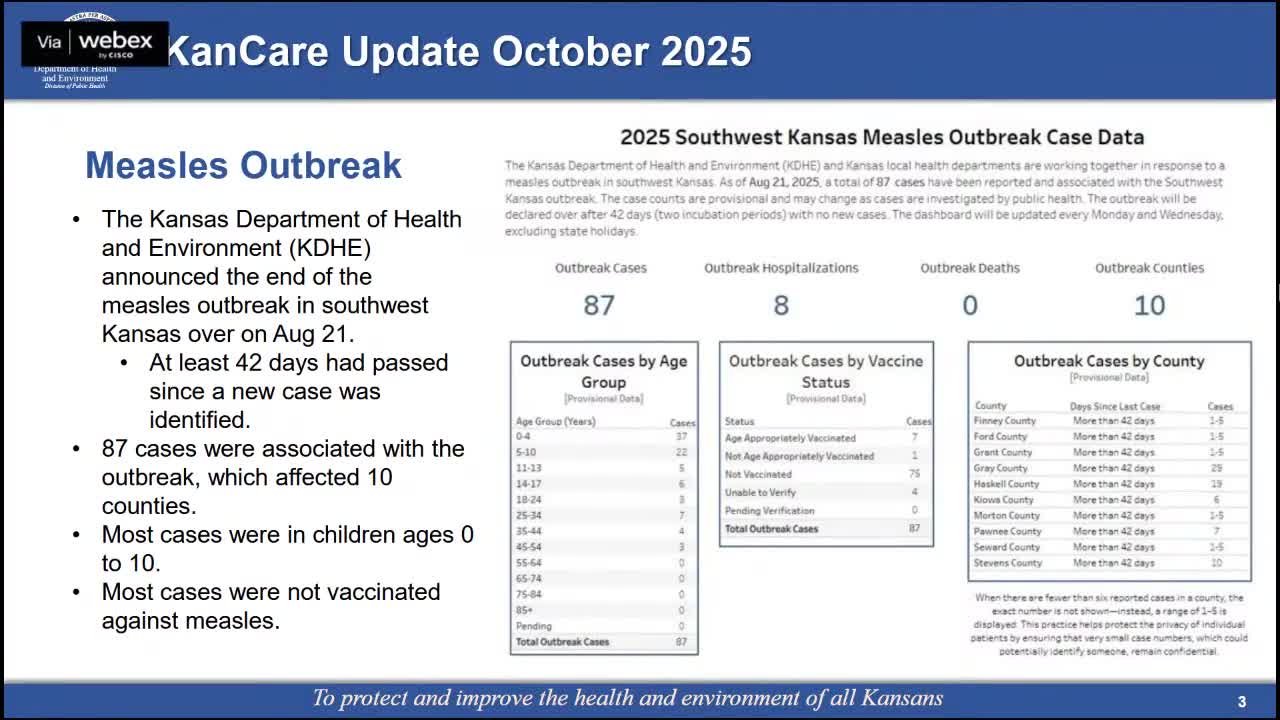
Summary
Secretary Janet Stanek told the committee the state declared an end to a southwest Kansas measles outbreak, is assembling a rural health transformation alliance to apply for federal funding, and is preparing for federal HR1 provisions that will reduce prior‑medical look‑back windows and change immigrant eligibility rules that may remove coverage.
Kansas Department of Health and Environment Secretary Janet Stanek told the Bethel committee that KDHE has closed a southwest Kansas measles outbreak and is working on several federal initiatives that could change Medicaid eligibility and funding flows.
On infectious disease, Stanek said KDHE declared the measles outbreak over on Aug. 21 after 42 days without new cases. The outbreak had 87 confirmed cases across 10 counties, and most cases were among unvaccinated children ages 0‑10.
On rural health, Stanek described the state’s rapid effort to prepare a federal application for the Rural Health Care Transformation program. Kansas submitted a letter of intent and created the Kansas Rural Health Innovation Alliance (KRHIA) to gather stakeholders, and plans to submit a full application by the federal deadline (application released Sept. 15; submission required by Nov. 5). Stanek emphasized the program funds transformation projects, not one‑off equipment purchases, and KDHE is partnering with KU’s care collaborative to develop proposals and the alliance governance.
Stanek and KDHE deputy secretary Christine Osterlund also briefed the committee about large federal changes in HR1 that affect Medicaid. Key points:
- Immigration eligibility: HR1 redefines some immigrant categories that qualify for Medicaid; KDHE’s initial review estimates at least 2,234 current Medicaid members could lose eligibility under the new federal interpretation. KDHE estimated those members represent roughly $3.6 million in state general fund spending and about $6 million in federal funds annually, and that CMS monthly files will let the state re‑verify immigrant status going forward.
- Prior medical look‑back: HR1 reduces the prior‑medical look‑back from 90 days to 60 days for non‑expansion states; KDHE estimates a reduction in prior‑medical payments that could lower state outlays in the affected fiscal years. (For expansion states the window changes differently; the staff said the law’s details vary by state status.)
- Continuous eligibility waivers and other changes: CMS has signaled changes and delays for certain final rules; KDHE said it has to review multiple guidance documents and expects additional clarifications from CMS. KDHE reported receiving an initial immigration‑status file from CMS and will receive regular files for ongoing verification.
On out‑of‑state residency and eligibility, KDHE said it is piloting an automated verification process with its contractor Gainwell and other states to better detect dual enrollments and claims activity across state lines; the current PARIS federal report is slow and incomplete, the agency said.
Ending: Stanek said KDHE is moving quickly to convert stakeholder input into a strategic rural application, to work with other agencies and MCOs on federal changes, and to pilot technical solutions that reduce duplicate enrollments and improper payments.
Provenance: KDHE testimony to Bethel committee; details provided by Secretary Stanek and Deputy Secretary Osterlund.