
Easley Combined Utilities reports adequate water capacity, aging lines and $2M in storm damage
Get AI-powered insights, summaries, and transcripts
Subscribe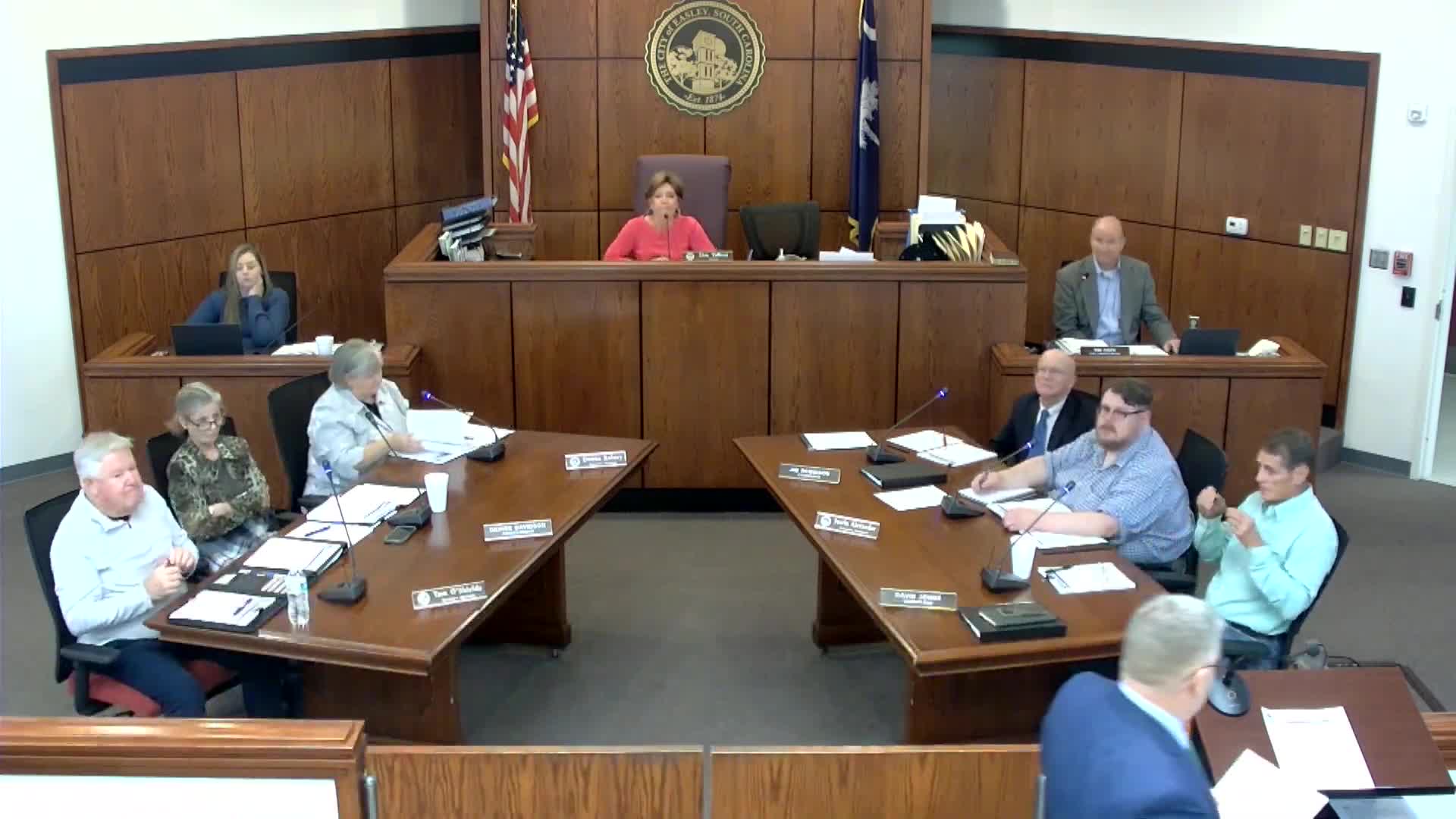
Summary
Easley Combined Utilities gave a status report to the council highlighting adequate water treatment capacity, aging distribution infrastructure, nuclear power contracts and about $2 million in estimated hurricane damage awaiting federal/state grants.
Andy Sevick, a representative of Easley Combined Utilities, briefed the City of Easley Council on the utilities' structure, current capacity and infrastructure challenges during the meeting.
Sevick described Easley Combined Utilities as a political subdivision and a municipal utility governed by three elected commissioners. He said the utility serves about 17,000 meter accounts for electric service and roughly 15,000 water meters. On power supply, he said Easley participates with nine other cities in ownership of part of the Catawba nuclear plant and that the joint contracts have been extended to the projected life of the plant (through at least 2063). “We own, along with 9 other cities, part of the Catawba nuclear plant,” he said.
On storm impacts, Sevick reported an estimated $2,000,000 in damages from Hurricane Hilleen; he said the utility has submitted documentation to FEMA and state review, and that three of eight projects had already received funding approval. “All of our homework has been done on that. We've turned it in. We're waiting for grading, from the mainly from the state now,” he said.
Sevick described the water treatment plant on Saluda Lake as an 18 million gallon-per-day facility with current peak use around 9–10 million gallons per day, indicating available capacity. He also discussed sewer system capacities: Bridal Branch plant allocated flow about 75 percent, George's Creek about 74 percent and Golden Creek about 26 percent. He said Bridal Branch is the largest basin and the utility is saving remaining Bridal Branch capacity for development within city limits by requiring projects in that basin to be annexed into the city to receive sewer service.
Sevick identified aging water and sewer mains (some installed in the 1980s and 1990s) as ongoing maintenance priorities and noted continued work on watershed conservation and streambank restoration in partnership with Save Our Saluda Nature Land Trust to address lake sedimentation issues following past dredging.
Why it matters: The utility's reported capacity and infrastructure needs inform council members' decisions on development moratoriums, annexation requests and capital planning; the FEMA- and state-eligible storm repairs also affect near-term utility budgets and capital projects.
What was not specified: The presentation described capacities and project submissions, but did not provide detailed project-by-project timelines, exact funding awards for the remaining projects, or an explicit contingency schedule tied to development approvals.