
Easley Combined Utilities outlines power, water and sewer capacity, aging infrastructure and upcoming funding needs
Get AI-powered insights, summaries, and transcripts
Subscribe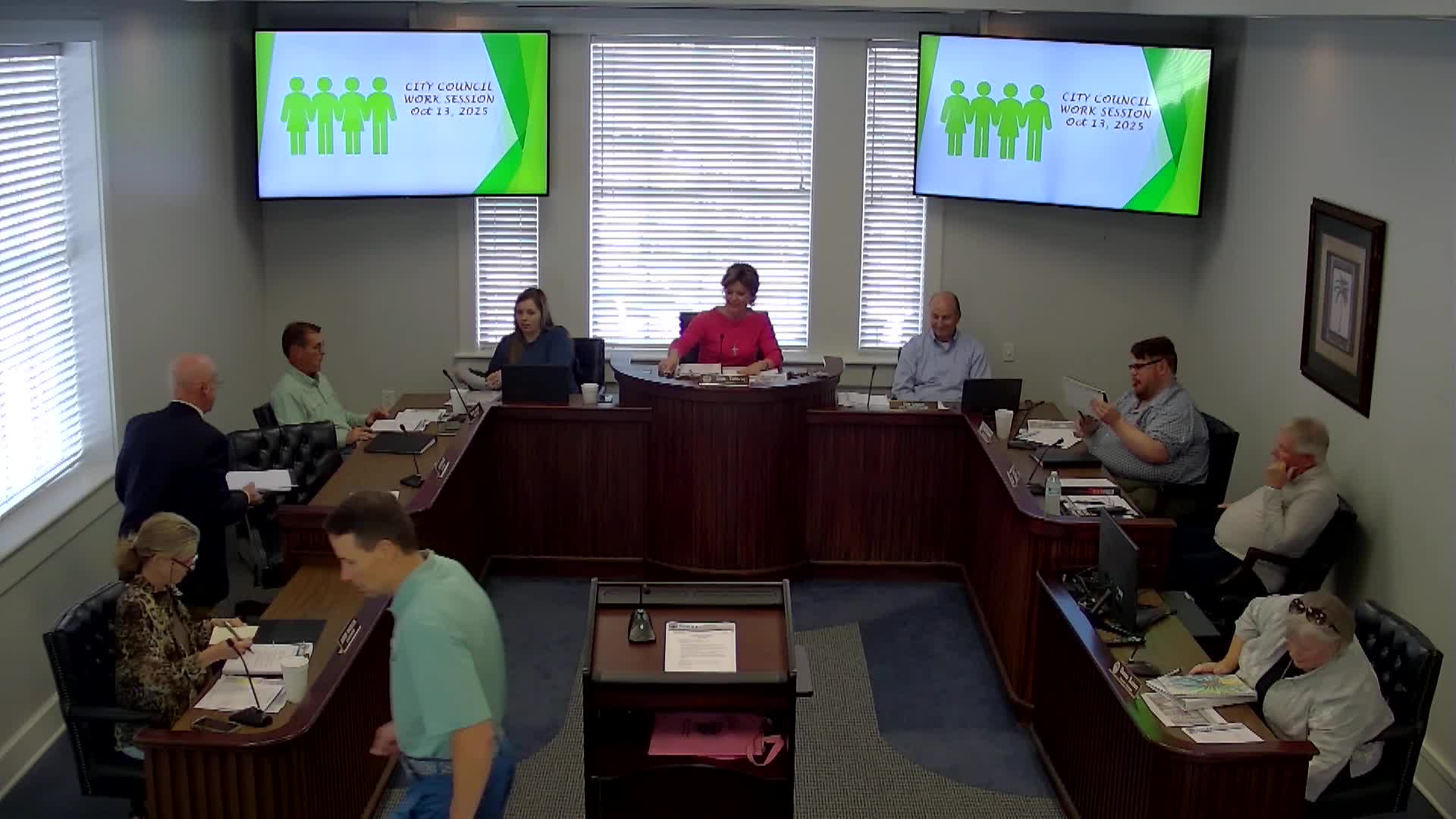
Summary
Easley Combined Utilities officials described system ownership of Catawba nuclear plant power, a needed supplemental power contract, growing customer counts, sewer-basin service rules tied to annexation, aging sewer mains that may require borrowing, and federal FEMA reimbursements for storm repairs.
Andy Savick, a representative of Easley Combined Utilities, told the Easley City Council at a work session that the utility is positioned to meet current demand but is facing several infrastructure and contract milestones that could affect future costs and investment. He briefed the council on the electric, water and sewer systems, noting ownership in the Catawba nuclear plant and active planning for aging sewer lines.
The update matters because Easley’s utility decisions affect rates, annexation policy and where new development may connect to sewer service. Savick said the utility owns a share of the Catawba plant through the Piedmont Municipal Power Agency joint-action arrangement (PMPA) and that the city’s base-load contract was extended to mirror the life of the plant "through 2063 or the life of the plant." He said supplemental power contracts (currently with Santee Cooper) expire Dec. 31, 2028, and replacements must begin Jan. 1, 2029, and that negotiations are ongoing.
Savick gave system counts and trends: roughly 17,000 electric customers (up from about 15,000 ten years ago), about 175 miles of underground electric lines and 235 miles of overhead lines, and roughly 15,000 water customers. He said Easley’s Saluda Lake treatment plant has an 18 million gallons per day (MGD) maximum; typical summer production is about 9–10 MGD and the system does not currently have capacity shortfalls. For sewer, he reported about 12,785 customers (compared with roughly 9,000 ten years ago) and described four basins tied to three wastewater plants and shared capacity in a REWA plant. He said Bridal Branch was expanded from 3.5 MGD to about 4.2 MGD; Georges Creek is about 0.82 MGD, and Golden Creek about 0.58 MGD.
Savick described a new sewer service policy passed in February that ties guaranteed sewer service to annexation in certain basins. "If you're in the Bridal Branch Basin ... and you want to develop, if you're not annexed into the city, you're not getting sewer," he said. He explained that Easley is saving excess Middle Branch capacity for properties that become part of the city through annexation; developments contiguous to the city may be considered differently, and requests that follow denials of annexation are judged by the utilities commission on a case-by-case basis. REWA-related developments are treated similarly but depend on REWA capacity and planned expansion.
Savick also described how allocated flow works under state guidance (referenced in the presentation as "DES" standards): Easley currently uses a conservative 300 gallons-per-day allocation per house for planning, though actual use is typically lower. He said Middle Branch’s allocated flow is about 75 percent; internally Easley still watches a 90 percent planning threshold and would plan for expansion if nearing 80 percent. He gave example counts: about 600 new houses would push Bridal Branch toward 80 percent and roughly 2,000 houses to reach 90 percent of allocated capacity (numbers are tied to in-city additions).
On capital and repair needs, Savick said the utility spent "a little less than $2,000,000" on storm repairs and has eight FEMA projects, of which three smaller projects have been reimbursed. He described a costly dredging project at Saluda Lake from roughly 12–13 years earlier, originally estimated at $7.5–8 million and expected to last 40–50 years, but which had a much shorter effective lifespan; the utility has since emphasized upstream watershed work, streambank restoration and conservation instead of repeated large dredges. He identified several aging sewer mains and pump stations in Middle Branch, Brushy Creek and 18 Mile Creek that he said are 40–50 years old and will require replacement; those projects may require the utility to borrow funds and the utility plans to come to the council for assistance when that becomes necessary.
Savick addressed lead-and-copper service-line work and federal PFAS testing: he said the utility has inventoried service lines and is "in pretty good shape," noting a 10-year timeline for replacing identified lead and copper lines; he also said the utility’s PFAS (PFOA) test results remain below the levels discussed federally and that federal standards appear to be in flux.
Savick summarized the near-term challenges as: negotiating supplemental power contracts, continuing FEMA project reimbursements, replacing aging distribution and sewer lines, addressing watershed management, and planning for pump-station and line replacements. He said the utility will hold public meetings for neighborhoods affected by construction and that engineering and site preparation work are underway on identified projects.
Savick and council members did not record any formal action or vote on the issues during this portion of the work session; the presentation was informational and council members asked clarifying questions about capacity, timelines and funding.
Going forward, Savick said the utility will continue to track basin allocations, use flow advance agreements where appropriate, pursue FEMA reimbursements, and return to the council when borrowing or other council authorization is required for major sewer replacements.