Get Full Government Meeting Transcripts, Videos, & Alerts Forever!
Get email alerts on the Reparations topic
No spam. Unsubscribe anytime.
Greenbelt Reparations Commission presents community-healing framework, urges more Indigenous and generational African American representation
Summary
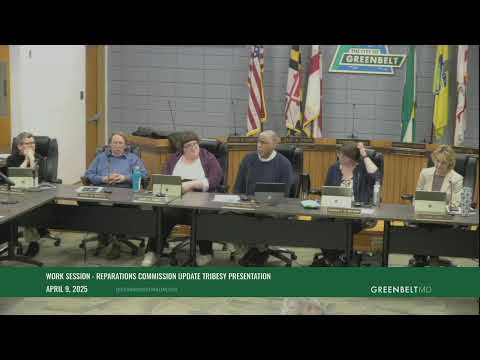
At a Greenbelt City Council work session, the Greenbelt Reparations Commission and outside consultants summarized their research and recommended centering community-healing practices, increasing Indigenous and generational African American representation on the commission, and formalizing city support and outreach.
The Greenbelt Reparations Commission on Tuesday presented a research-based, community‑healing framework to the Greenbelt City Council and urged the city to increase Indigenous and generational African American representation on the commission and provide clearer structure and resourcing for its work.
Lois Rosado, co‑chair of the Greenbelt Reparations Commission, told council members the city was founded as an exclusionary, “white community,” and that African Americans helped build Greenbelt in 1935 but were not initially allowed to live there. Rosado said the commission would deliver recommendations to the council after completing its research and outreach.
The commission contracted consultants to support its work. Rena Doyle, who identified herself as co‑founder of Tri de C Consulting, summarized the consultants’ approach and findings, saying the report is designed to “model what community healing could look like” and to treat reparations as “a pathway for continuous forward movement” rather than a one‑time checklist. June, a consultant with the project team, said the document intentionally uses cultural framings and is not meant to read like an academic report.
Consultants and commission members described research and outreach completed to date: seminars and webinars on reparations, review of 78 national and local initiatives, attendance at national reparations conferences, testimony before the Maryland General Assembly on the Prince George’s County lynching memorial project, town halls, pop‑up tables, surveys and interviews with residents, and reporting in the Greenbelt News Review. The team said its outreach included tabling near the Giant supermarket and collecting survey responses from residents and from student researchers; one early tabling produced 31 survey responses, with additional responses collected at later events.
Consultants and commission members said their research identified harms that include historical exclusion from housing (the presenters noted African Americans were excluded from living in Greenbelt prior to 1965), political underrepresentation (the council was all white until 2009), economic and cultural losses, and intergenerational trauma. The team emphasized that reparations, as they frame it, must address multiple domains—economic, health, spiritual, political and social—and be grounded in the priorities of affected communities.
Gail Watts, identified as a co‑founder with the consultant team, and Maya, a coordinator on the project, described a teaching and learning process for the commission. The consultants said the commission’s demographic makeup slowed some work: they reported that white commissioners were often overrepresented in discussion, and that time had to be spent on process and structure rather than substantive reparations content. The consultants recommended greater representation of people most affected—generational African Americans and Indigenous people—on the commission and additional training and supports for commissioners who will listen to traumatic oral histories.
Denise Nazon, vice chair (identified on the call as co‑chair/secretary) of the reparations commission, said the training provided by the consultants was “authentic” and helped the commission reframe its work. Several commissioners and council members asked how the city should recruit and meaningfully compensate Indigenous participants and others who carry unpaid community expertise; consultants recommended building relationships, allowing communities to set pace and compensation, and using culturally synchronous engagement and storytelling approaches.
Council members acknowledged shortcomings in the original structure and appointments. Mayor Helen Jordan and other councilmembers said the city had intentionally been hands‑off when the referendum established the commission in 2021, but several councilmembers and commissioners said that approach should be rethought so the commission can obtain needed outreach, recruitment and operational support.
Consultants offered organizational suggestions in their written report (presenters said those recommendations include committee structure and a timeline, and that the report had been vetted with the city manager and commission leadership). The commission and consultants recommended stronger city involvement in three areas: (1) recruitment and outreach to ensure affected communities are represented; (2) funding or compensation for community participants and expert interviewers; and (3) integration with city staff or the Office of Diversity, Equity and Inclusion so the work is sustained rather than episodic.
Commission members emphasized boundaries for volunteers: several commissioners said volunteers should not be expected to conduct trauma‑centered interviews alone and recommended hiring trained professionals to document and record painful oral histories. Denise Nazon told council the commission remains volunteers and recommended that professionals be engaged to collect and preserve stories.
No formal council votes were taken at the work session. The meeting concluded with council members thanking the commission and consultants for their work and asking staff to follow up on recruitment ideas and the consultants’ written recommendations. Mayor Jordan also reported a separate administrative update: an email from a state senator confirming a $200,000 bond bill for elevator renovations at the community center.
The commission said it plans continued tabling and community outreach in 2025 and will prepare formal recommendations for council consideration once it completes its research and listening sessions.