
Sawyer County HHS warns of caregiver and clinician shortages as CLTS referrals rise and out‑of‑county placements drive costs
Get AI-powered insights, summaries, and transcripts
Subscribe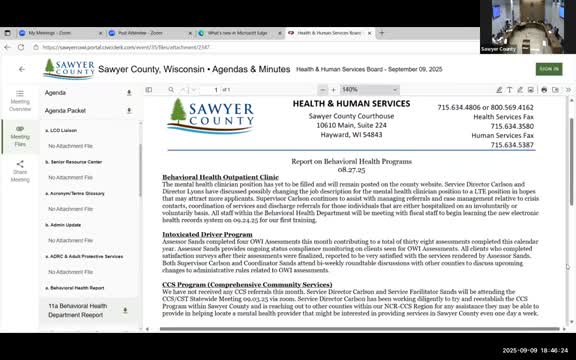
Summary
Behavioral health staff reported resignations and an increasing number of CLTS (Children's Long-Term Support) referrals that could push caseloads above 60, while the county explores intensive foster-care options to reduce costly residential placements and out‑of‑county stays.
At the Sept. 9 meeting of the Sawyer County Health and Human Services Board, behavioral health staff described staff turnover and rising case referrals that county leaders said could increase out-of-county placements and budget pressures.
Alicia, the behavioral health reporter to the board, said Terry Brown would resign with a last day of Nov. 21 and that the department expects CLTS caseloads to exceed 60 within weeks. Alicia said the department had added three new CLTS referrals since the written report and that fall school start typically drives further increases.
"We've had another 3 referrals. Once school starts, we always see an increase in referrals to this program. So we will definitely be over the 60 mark, probably more like 63, 64 within the next couple of weeks," Alicia said.
Caitlin, who oversees the Community Support Program (CSP) and mobile crisis work, told the board the CSP population remained just under 50 clients and that a nurse practitioner would join the program on Oct. 1 to support an aging population that needs more prescriber access.
County staff discussed several clients in high-cost placements. Julie and other staff described one client moved to Winnebago and subsequently to a crisis bed with plans to transition to a lower‑cost placement, and another long‑term escalated case that county staff called "very, very complex." Staff said when clients move to out-of-county facilities their local payments pause, but long placements remain a major budget driver.
Board members and staff discussed a newly identified toolkit and pathway to use specialized foster-care placements combined with CLTS supports as a cost‑saving alternative to residential care. The health and human services director said the county is exploring developing a local intensive foster-care model for children with significant needs, coordinating with the county's foster-care and kinship program lead.
"If we can develop specialty foster care placements, we pay foster care rates rather than residential treatment center rates, and CLTS could pick up the higher-end supports — that may reduce county costs and keep children closer to home," the director said.
Staff also flagged recruitment challenges for a mental‑health clinician position and discussed making a limited-term (LTE) position to provide partial coverage. The county's intoxicated‑driver assessment program (IDP) has performed 38 assessments so far this year; staff said possible chapter 75 changes to IDP rules were circulating and could affect provider requirements.
Why it matters: Rising CLTS referrals, staff turnover and the expense of out-of-county placements were framed as ongoing budget pressures and operational risks for the department. Board members asked for more detail on Medicaid coverage and account balances; staff said Medicaid may cover some hospitalizations but generally does not cover supportive-home long‑term placements unless clients meet specific functional-eligibility categories.
Next steps: Staff said they will continue recruitment, consider LTE options, pursue specialty foster‑care pilot possibilities, and return with more detailed financial and program data.