
Brighton launches comprehensive-plan update, consultants outline 4-window public engagement
Get AI-powered insights, summaries, and transcripts
Subscribe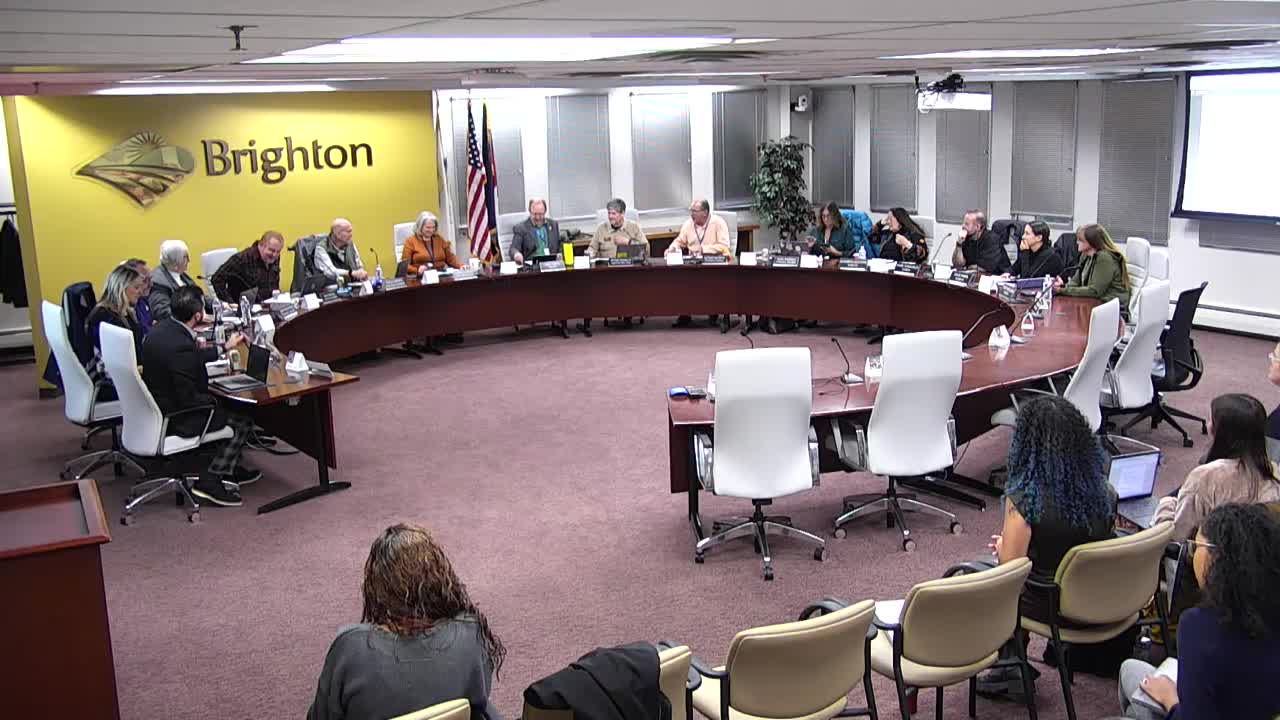
Summary
Brighton city officials and consultants formally kicked off an update to the city's comprehensive plan at a joint study session, laying out a 14-to-18-month schedule of technical analysis and community engagement aimed at producing a concise, action-oriented guidance document for land use, transportation, housing and other policies.
Brighton city officials and consultants formally kicked off an update to the city's comprehensive plan at a joint study session, laying out a 14-to-18-month schedule of technical analysis and community engagement aimed at producing a concise, action-oriented guidance document for land use, transportation, housing and other policies.
City Manager Michael Martinez introduced the work, and Design Workshop principals described a four-window engagement approach that will include a statistically valid survey, targeted focus groups, pop-up events, and a community advisory group. "This process will typically take about 15 to 18 months, and there's gonna be a lot of public engagement," Community Development Director Holly Prather told the council and planning commissioners.
Why it matters
The comprehensive plan directs long-range policy and is used as a review criterion for zoning, subdivisions and other land-use decisions. Updating the 2016 plan now will give staff, the planning commission and council new policy guidance as Brighton continues to grow. "It helps support and provide guidance on things like land use, on housing, public review process, services, natural resources," consultant Emily Burrows said, describing the plan as "your blueprint into the future." Council and commission members repeatedly asked for a document that is easier for residents to read and provides flexible options for changing circumstances.
Key decisions and next steps
Design Workshop said the process will: (1) document existing conditions and review prior plans; (2) perform technical analyses (transportation, water/environment, economics/housing); (3) run four distinct community-engagement windows (foundation, growth scenarios, community choices/priorities, plan sharing); and (4) deliver a vision, goals and an implementation framework that identifies short- and long-term actions. The first engagement window will run through November and include both a mail/phone-based statistically valid survey and an open online survey for additional input.
Council members and planning commissioners stressed several priorities for the update. Planning Commissioner Katie Ladon said she uses the comp plan constantly and wants the new document to be both readable and to include maps that are easier for the public to interpret: "I use the comprehensive plan in just about every single thing that comes up before us on the planning commission...I'd also like to see the maps. It's very difficult for a lot of people to read them." Council Member Jim Snyder urged plain-language summaries for residents: "I jokingly told Summer you need a 4 year college course to understand this thing. So I'm hoping as we melt this down, we can make it, so that it's fairly comprehensible." Mayor Pro Tem Tom Green and others requested that the plan be flexible so it does not "hold us hostage" to 20-year assumptions and that it provide interactive, GIS-driven tools so residents can explore land-use, transportation and related layers online.
Engagement and documentation commitments
Consultants said they will produce engagement reports for each window that document methods, participant demographics and verbatim comments. "For each of these engagement windows, we will be creating a report that talks about how did we engage the community, what did we hear, what were the common themes," the consultant said. Staff requested council members and commissioners help publicize events and surveys within their wards and networks; several members volunteered to host or attend pop-up events in neighborhoods, at community festivals, or at school events.
Topics raised by elected officials and commissioners
Speakers named water supply, affordability and metro district tax burdens, walkability and safety (especially sidewalk gaps in Ward 3), protection and future of conserved farmland, and the need to reach both existing residents and landowners/developers as distinct stakeholder groups. Commissioner Kylie Parks highlighted sidewalks and safe walking routes near schools; Council Member Pulaski and others said growth pressures differ by ward and asked staff to explicitly account for that in scenario work.
Timing and implementation
Design Workshop projected the project will span roughly 14 months from kickoff and finish in 2026; staff also referred to a 15-to-18-month timetable in remarks. The consultant and staff said they will coordinate with other ongoing city plans (for example, the transportation master plan) to avoid duplicative analysis and will provide interim briefings to the planning commission and city council as drafts become available. No formal votes or ordinance changes were taken at the study session; staff will return with draft documents and engagement materials for future meetings.
The session closed with council members urging broad public participation and clear communication of results and next steps. "Let's take it seriously. Let's reach out, get out to the community, and make sure this is done correctly," Mayor Greg Mills said.