Get Full Government Meeting Transcripts, Videos, & Alerts Forever!
Get email alerts on the Waste Diversion topic
No spam. Unsubscribe anytime.
Littleton environmental board discusses South Metro waste-diversion plan, hauler licensing and outreach
Summary
Littleton Environmental Stewardship Board members spent the meeting focused on the South Metro Waste Diversion Plan, staff efforts to prepare hauler licensing and a regional outreach push ahead of Council consideration.
Littleton—nvironmental Stewardship Board members spent the meeting focused on the South Metro Waste Diversion Plan, staff—fforts to prepare hauler licensing and a regional outreach push ahead of Council consideration.
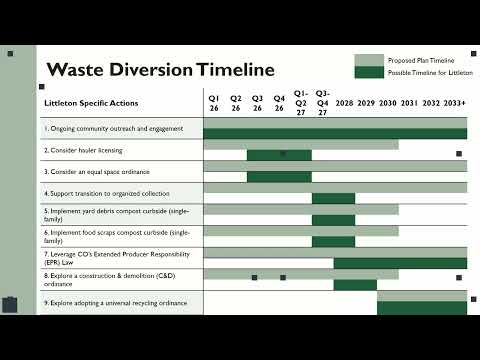
Laura, a city staff member who presented the timeline and next steps, said she plans to present the diversion plan to City Council for adoption and described a phased approach that begins with community outreach and the development of hauler licensing requirements. "Next year, we're really looking at community outreach and engagement and hauler licensing," Laura said. She told the board the city would likely begin teeing up licensing requirements in 2026 and start a formal licensing process in 2027.
The plan and licensing are separate steps. Laura said hauler licensing would be implemented through the city's business-license framework and "would have very specific requirements" for companies that operate in Littleton, including insurance and truck fees the city could use to fund enforcement and program support. She said hauler licensing is intended to limit the number of trucks on city streets, reduce pavement wear, and improve accountability by requiring haulers to report tonnage so the city can establish baselines for diversion rates.
Board members pressed staff for details about how licensing would intersect with organized or contracted collection. Laura explained that organized collection (where the city contracts with a single or small number of haulers) is constrained by state rules that allow HOAs and some commercial entities to opt out. "There's a specific law that says HOAs can exempt themselves," she said, adding that multifamily properties with seven or more units can opt in but are not compelled to join a city contract. For a city-contracted single-hauler model, Laura said the city would have to run a request for proposals (RFP), a process she estimated could take about a year.
Board members and staff discussed the potential design choices and sequencing: adopt the regional waste-diversion plan first, ramp up outreach and education to residents and multifamily operators, create a hauler licensing ordinance (which would require two public hearings), then consider contracting or other forms of organized collection later. Laura said the licensing ordinance itself would proceed by ordinance and two Council readings; individual implementation steps (for example, specific licensing terms or any single-hauler contract) would come back separately.
Several board members emphasized outreach and community education as central to any successful change. "Not everyone has the opportunity or the free time to do so, but everyone has trash," Laura said, urging a sustained, multi-channel campaign and regional coordination with Sheridan, Englewood and Centennial. Scott, a board member, urged the board to clarify its priorities and to plan its role: "I think we need to, revisit our conversation about priorities as a board," he said, noting the board can advise council and also help with community-facing efforts such as tabling at events.
Board members proposed concrete outreach actions: partner with local nonprofits and neighborhood groups, piggyback on existing neighborhood block parties and farmers markets for tabling, and plan one larger annual recycling/event drive (e-waste/paint/drug takeback) that could be repeated and scaled. Laura said extended producer responsibility (EPR) funding will become available Jan. 1 and could be a source for outreach and for supporting regional infrastructure; she also suggested applying for state mini-grants to fund event coordination or consultants.
Discussion covered multifamily and commercial properties repeatedly. Laura said properties with seven or more units are governed differently under state law: they can opt into contracts but generally are not automatically covered by a city-organized collection program. She and board members noted that many larger buildings currently lack recycling at a basic level and that a city contract could reduce costs for those residents if the city negotiates better prices regionally.
On organics and composting, staff told the board that organics infrastructure is less developed regionally and likely will be a later-phase investment because of cost and the need to avoid contamination of organics streams. Laura mentioned a regional goal of a regional drop-off program around 2027 but said timing will depend on how each city chooses to fund infrastructure.
Board members asked for early opportunities to brief a newly seated City Council in early 2026 (first quarter) to gauge appetite and to present community-engagement plans before regulatory steps, and Laura said she expects to bring drafts to the board before formal Council hearings. Board members and staff also discussed operational details: business-license fees are adopted annually, licensing could include per-truck fees tied to road impact, and licensing could require haulers to submit data on tonnage and destinations so the city could claim reimbursements tied to diversion rates.
No formal votes were taken during the board iscussion; staff described the proposal and requested the board's input on outreach and stakeholder engagement ahead of Council review.
The board plans follow-up at future meetings on the diversion plan rollout, specific outreach strategies, and the licensing draft. Laura said she will continue regional coordination with neighboring cities and with regional entities such as Douglas County and South Platte Renew, and she offered to share examples of successful large-scale recycling events used elsewhere as models for Littleton.
Ending: The board agreed to consider how it wants to plug into outreach and to revisit agenda priorities and stakeholder roles in upcoming meetings. Staff will present a draft communication plan and a licensing timeline to the board prior to formal Council hearings.