
Milton board grants limited 8‑foot fence variance at 5500 Dogwood Drive, ties approval to narrow area and conditions
Get AI-powered insights, summaries, and transcripts
Subscribe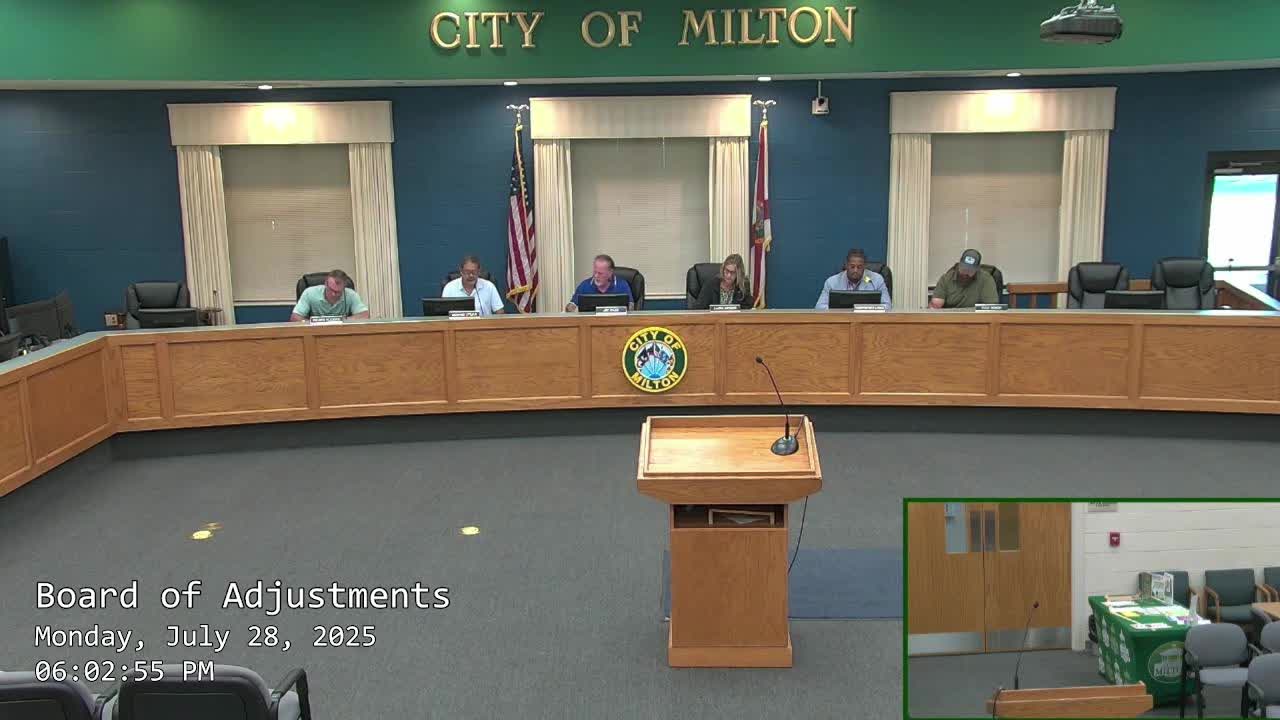
Summary
After a lengthy public hearing with neighbors and the property owner, the Board of Adjustments approved an 8‑foot fence for a short section of the rear/side yard at 5500 Dogwood Drive; the rest of the fence must remain at 6 feet and the approval carries conditions on repair, ownership and future replacement.
The City of Milton Board of Adjustments on July 8 approved a limited variance to allow an 8‑foot privacy fence along a short section of the northern side and rear yard at 5500 Dogwood Drive, with the remainder of the property’s fence required to remain 6 feet tall. The board attached conditions including a requirement that any repair exceeding 50% of the fence require re‑approval and that future owners or renters must seek a new variance if the fence is not maintained in compliance.
The application sought an 8‑foot fence along the parcel’s side and rear yards in the R‑1 single‑family zoning district; the Unified Development Code limits residential fences in side and rear yards to 6 feet. Planning staff outlined the application and the four hardship criteria the board must consider for a variance. Staff noted six certified notices were mailed; five were delivered and one was returned. The applicant provided five letters of neighbor support, two of which were from properties inside the official notice area.
Several neighbors opposed the request. Jim Hawthorne, who lives at 5510 Dogwood Drive across the property line, outlined multiple objections including concerns about maintenance access in the narrow space between fences, post height exceeding the ordinance and potential effects on neighborhood aesthetics. Hawthorne asked whether the 8‑foot allowance would be permanent: “Will this be a forever 8 foot fence if authorized long after the dog has passed away?”
The applicants, Wade and Teresa Schreckengost, said the request is driven primarily by dog‑safety concerns. Wade Schreckengost described the dog as an “escape artist” and said the property includes existing masonry knee walls and a small ledge near the fence that could let the dog scale a standard 6‑foot fence. “We are asking for a variance,” he said, “because our dog climbs, jumps, and tries to get over a fence.” Teresa Schreckengost said the family paused construction after staff advised them to stop and that they would accept a narrower 8‑foot area if the board required it.
Board members debated the standard for hardship. Some members said the existing knee wall and the configuration of the lot could constitute a hardship not created by the applicant; others said a dog’s future behavior or the owner’s prior choices were insufficient to meet the UDC criteria and cautioned against setting a precedent. Planning staff said it had no specific objection and left the determination to the board.
A motion to approve the variance was made with the condition that the 8‑foot height be limited to the short section adjacent to the existing knee wall (the area the applicant had highlighted on the plan), that all other fence sections be 6 feet, that any repair replacing more than 50% of the fence would require reapplication for approval, and that ownership/lease transfers require new review. The motion carried by majority vote.
The board’s decision resolves a contentious local dispute but makes clear the approval is site‑specific and tied to the board’s factual findings about the existing wall and the narrow area where the 8‑foot section was permitted. The applicant must obtain permits and meet any building and utility easement requirements before completing the fence.